Danville may have discovered the secret to eternal life. Forget kale, Pilates and expensive supplements. Simply win a seat on the Town Council, announce that experience is priceless, and renew every four years. If anybody asks when you plan to leave, explain that you are still learning the job.
Welcome to election season in Danville, where the trees change color, the campaign signs multiply and the phrase “fresh leadership” can provoke the same reaction as a proposed high-rise next to someone’s backyard.
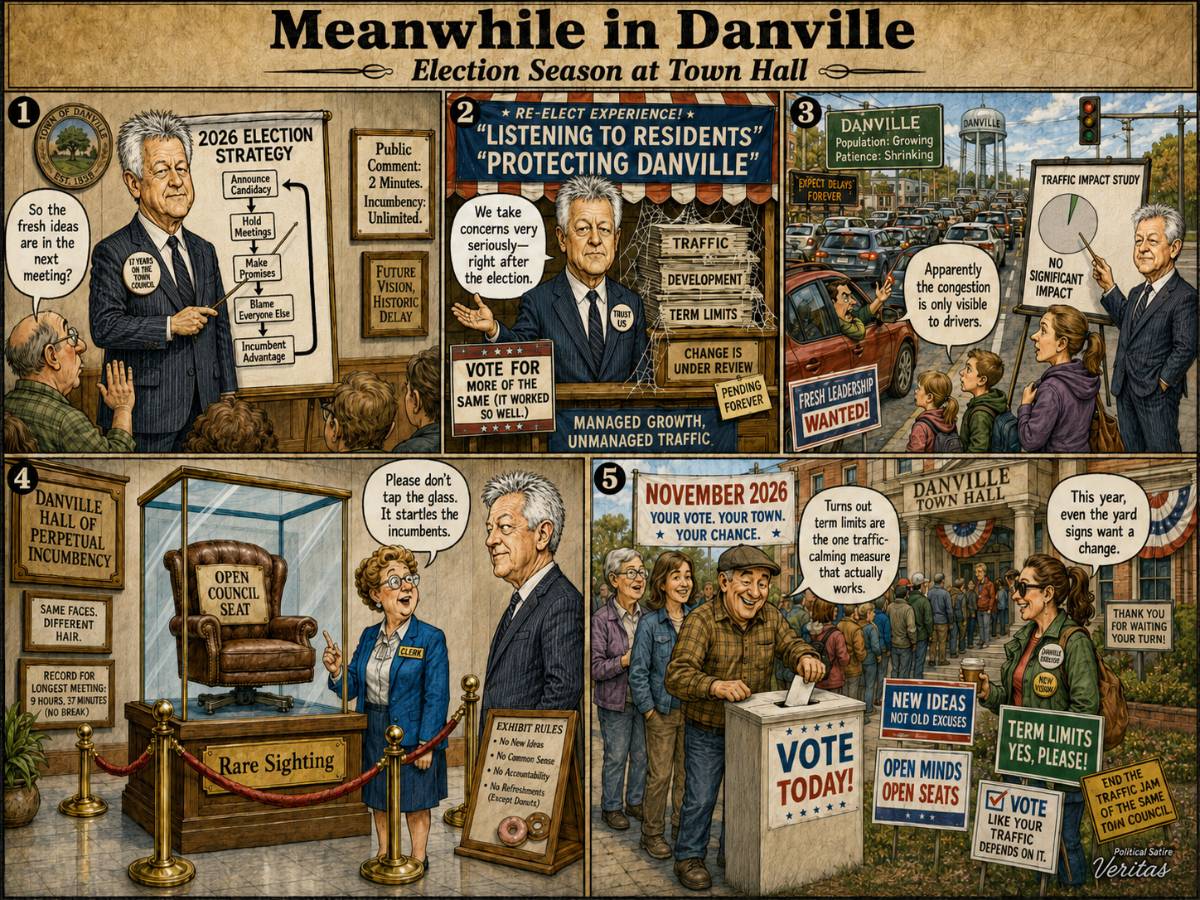
This week’s “Meanwhile in Danville” cartoon imagines Town Hall as a museum of perpetual incumbency. Inside a glass case sits an empty council chair labeled “Rare Sighting.” Outside, residents queue to vote beneath a sign that says, “Thank you for waiting your turn.” It is funny because everyone knows the chair is not literally behind glass. The glass would require a planning permit.
Robert Storer has served on the Town Council since 2009, after eight years on Danville’s Planning Commission. That is about a quarter-century helping shape the town. At this point, Storer has more institutional memory than the archives. If institutional memory could clear intersections, Danville drivers would be home before they left work.
Instead, consider the familiar traffic-impact study. The artist draws a town drowning in cars while a cheerful official points to a chart announcing “No Significant Impact.” Evidently the cars are merely attending a very long community meeting. Drivers call it gridlock. The study calls it a Tuesday.
Let’s be fair: traffic is complicated. State housing mandates matter, development is not automatically bad, and no single councilmember controls every congestion problem. But a quarter-century of experience invites more than applause. It invites the awkward question: What has actually improved?
Then there is development. In 2015, Storer voted for Ordinance No. 2015-09, within a framework under which the Planning Commission makes final decisions on many planning applications unless they are appealed. Our earlier columns examined major housing projects whose principal land-use approvals appear to have become final without a later Council vote on the merits.
Government has invented an impressive relay race. Residents ask their elected councilmembers about a project. The Council points to the Planning Commission. The Commission points to the rules. The rules point to the appeal procedure. By the time everyone has passed the baton, the resident has run ten laps and the finish line has been rezoned.
No, that does not mean every project was wrong, or that Storer personally approved them all. It means voters should ask whether major land-use changes deserve a final, recorded decision from the people they elect. Accountability should not be an optional upgrade with a processing fee.
And now, term limits. Some argue that long-serving councilmembers understand the budgets, state requirements and local history. That is a serious point. Others argue that fresh perspectives are healthy and nobody should confuse an elected office with a family heirloom. Also a serious point. The debate deserves more than “trust my experience” or “throw everyone out.”
Experience is like the sourdough starter your neighbor has maintained since 2009. Impressive, certainly. But eventually somebody should ask whether it is still producing good bread, or merely taking up the entire refrigerator.
The cartoon’s strategy board offers another lesson: announce, hold meetings, make promises, blame everyone else, repeat. It is not a factual transcript of any candidate’s conduct. It is satire aimed at a political habit older than Danville’s most seasoned incumbent: campaigning as though the problems began five minutes before the election.
After seventeen years on the Council, “We’re studying it” should come with a tracking number. “We’re listening” should come with a receipt. And
“We’re protecting Danville’s small-town character” ought to be measured against streets, buildings, parking spaces and the lived experience of residents—not the attractiveness of the campaign mailer.
Storer can fairly point to public service, land-use knowledge and support for open-space preservation. His opponents and critics can point to growth, congestion and decisions they believe deserve closer scrutiny. That is why elections are useful. Unlike an architectural rendering, they contain real people, imperfect choices and occasionally a parking problem.
On November 3, Danville voters will have a choice, not a ceremonial ribbon-cutting for the next term. They can weigh experience against outcomes, continuity against fresh ideas, and promises against the public record. The job is not to reward longevity or punish it automatically. The job is to decide who should lead next.
After twenty-five years, the real question is not whether Robert Storer has enough experience. It is whether Danville is satisfied with what that experience has delivered. The council chair is not a museum exhibit. It belongs to the public—and the public gets to decide who sits in it.
0
0

Comments