Editorial note:
This illustrated opinion series examines a recurring pattern in local government. The “Master Puppeteer” is a political archetype, not an allegation that any particular person has committed an unlawful act. The series explores political culture, independence, access, public accountability, and the risks that arise when experience hardens into entitlement.
The cartoons depict patterns of political influence and institutional culture. They do not suggest that every person shown within such a system knowingly participates in, recognizes, or accepts that influence.
THE MAN ABOVE THE CHAMBER - PART 1 OF 5: The Hidden Government at Town Hall
Episodes 1-4: Endorsements and the First Visible Strings
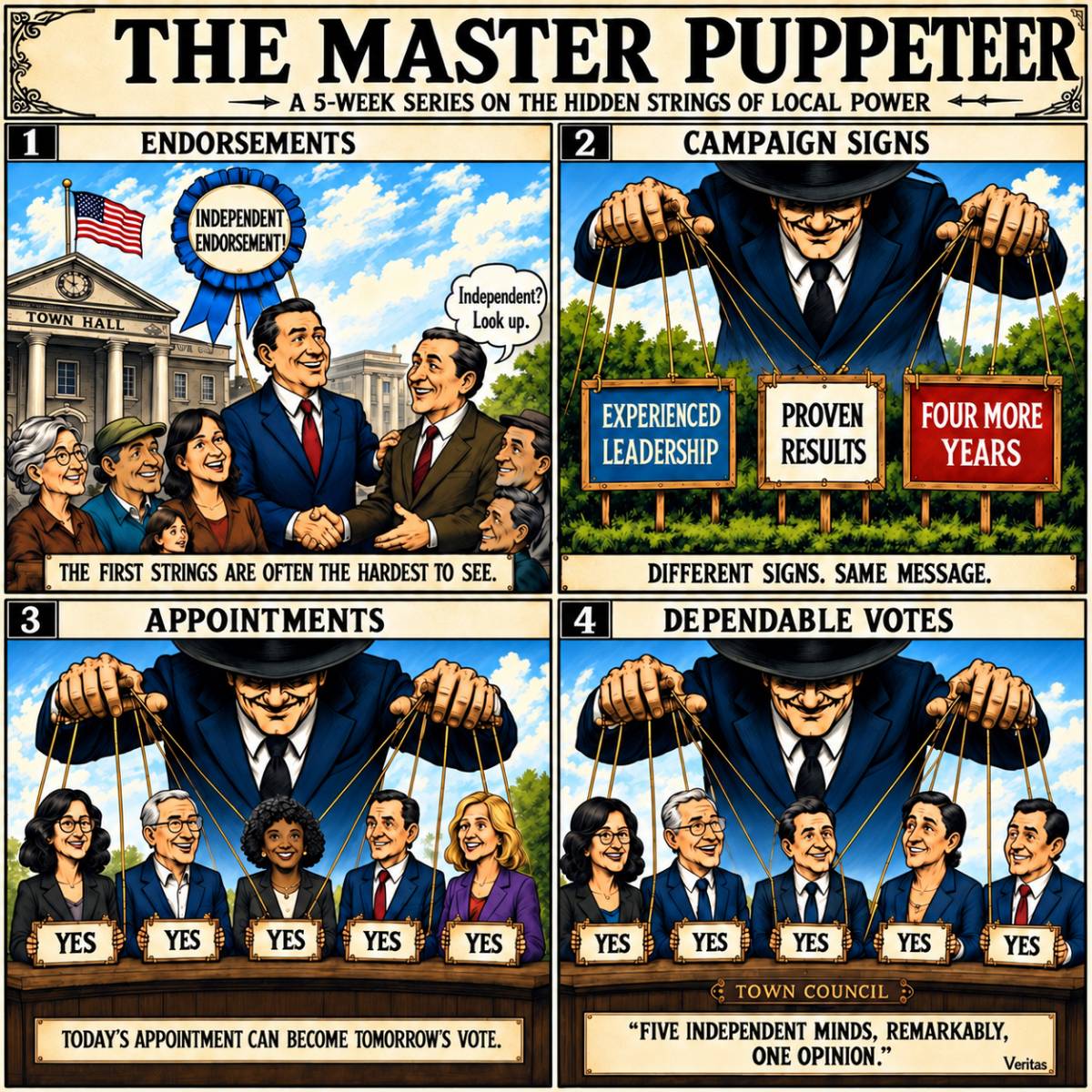
“The mayor held the gavel, but no one in the room seemed confused about who was in charge.”
The Man at the Far End of the Dais
The mayor held the gavel, but no one in the room seemed confused about who was in charge. At the far end of the dais sat the council’s longest-serving member, leaning toward his microphone with the ease of a man who had outlasted several mayors, numerous managers, and more controversies than anyone cared to remember.
When a colleague questioned the staff recommendation, he interrupted. When an employee explained a technical point, he corrected the explanation. When a resident objected, he listened with the patient expression of someone waiting for a misunderstanding to exhaust itself.
The discussion continued, yet the result already felt settled. One objection softened. Another councilmember nodded. By the time the vote was called, five independently elected officials had arrived at precisely the conclusion the longtime member favored from the beginning.
He would later say it had all been done “for the good of the town.” It was his favorite explanation, broad enough to cover almost anything and noble enough to discourage questions. Yet, curiously, what was “good for the town” so often seemed to preserve his influence, strengthen his allies, protect his agenda, and reinforce his position at the center of local government.
After enough years in office, the boundary between public interest and personal interest can become difficult to see—especially for the official who has begun to believe they are the same thing.
The Official Government — and the Other One
Every municipality has an official government: a mayor, a council, a manager, an attorney, department heads, commissions and boards. The organizational chart places residents at the top and elected officials beneath them. At least, that is the theory.
Some towns also develop an unofficial government. It has no title and no box on the chart. Its influence travels through longevity, endorsements, appointments, private conversations, campaign alliances and the cultivation of successors. At its center is a familiar political type: the officeholder whose experience has become entitlement, whose influence has hardened into control and whose public service has begun to resemble personal rule.
He is the Master Puppeteer.
The Master Puppeteer does not need formal authority over everyone around him. His power comes from relationships accumulated over time — endorsements, appointments, political debts, access, institutional memory, and the expectation that others already know what he wants.
He is not one particular official but a recurring figure in local government. Titles rotate. Managers arrive and depart. Elections pass. He remains.
The Puppeteer may not have begun as a manipulator. In his earlier years, he might have been diligent, curious, and unusually prepared. His experience was genuine, and his knowledge was valuable. The trouble began when he decided that being the most experienced person in the room also made him the smartest — and that being the smartest meant everyone else should listen, follow, and, when necessary, get out of the way.
When Experience Becomes Entitlement
“I have been here longer” acquires the force of “I understand this better.” Eventually, “I understand this better” becomes “There is no reason to keep discussing it.” Staff members may bring professional analysis, residents may describe firsthand experience, and newer councilmembers may carry decades of expertise from outside Town Hall. He listens, then explains the town to them.
Longevity becomes authority without any formal transfer of power. In time, he begins to see himself as indispensable. He does not believe he is taking power from others. He believes he is rescuing the town from their judgment.
How the Strings Work
The Puppeteer rarely gives direct orders. That would be crude. His power operates in the small-town register: endorsements, appointments, committee assignments, introductions, private conversations, and the strategic withdrawal of approval.
To an ally, he offers encouragement. To an ambitious commissioner, recognition. To a future candidate, access and endorsements. To a critic, perhaps nothing at all, an invitation fails to arrive. A reappointment becomes uncertain. A once-friendly conversation turns formal. No threat is made, yet the message may still be understood.
He constructs a world in which obedience appears prudent. “Unity” replaces disagreement. “Team players” become more valuable than independent ones. A staff report is asked to become “more constructive.” There are no recorded commands transferring authority — only a pattern in which loyalty looks like independence, choreography looks like consensus, and one person’s agenda begins to resemble the natural will of the town.
Next week: How endorsements, appointments, and campaign alliances can shape the council that comes next.
0
0

Comments