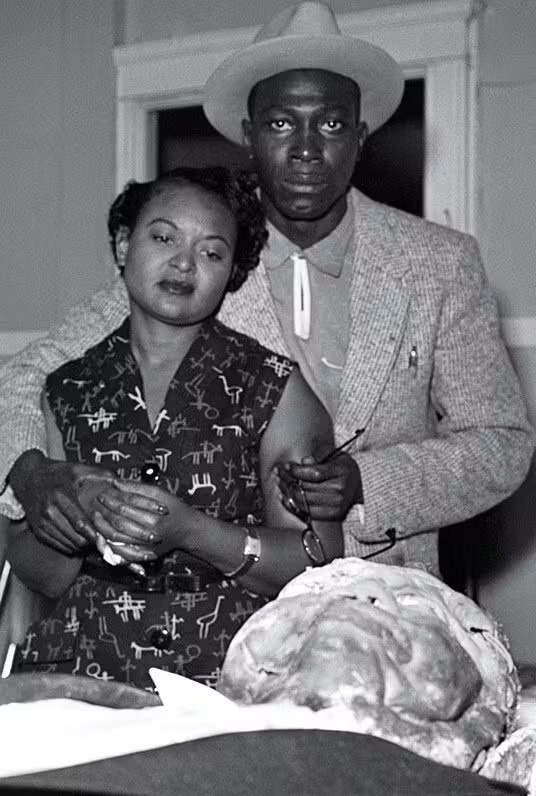
Photo Credit: Public Domain / Wikimedia Commons / Held by future husband Gene Mobley, Mamie Till-Mobley (left) looks upon her son Emmett Till after his death in 1955.
(OPGOV GLOBAL) – In the early morning hours of August 28, 1955, fourteen year old Emmett Till was abducted from his great-uncle’s home in Mississippi. His mutilated body was discovered three days later in the Tallahatchie River.
The brutality of his murder shocked the nation, and his mother, Mamie Till-Mobley, made “the courageous and historic decision" to have his body displayed in an open casket, forcing millions of Americans to confront what had been done to her son.
But August 28, 1955, is more than a date on a calendar. In another sense, the date itself does not matter. What matters is what happened—and what that event continues to mean.
Emmett Louis Till, born in Chicago on July 25, 1941, could not have known that his name would eventually become synonymous with racial violence, or that his tragic end would be “a turning point for the Civil Rights Movement” of the mid-20th century. He could not have known that a photograph of his mutilated body would become among the most powerful images in American history.
He was simply a boy.
And then he was murdered.
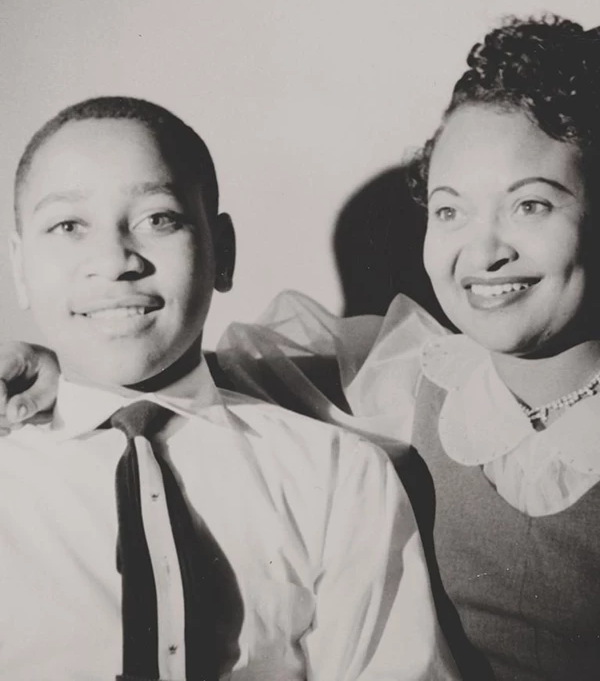
Photo Credit: National Park Services / Library of Congress / Emmett Till and his mother Mammie Till-Mobley ca. 1954
That is the power of words, images, and collective memory. A person's life can become a name in a history book, a photograph in a museum, or a sentence in a speech. Sometimes, however, a name becomes something more. It becomes a symbol—not because the person asked to become one, but because the circumstances of his or her death compel later generations to confront something about themselves.
This is the strange power of history.
We often treat history as a collection of dates: July 25, 1941; August 28, 1955; January 15, 1929. We commemorate birthdays, anniversaries, battles, assassinations, victories, and tragedies. We place dates on monuments and plaques and teach them in classrooms.
But time itself is indifferent.
August 28 is simply another point in the movement of the Earth around the sun. Seventy-one years passing does not make August 28, 1955, inherently more or less significant. The calendar does not remember. We do. That is why collective memory matters.
We can remove plaques from museums. We can debate statues and monuments. We can argue over which books belong in classrooms and which historical figures deserve celebration. Societies should be able to reconsider how they represent their past.
But there is a difference between reconsidering history and erasing it.
We should be capable of examining the things that embarrass, horrify, or divide us. We should be able to read difficult books, question monuments, criticize historical figures, and understand the circumstances in which they came to exist. Context is not glorification, and remembering is not endorsement.
Denying history, however, is another matter.
History itself cannot be changed, but what we learn from it can change. The events remain fixed. Our understanding of them does not. That is perhaps one of the most important lessons gleaned from the death of Emmett Till.
The purpose of remembering tragedy is not merely to feel terrible about something that happened long ago. It is to ask what conditions allowed it to happen, why people tolerated those conditions, and whether we are capable of recognizing them when they appear again.
This is where the familiar warning that “history repeats itself” becomes complicated. Does history actually repeat itself? Or do human beings repeatedly recreate the conditions that produced earlier tragedies?
Perhaps there is nothing mystical about repetition. Perhaps it is simply human nature. We forget. We become complacent. We convince ourselves that the past was different, that people were different, that such things could never happen again.
Then we discover that hatred, fear, tribalism, and violence are not relics of some primitive past. They remain human possibilities.
More than seven decades later, August 28 arrives again. Late summer begins giving way to autumn. Children return to school. Life continues, as it always does. Some people will know what happened in Mississippi in 1955. Others will not. Some will care deeply. Others will not care at all.
But the passage of time does not diminish the significance of what happened. If anything, it increases our responsibility to remember, because eventually everyone who personally experienced that era will be gone. The date is arbitrary, but the event is not.
We could remember Emmett Till on August 28, July 25, or any other day we choose. The calendar is simply a tool we use to organize our lives. What matters is what we do with the memory once we have recalled it, for human beings give meaning to time by remembering what happened within it.
Emmett Till lived and died in a world wrought with division and violence. More than seventy years later, we inhabit a different world—but not an entirely different human one.
Have we learned anything?
Will we learn enough?
Perhaps that is both the ultimate lesson of the story of Emmett Till, and the greatest test that remains before us. A tragic death happened on a particular night, in a particular place, to a particular fourteen-year-old boy. But the questions raised by his life and death belong to all of us.
The calendar does not remember.
We do.
To add to or correct any information in this report, please contact me at robert.m@lead4earth.org or leave a comment below with your thoughts.
0
1

Comments