(Pleasanton, CA)
Heavy equipment went into the Amador Theater on Friday, July 31, and by the end of this month the building will be gone.
The theater opened in 1932. It sat on the Amador Valley High School campus for 94 years, and for most of that time it doubled as the city's main performance venue. It is being demolished to clear ground for a new performing arts center, and the Pleasanton Unified School District expects the demolition to be complete by the end of August.
Crews did not start with the theater. Blach Construction, the district's contractor, began the week of July 28 with the wrestling room and part of the small gym, then worked toward the theater. Susanne Frey, PUSD's safety and communication coordinator, said the sequence was chosen for safety reasons. Over the summer the same crews renovated the existing locker rooms, installed new utilities and prepared both the gym and the theater for demolition.
Superintendent Maurice Ghysles acknowledged what the building meant, telling reporters the theater holds memories for students, staff, alumni and the wider community, and that the district recognizes the significance of the moment.
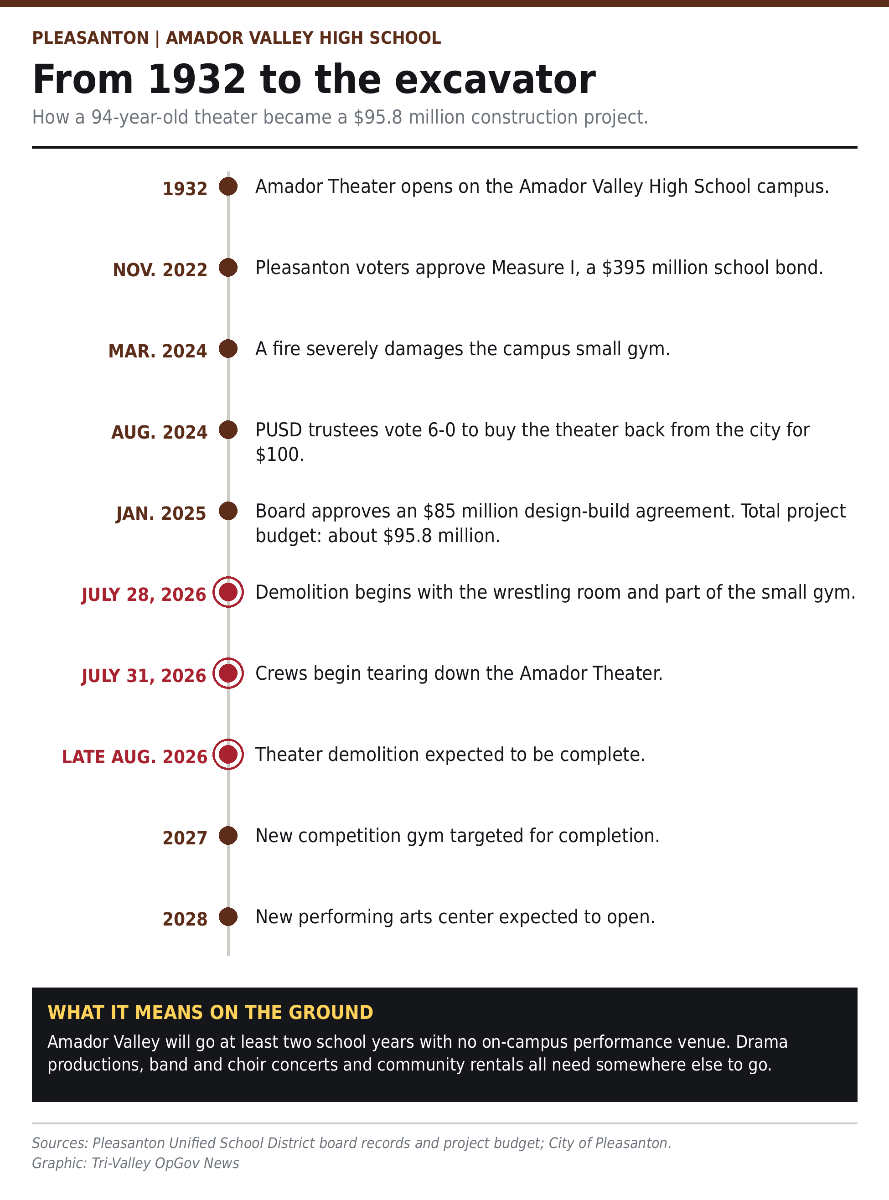
How Pleasanton got here
The demolition is one piece of a campus overhaul funded by Measure I, the $395 million general obligation bond that Pleasanton voters approved in November 2022.
In January 2025 the PUSD Board of Trustees approved an $85 million design-build agreement for new athletic and performing arts facilities at Amador Valley. The district puts the total project budget at about $95.8 million.
The full scope covers more than the theater. The plan is to build a new performing arts center on the theater's footprint, modernize the existing music building, convert the current competition gym into a practice gym and locker rooms, demolish the small gym, and construct a new competition gym. The small gym had been out of service since a fire severely damaged it in March 2024.
Ownership of the theater changed hands two years ago. The city of Pleasanton had held it under a 50-year conveyance agreement, but the city moved most of its programming to the Firehouse Arts Center downtown, and the theater's balcony had been closed for years because of structural weakness, cutting its usable capacity. City studies found that bringing the building up to current codes would require substantial renovation.
On Aug. 22, 2024, the PUSD board voted 6-0 to exercise a repurchase option and buy the building back from the city for $100. The district also took on the maintenance and operating costs, which the city had estimated at about $67,000 a year. The immediate benefit at the time was that Amador Valley gained a large indoor space to use while the fire-damaged small gym was offline.
The gap years
The construction timeline is where this story lands for families.
District officials expect construction of the new structures to begin in the fall or winter. The new competition gym has been targeted for completion in 2027 and the new theater in 2028.
That means Amador Valley will run at least two school years without an on-campus performance venue. Drama productions, band and choir concerts, awards nights, guest speakers and any event that used to fill those seats need somewhere else to go. The Firehouse Arts Center is the obvious candidate, but it is a booked municipal venue with its own calendar, and neighboring school theaters have their own seasons.
Community groups that rented the theater are in the same position. So are families who counted on walking to campus for a Friday night show.
There is a second, more mundane effect. A demolition and construction site of this size on an active high school campus for two years means truck traffic on surrounding streets, dust control measures, staging areas eating into parking, and noise during instructional hours. Neighbors on the streets around the campus should expect the construction schedule to shape their mornings.
What taxpayers are buying
Measure I is a general obligation bond, which means it is repaid through an assessment on Pleasanton property owners. Roughly $95.8 million of that $395 million is going into this one campus.
When the demolition was first proposed years ago, some residents objected to losing a 1932 building rather than restoring it. The district's position, backed by the city's own condition studies, was that the cost of code compliance and structural repair made replacement the more defensible use of bond money. Reasonable people disagreed then, and the argument is now settled by an excavator.
0
0

Comments