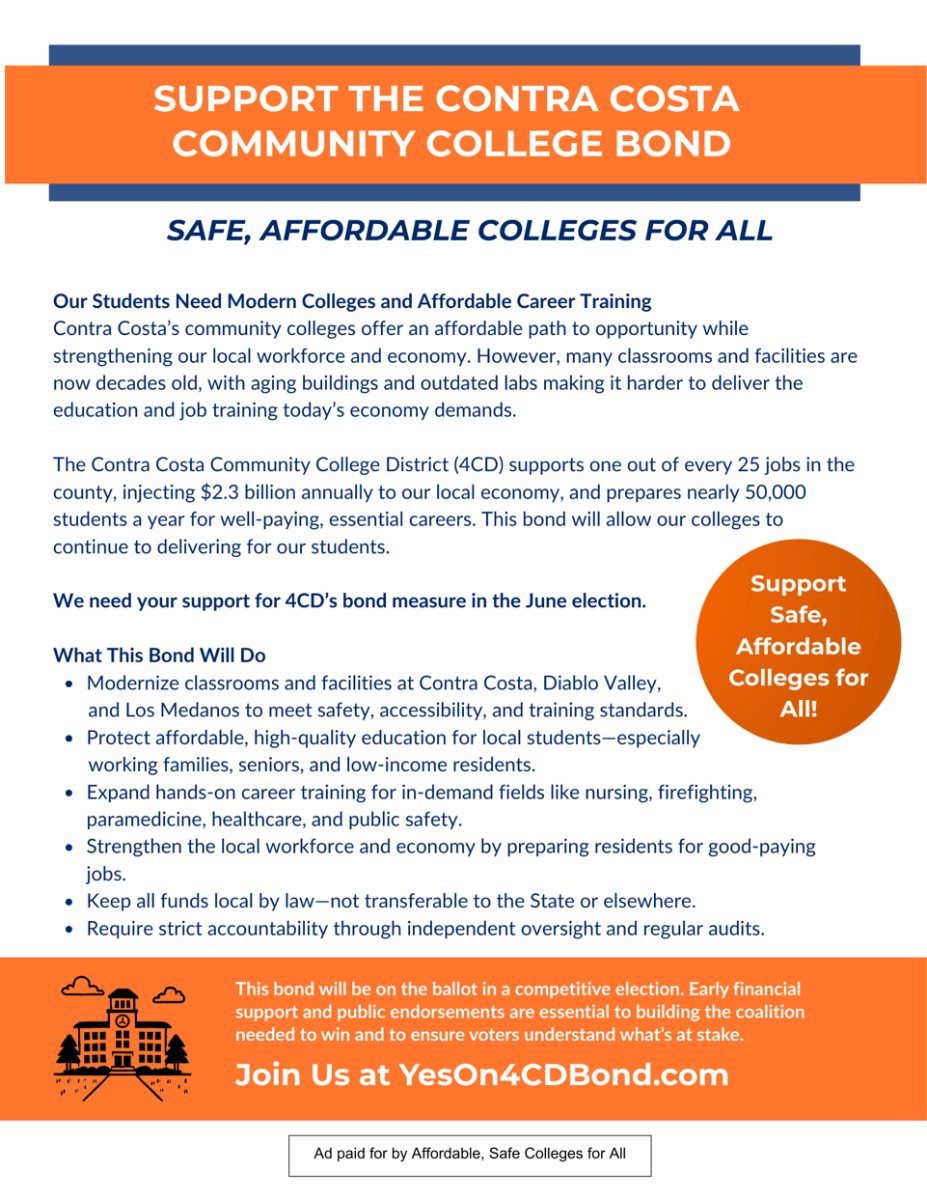
On June 2, Contra Costa voters will decide Measure G — a $920 million general obligation bond for the Contra Costa Community College District (4CD). It needs 55% to pass. If approved, property owners will pay roughly $10 per $100,000 of assessed value annually, generating about $57 million each year for upgrades at Contra Costa, Diablo Valley, and Los Medanos colleges. Contra Costa County
For a home assessed at $700,000, that's about $70 a year — less than a tank of gas a month.
What It Builds
By state law, the funds can only be used for facilities, never for salaries or operations. Projects include a new Contra Costa College Science Center with a planetarium, Art and Athletics complexes at Diablo Valley, and a 55,000-square-foot Brentwood Center for Los Medanos, along with a nursing and EMT training hub, an updated early childhood facility, and utility upgrades to reduce emissions. 4CDEastbayleadershipcouncil
These are the buildings where Contra Costa's nurses, firefighters, paramedics, and trades workers actually get trained — at a fraction of CSU or UC cost.
The Trustee's Case
Trustee Andy Li, who has represented Ward 4 (San Ramon area) since 2018 and served as board president in 2021, framed the bond simply: every dollar 4CD invests in modern facilities is a dollar a working family doesn't spend at a four-year school. Let the labs and classrooms decay, and that low-cost on-ramp closes. Leadershipsrv
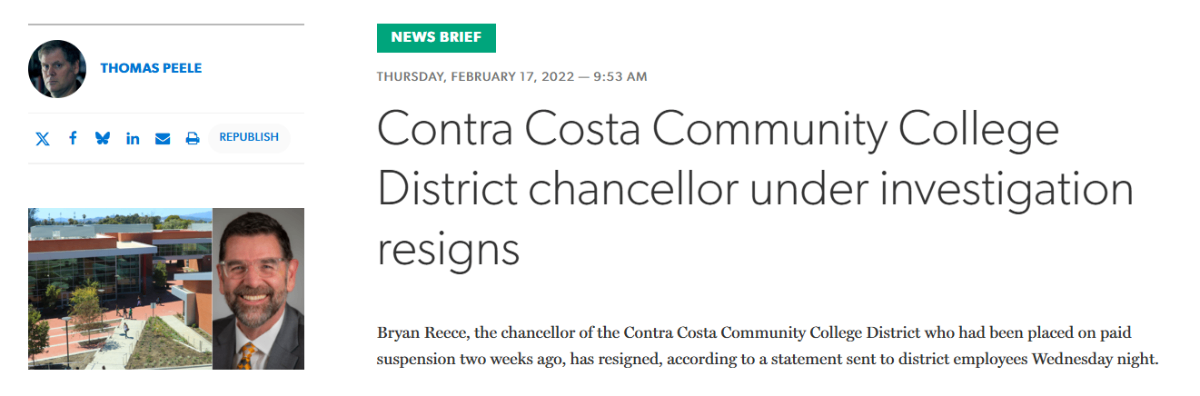
On accountability, Li pointed to 2022. Chancellor Bryan Reece was placed on administrative leave amid an investigation and resigned that February, after an outside investigation supported concerns about his role in a $10 million marketing contract that the board ultimately rescinded. The board moved unanimously to part ways with its own top executive — evidence, Li argued, of a body that takes oversight seriously. EdSourcePleasanton Weekly
The Skeptic's Concession — and His Concern
The most credible voice on the other side belongs to Marc Joffe, president of the Contra Costa Taxpayers Association (CoCoTax). Joffe is no soft critic: he's been vocal in opposing Measures A and B on the same June ballot. CoCoTax is recommending a "no" vote on Measure G as well.
But Joffe's own published reasoning, posted on Nextdoor to neighbors, contains a concession most bond critics never make. As a member of 4CD's Citizens' Bond Oversight Committee, he has watched the district spend previously authorized bond funds up close. His conclusion, in his own words: the district does an excellent job, and he's confident that if the bond is authorized, the money will be spent on the intended purposes and not wasted.
That's a remarkable thing to hear from the county's chief bond watchdog. It means the trust question — will they spend it honestly? — is largely settled, even among skeptics.
Joffe's actual concern is different, and worth engaging with directly. He argues that fewer students are expected to graduate from high school in the years ahead, many courses are already offered online, and so the need for new community college facilities should be limited. He also notes that if 4CD fills the gap with enrichment classes for older adults, voters should ask whether taxpayers should fund those.
It's a serious argument. It's also, we think, incomplete.
Statement from Diana Honig the Governing Board President, Contra Costa Community College District
Despite declining enrollment for K-12 schools due to a drop in population growth, our District's enrollment is up this year. I suspect that is because the UC and CSU systems continue to be so competitive, so community colleges remain an affordable option. In addition, our community colleges remain the best, and sometimes only, option for many students who need affordability, strong support, and flexibility. 4CD provides an educational home for everyone, young people, older adults, single parents, part-time working students, students with disabilities, veterans, immigrants and ESL students. No one is rejected - and we offer low-cost and free tuition, a high level of supports and services, and a flexible schedule to help everyone succeed, no matter their educational goal.
Why the Demand Is Still There
The bond project list isn't primarily about adding seats for students who aren't coming. It's about replacing buildings the current students already use. Aging HVAC, seismic retrofits, electrical and plumbing upgrades, and accessibility compliance don't depend on enrollment growth — they're required by code regardless of whether 4CD serves 22,000 students or 50,000.
More importantly, the demand for hands-on workforce training in Contra Costa is increasing, not declining. Nursing shortages at John Muir and Kaiser, paramedic recruitment for AMR and Con Fire, and trades hiring across the county all run through 4CD's career programs. These cannot move online. A new nursing and EMT training hub, a modern science center, and replacement labs are the physical infrastructure for the jobs Contra Costa actually needs filled this decade.
On cost: Joffe correctly notes that combined with the $727 million still owed on three previous bonds, the total community college bond levy will temporarily reach about $25 per $100,000 of assessed value. For a $700,000 home, that's roughly $175 a year — real money, but spread across the lifespan of an investment that funds buildings used for the next 40 to 50 years.
The Bottom Line
4CD supports one in every 25 jobs in the county and contributes $2.3 billion annually to the local economy. The watchdog has already conceded the money will be spent well. The remaining question is whether voters believe modernized career-training facilities are worth $70 to $175 a year per household to keep open and functional. Yes on Measure G
We think they are. A yes vote on Measure G keeps Contra Costa's clearest path to a middle-class career open, modern, and safe — even as the rest of the cost of living rises around it.
0
0

Comments