(OPGOV GLOBAL) – A sweeping veteran’s legislative package intended to overhaul benefits, health care, and Department of Veterans Affairs operations is drawing sharp reactions from lawmakers, veterans’ organizations, and labor unions, setting up what could become one of the year's most consequential debates over veterans’ policy.
The Take Care of America's Veterans Act (H.R. 9237) is a 554-page omnibus bill combining more than 60 veterans’ measures into a single package. Introduced by House Veterans' Affairs Committee Chairman Mike Bost (R-Ill.) and other Republican lawmakers, it would amend Titles 10 and 38 of the U.S. Code, while making broad changes to veterans' compensation, education, health care, workforce policies, memorial affairs, and VA operations.

(Credit: MAJ Richard Star, St. Louis District Deputy District commander, USACE.)
Among the legislation's most significant provisions is the Major Richard Star Act, a long-sought bipartisan measure that would allow certain combat-injured military retirees to receive both military retirement pay and VA disability compensation without the current offset. The proposal is named for Army Major Richard Star, a post-9/11 combat engineer who developed cancer linked to toxic exposures during deployments to Iraq and Afghanistan. Forced to medically retire before reaching 20 years of service, Star lost a portion of the retirement pay he had earned because federal law offset it against his VA disability compensation. He spent the final years of his life advocating for Congress to end what he viewed as an injustice affecting thousands of medically retired combat veterans before dying in 2021, a year after legislation bearing his name was first introduced. His story has since become the driving force behind the effort to eliminate the offset.
Although legislation bearing his name was first introduced in 2020, Major Star died in 2021. His story has since become the driving force behind the effort to eliminate the offset for future combat-injured retirees.
Military retirement pay compensates veterans for years of service, while VA disability compensation addresses service-connected injuries and illnesses. Under current law, many medically retired combat veterans receive less retirement pay because the two benefits are offset. According to the Star Act Alliance, nearly 60,000 veterans are affected.
Beyond the Richard Star Act, the legislation includes expanded survivor benefits, disability claims reforms, caregiver support, women's health research, Guard and Reserve home loan expansions, mental health initiatives, service dog programs, and dozens of other veterans priorities.
Despite those expansions, the legislation has encountered growing opposition.
A coalition of 22 labor unions representing hundreds of thousands of Department of Veterans Affairs employees, led by the American Federation of Government Employees (AFGE), argues the bill contains provisions that would reduce future disability compensation for some veterans, expand reliance on private-sector health care through the Veterans Community Care Program, and weaken workplace protections for portions of the VA workforce.
"This legislation cynically packages long-sought, well-deserved new benefits for disabled veterans with benefit cuts to other veterans and a slew of provisions designed to further privatize the VA healthcare system," the coalition wrote in a letter to Congress.
AFGE National President Everett Kelley echoed those concerns during a Capitol Hill press conference.
"A bill that calls itself the 'Take Care of America's Veterans Act' ought to live up to that name," Kelley said. "Instead, this bill should be called the 'America's Veterans Beware Act.'"
Last month, Senate Veterans' Affairs Committee Ranking Member Richard Blumenthal (D-Conn.) sought unanimous consent to pass the standalone Major Richard Star Act, proposing to offset its cost using billions of dollars in unobligated Department of Defense funding rather than reductions to future veterans' disability benefits. Republicans objected, preventing the measure from advancing under that procedure.
During the debate, Blumenthal argued Congress should fulfill its promise to combat-injured veterans without requiring other disabled veterans to bear the cost.
"The cost of caring for our veterans is a cost of war," Blumenthal said on the Senate floor. "We made that promise to them. A great nation keeps its promises."
Sen. Thom Tillis (R-N.C.) responded that he supports expanding benefits for combat-injured veterans but argued Congress should identify a sustainable funding source before creating new long-term obligations, saying lawmakers should avoid making promises that cannot ultimately be fulfilled.
While the Major Richard Star Act enjoys broad bipartisan support—with 336 House cosponsors and 79 Senate cosponsors—the central dispute is whether it should be funded through changes elsewhere in veterans benefits or advanced as standalone legislation.
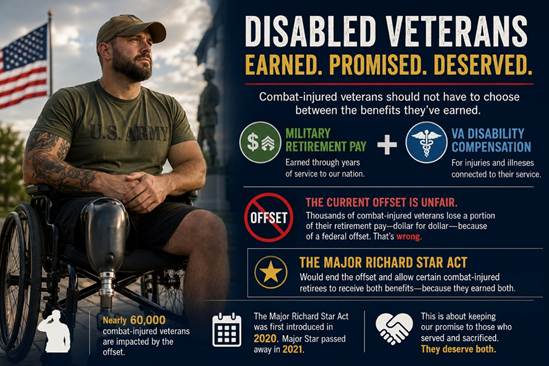
(Image: Ai graphic, OpGov.News.)
Supporters of the omnibus legislation argue it delivers decades of bipartisan veterans’ priorities in one measure, while modernizing veterans' services and expanding access to care.
Supporters argue the package delivers decades of bipartisan veterans’ priorities in a single bill, including caregiver assistance, rural health care improvements, prosthetics, suicide prevention initiatives, telehealth expansion, women's health research, VA infrastructure modernization, and workforce reforms.
At the center of the debate is not whether veterans deserve expanded benefits—both sides agree they do—but whether Congress should package those expansions alongside broader reforms that critics argue could reduce future disability compensation and reshape how veterans receive their health care.
The bill has advanced through the House Rules Committee but has not yet been approved by Congress. As lawmakers prepare for floor consideration, veterans organizations remain sharply divided over whether Congress should pass the comprehensive package or instead advance broadly supported measures—such as the Major Richard Star Act—as standalone legislation.
If approved by the House, the legislation would move to the Senate, where its future remains uncertain amid bipartisan disagreement over several of its funding provisions.
To learn more about the historic Take Care of America’s Veterans Act as it heads to the House Floor for a vote this week, click here.
If you’d like to add or correct anything in this report, feel free to reach out to me or leave a comment below. Submit tips and story ideas to Sarah Denos at sarahkdenos@gmail.com.
0
0

Comments