(SACRAMENTO, CA.) — During Tuesday's annual public safety update, the Sacramento County Board of Supervisors reviewed jail overcrowding and compliance with the 2020 Mays Consent Decree, a federal mandate stemming from a lawsuit by Disability Rights California and the Prison Law Office. While partial compliance has been achieved, independent monitors report critical safety deficiencies, ensuring continued federal oversight of the jail system.
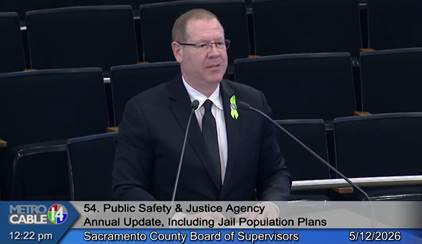
Deputy County Executive Eric Jones presents an annual public safety update on jail population reduction plans during the Sacramento County Board of Supervisors meeting in May 2026. (Photo: Metro Cable 14/YouTube)
OpGov.news reports Deputy County Executive for Public Safety and Justice Agency Eric Jones presented at the meeting and outlined the county’s progress and ongoing challenges, noting that ongoing compliance costs now well exceed $90 million annually.
"Fifty-five percent of provisions within the Mays Consent Decree are in substantial compliance,” Jones said, noting that 60 specific provisions have transitioned to self-monitoring status.
However, Jones acknowledged that overall progress across remedial plans remains "uneven." While the county expanded its jail psychiatric units ahead of schedule, physical layout limitations continue to stall broader medical and ADA upgrades.
“It’s very difficult work,” Jones said. “It takes a little bit longer, and there are some facility restrictions that are a barrier to that.”
Jones also acknowledged persistent barriers to shrinking the current average daily population of 3,234 inmates, including the complexity of release decisions and the need for better communication with first responders about alternatives to jail.
“We’re talking about reducing incarceration, finding alternatives for folks who really deserve and need help but don’t necessarily belong or need to be in the jail, so we need those alternatives,” he said.
Community advocates for Decarcerate Sacramento, however, argued that the county was not moving fast enough to reduce reliance on incarceration.
Christopher Carbajal-Carbajal challenged the Board’s approach: “The county has immense power. The county controls budgets, policy priorities, contracts, investments and the systems that drive incarceration as a county. So, when we talk about the Mays Consent Decree, the jail population reduction plans or the correctional facility master planning processes we need to be honest about what is actually happening here.”
Carbajal-Carbajal continued, “The county’s own data and planning documents have repeatedly shown that investing in housing, behavioral health care, treatment prevention, diversion and community services can reduce the jail population by hundreds of people without building or expanding jail infrastructure. The question is whether this county is willing to fully commit to that path, because right now we continue to see enormous institutional energy directed towards sustaining and modernizing incarceration, while community systems actually that keep people safe remain underfunded and insufficiently scaled.”
AJ Alvana also cited a recent audit by court watch volunteers: “We tracked ten people who were ordered released inside of courts and then released outside of the jail. Average time from point of release—ordered release to point of release was four hours and 33 minutes. One person released—ordered released at 3:56 p.m. and actually released at 11:58 p.m… .”
Alvana concluded, “Effective jail population reduction is not a recommendation, it is necessary for compliance with the Mays Consent Decree and until enough effective measures are fully implemented to—and their impacts are sufficient, then we shouldn’t be talking about building a new jail, expansion or anything else, right?”
Supervisors and staff acknowledged the need for ongoing community engagement and transparency as the county continues to navigate the requirements of the consent decree and the broader debate over public safety, incarceration, and investment in community-based services.
Story image of Sacramento County Jail, credit: Wikimedia Commons. Submit Sacramento County tips and story ideas to Sarah Denos at sarahkdenos@gmail.com.
0
0

Comments