(OpGov Global, USA) - Many service members have a hard time adjusting or transitioning after coming home from a combat zone. Some develop sleep issues, have injuries that require medication, and many experience the invisible wounds of post-traumatic stress disorder (PTSD).
We will look at statistics that are staggering when put into perspective, particularly the number of service members who made it home only to later die by suicide. We will also list programs available to service members, veterans, and civilians who may be experiencing suicidal thoughts.
Photo Credit: Suicide Prevention - Child Abuse Prevention Council/ Suicide Prevention Ribbon
While I served in the Army, we had a program called the Resilience Program. I was a master resilience trainer, and one of the hardest lessons was recognizing how challenging it could be to see when a service member was in crisis.
One of the things we would say to service members was that suicide was a permanent solution to a temporary problem. Looking back, I realize that even though they heard that, the problems they were facing could feel too difficult to live with. These included divorce, the loss of a loved one, the loss of a fellow service member, financial problems, breakups, and survivor's guilt.
Service members you did not expect to die by suicide sometimes did. In 2008, while I was in Iraq, a chaplain assistant died by suicide. That was hard to believe. The person we confided in, the person who would lift everyone's spirits, had died by suicide. That's when I realized anyone could be struggling, even when the warning signs weren't obvious.
Veteran Suicide Statistics
The Department of Veterans Affairs released its 2026 National Veteran Suicide Prevention Annual Report on Sept. 30, 2026. The report contains veteran suicide statistics through 2024.
According to the VA's earlier report, the daily average of veteran suicide deaths dropped slightly from 17.6 in 2022 to 17.5 in 2023. The latest report, which includes revised historical data, found an average of 17.7 veteran suicide deaths per day in 2024.
In 2024, there were 47,291 suicides among U.S. adults, including 6,488 among veterans and 40,803 among nonveterans. The number of veteran suicide deaths was 174 fewer than the revised 2023 total.
That represents an average of approximately 129.2 suicide deaths per day among all U.S. adults, including 17.7 among veterans and 111.5 among nonveterans.
The number of veteran suicides per year ranged from 6,247 in 2004 to 7,015 in 2018. For nonveteran U.S. adults, the number of suicides per year ranged from 23,291 in 2001 to 41,192 in 2022.
Over the 24 years from 2001 through 2024, there were 944,915 suicides among U.S. adults, including 159,980 among veterans and 784,935 among nonveterans.
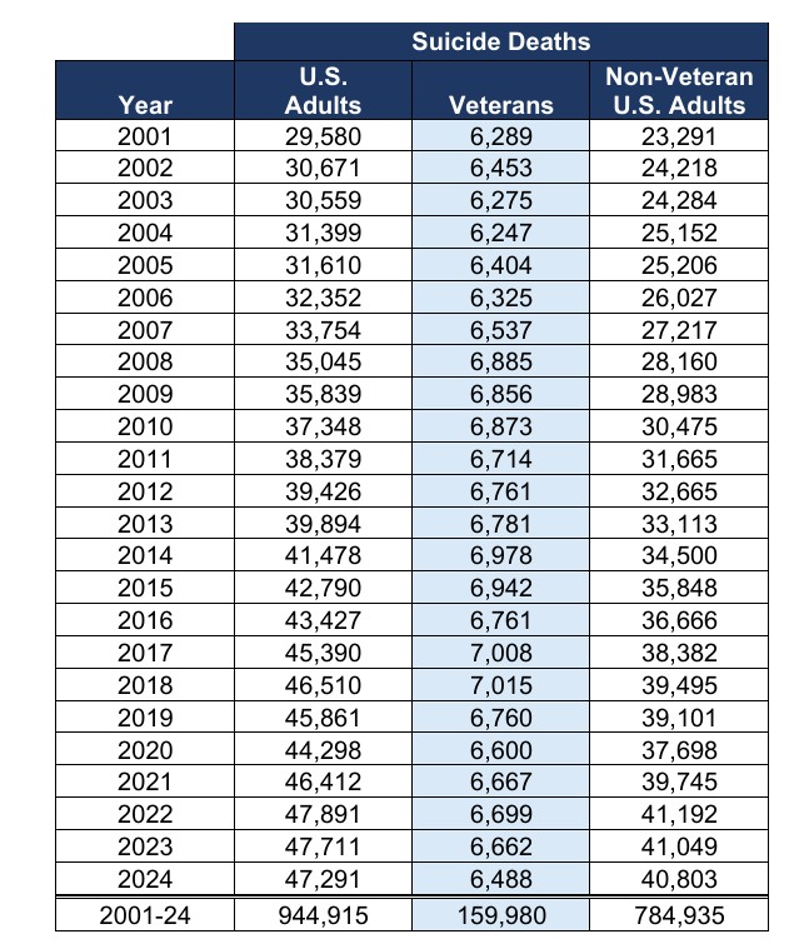
CMR_2026_National_Veteran_Suicide_Prevention_Annual_Report.pdf/ Shows the rate of Successful Suicides in the U.S., comparing private citizens to Veterans.
The VA study identified several factors associated with suicide risk among veterans.
In 2024, approximately 62% of veterans who died by suicide had not received VA health care during the year of their death or the previous year.
The report also found that suicide rates among veterans enrolled in Veterans Health Administration (VHA) care decreased by 4.8% from 2023 to 2024. During the same period, suicide rates among veterans not enrolled in VHA care increased by 3.7%.
These statistics highlight the importance of making resources available and ensuring that veterans know where to seek assistance.
The difficult thing to take in when looking at these statistics is the number of lives lost. The Defense Casualty Analysis System reports 4,418 U.S. military deaths during Operation Iraqi Freedom and 2,350 during Operation Enduring Freedom.
The number of veteran suicide deaths over a 10-year period exceeds the number of military deaths recorded during either operation. However, these figures represent different populations and time periods and should not be interpreted as a direct comparison of combat deaths and suicide deaths among the same service members.
Below is a chart showing the top 10 states by veteran suicide deaths, alongside the veteran population in each state.
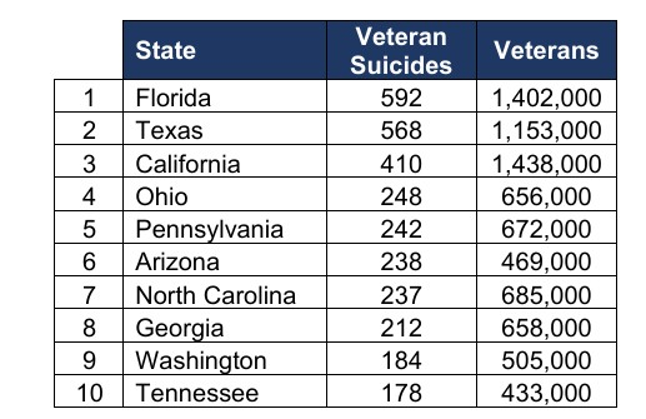
Photo credit: Department of Veterans Affairs / 2026 National Veteran Suicide Prevention Annual Report. Veteran suicide deaths and veteran population by state.
Recognizing the Warning Signs
In 2010, I played a character named "Jack" in a play at Fort Rucker, Alabama. I portrayed a soldier who had returned from combat but was detached from his family. The character began drinking and then using drugs heavily.
The name of the play was "Before Calling 911."
The play provided insight into what to do if you knew someone who was showing signs of contemplating suicide. It also explained the resources available and the steps to take if you encountered someone in need of help.
The title was based on what could be done to help someone before a suicide attempt occurred and emergency services had to be called.
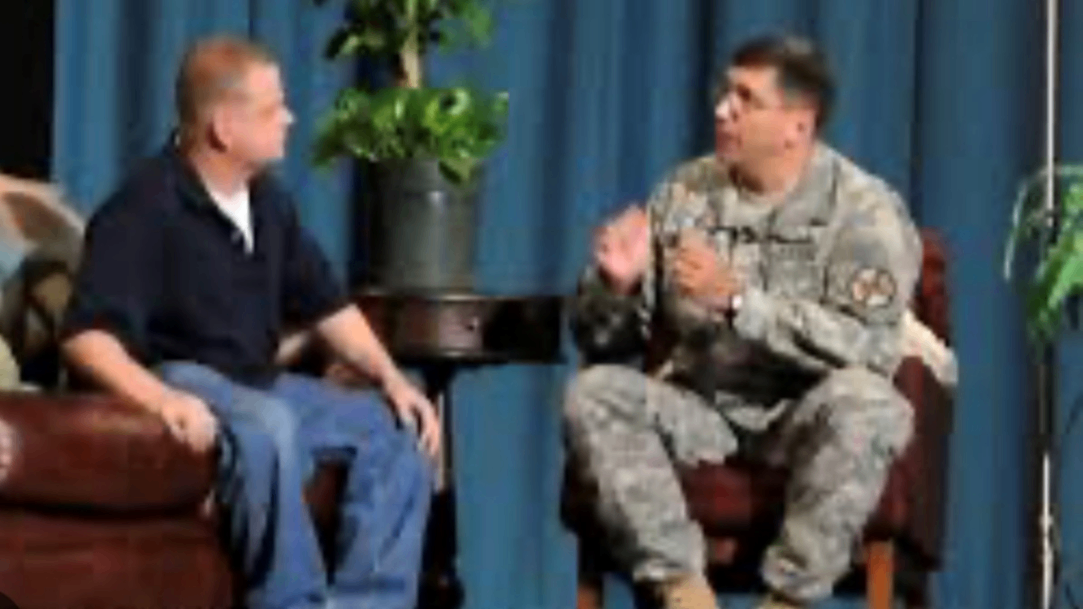
Photo credit: James Borchardt / "Jack," a character in the play "Before Calling 911," speaks with an Army chaplain while seeking help for suicidal thoughts.
What to Do When Someone May Be Considering Suicide
The first step is to ask questions to determine whether the person may be in danger of attempting suicide.
Some questions could include:
How are you coping with what's been happening in your life?
Do you ever feel like just giving up?
Are you thinking about dying?
Are you thinking about hurting yourself?
Are you thinking about suicide?
Have you ever thought about suicide before or tried to harm yourself?
Have you thought about how or when you would do it?
Do you have access to weapons or other items that could be used to harm yourself?
Asking someone directly about suicide can help start a conversation and does not cause suicidal thoughts.
Source: Mayo Clinic, "Suicide: What to do when someone is thinking about suicide."
Warning Signs to Look For
The next step is to recognize possible warning signs, including:
Talking about suicide, such as saying, "I'm going to kill myself," "I wish I were dead" or "I wish I hadn't been born."
Obtaining items that could be used in a suicide attempt, such as a firearm or a large supply of medication.
Withdrawing from social contact and wanting to be left alone.
Experiencing mood swings, such as being emotionally high one day and deeply sad the next.
Talking or writing about death, dying or violence.
Feeling trapped or hopeless about a situation.
Increasing the use of alcohol or drugs.
Changing routines, including eating or sleeping patterns.
Engaging in risky or self-destructive behavior, such as substance misuse or dangerous driving.
Giving away belongings or putting affairs in order without an apparent reason.
Saying final goodbyes to people.
Developing personality changes or becoming unusually anxious or agitated, particularly when accompanied by other warning signs.
Source: Mayo Clinic, "Suicide: What to do when someone is thinking about suicide."
Getting Help
If someone is showing signs of an immediate suicide risk, get help right away, especially if the person has already attempted suicide.
Do not leave the person alone if it is safe for you to remain with them.
Call 911 or your local emergency number if the person is in immediate danger. If it is safe to do so, help the person reach the nearest hospital emergency department.
Try to determine whether the person is under the influence of alcohol or drugs or may have taken an overdose.
Tell a trusted family member, friend or appropriate professional what is happening.
If it can be done safely, help reduce access to firearms, medications or other potentially dangerous items.
There are many resources available to assist someone in crisis. The most important thing is to take warning signs seriously and help the person find support.
Some people believe that a person considering suicide will not talk about it. However, people experiencing suicidal thoughts may communicate their distress directly or indirectly. Such statements should always be taken seriously.
Suicide Prevention Resources
988 Suicide & Crisis Lifeline
In the United States, call or text 988 to reach the Suicide & Crisis Lifeline, available 24 hours a day, seven days a week. Online chat is also available at 988lifeline.org. Services are free and confidential.
Veterans Crisis Line
U.S. veterans and service members experiencing a crisis can call 988 and press 1 to reach the Veterans Crisis Line. They can also text 838255 or chat online at VeteransCrisisLine.net.
Veterans do not have to be enrolled in VA benefits or health care to contact the Veterans Crisis Line.
Spanish-Language Crisis Support
Spanish-language support is available through the 988 Suicide & Crisis Lifeline. Call 988 and select the Spanish-language option, or call 1-888-628-9454.
Military OneSource
Military OneSource provides support and resources for eligible service members and military families. Visit MilitaryOneSource.mil for information about available services.
Emergency Assistance
Call 911 if someone is in immediate danger or needs emergency medical attention.
One Is Too Many
Although these resources and training programs are available, suicide remains a serious concern among active-duty service members, National Guard members, reservists, and veterans.
Right before I retired from the Army in 2019, we often spoke about veteran suicide at a rate of 22 a day. We would say that one is too many. Today, we are still far from the goal of preventing every suicide.
I would always tell my soldiers to try to understand the underlying issue behind someone's behavior.
"Know your battle buddy, and if someone seems off, let the chain of command know."
I would continue by saying, "Your battle buddy might be upset with you, but you may have saved their life."
That message remains just as important today.
Sources: Department of Veterans Affairs, 2026 National Veteran Suicide Prevention Annual Report; Defense Casualty Analysis System; Mayo Clinic; 988 Suicide & Crisis Lifeline; Veterans Crisis Line; Military OneSource.
0
0

Comments