(CONTRA COSTA, C.A.) --- It all comes down to campaign finance figures.
Independent District 2 State Assembly candidate Chirag Kathrani raised questions about how his opponent reports and spends campaign funds during a Zoom interview I had with him on Monday, April 20, pointing to large categories of “unknown” expenses, travel costs, and third-party payment arrangements that he says warrant closer public scrutiny.
Kathrani, a small business owner, said the issue is not how much is raised in funds but how transparently and efficiently it is spent in Assemblywoman Rebecca Bauer-Kahan's financial reports.
(Video: District 2 Candidate Chirag Kathrani on Campaign raise and spent.
Kathrani argues that campaign spending should be tightly controlled and has set a personal benchmark of about $100,000 for a full campaign, which he says is enough to reach voters through targeted outreach and basic operational needs.
He estimates, for example, that a full voter outreach cycle via text messaging costs roughly $8,000, and warns that excessive outreach can become ineffective or even lead to message blocking by carriers.
A review of campaign finance data referenced by Kathrani through Transparency USA is central to his critique of his opponent’s spending.
This site highlights approximately $727,000 in expenses labeled as “unknown.”
Kathrani says he contacted relevant officials and was told that portions of these funds were carryover amounts from prior campaigns, noting that reporting systems and regulations can sometimes create classification issues when funds are transferred between cycles.
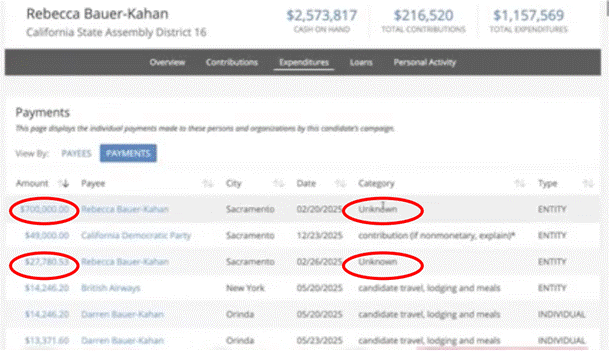
(Photo: Transparency USA)
He also points to roughly $14,000 in spending on British Airways flights, which he questions due to the airline’s limited relevance to local district travel.
In addition, Kathrani raises concerns about payments made to individuals connected to the campaign, including the candidate’s spouse, suggesting that such arrangements may create conflicts of interest or raise questions about the proper use of donor funds.
After subtracting what he describes as unclear or personal expenditures, Kathrani concludes that the opponent’s effective campaign spending aligns closer to his own $100,000 benchmark. He argues this reinforces his broader position that high fundraising totals do not necessarily translate into more effective voter outreach or better campaign outcomes.
Kathrani also draws attention to the sources of campaign donations, noting that many contributions to his opponent come from unions and Political Action Committees (PACs). He says his own campaign is deliberately structured to avoid PAC funding, emphasizing individual donors and grassroots support as a matter of principle and transparency.
Beyond financial questions, Kathrani raises concerns about candidate accessibility and responsiveness. He says attempts to engage in an open debate received limited response, noting that while one opponent, Joseph Roubaix, expressed willingness to participate, the primary candidate did not respond directly.
The candidate also claims that outreach to official assembly email addresses went unanswered, and that campaign communications were often routed through third-party entities handling endorsements and fundraising.
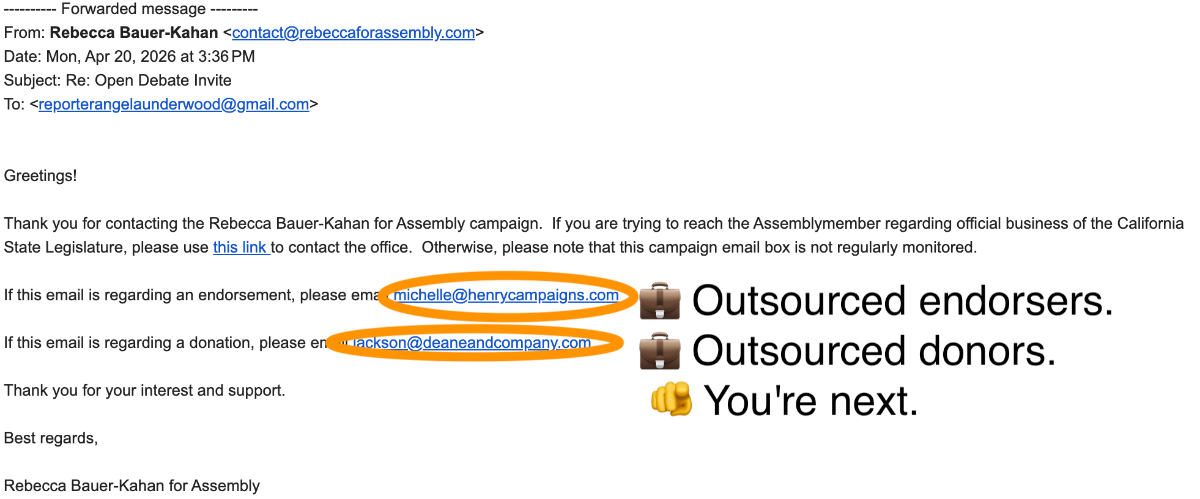
Photo Credit: Assemblywoman Rebecca Bauer-Kahn, automated email response to an open invite debate by Kathrani)
He argues that this structure can distance elected officials or candidates from direct constituent engagement and makes it more difficult for the public to receive timely responses. Kathrani further says that when officials are in office, continued fundraising activity can conflict with legislative responsibilities, potentially affecting attendance and participation in votes.
Another area of concern raised by Kathrani involves travel expenses charged to campaign funds. He describes some of the spending as luxury or foreign travel that he says appears disconnected from district-related duties. While he notes that certain trips were explained as attendance at artificial intelligence-related meetups, he questions the necessity of overseas travel when similar events are commonly held in Silicon Valley and other U.S. tech hubs.
He also clarifies that a previous concern about “double-dipping” in financial reporting was later resolved, with no evidence of duplicate expense entries identified.
Together, Kathrani says these issues point to a broader need for clearer standards in campaign finance reporting, stronger transparency in expense categorization, and closer public oversight of how donor funds are used. He maintains that voters should be able to clearly understand how campaign money is spent, not just how much is raised, and that elected officials should be held accountable for both financial decisions and day-to-day responsiveness to constituents.
0
0

Comments