(SAN RAMON, Calif.) -When Contra Costa County officials asked voters to approve another sales tax increase in June 2026, they said the money was needed to protect healthcare services from anticipated federal funding cuts.
The proposal would have raised an estimated $150 million annually for five years. But as the campaign unfolded, opponents questioned the county's financial projections, its existing reserves, and the need for another tax when voters had already approved Measure X in 2020.
The controversy deepened after a Superior Court judge ordered changes to the ballot language, finding that portions of the county's original wording were not sufficiently neutral.
On June 2, voters rejected Measure B by nearly 14 percentage points. The outcome ended the county's immediate effort to raise additional sales tax revenue but left unresolved questions about how it would address future healthcare funding reductions.
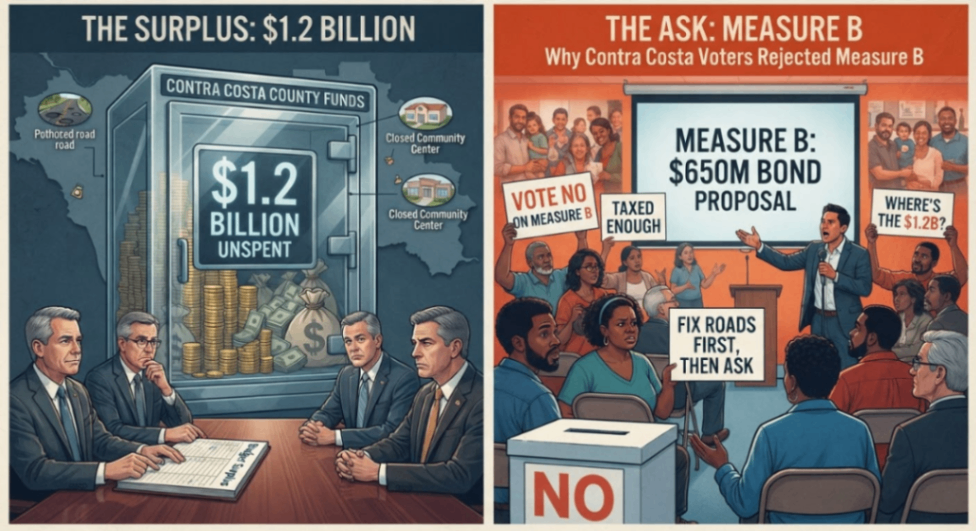
Photo Credit: AI Veritas
A $307 Million Loss That Wasn't Annual
The controversy began in March 2026, when the Board of Supervisors voted to place Measure B, a five-year, 0.625 percentage-point countywide sales tax increase, on the ballot. County officials pointed to anticipated federal healthcare funding reductions as a major reason for the proposal.
But the county's financial projections soon came under scrutiny.
An initial county staff report projected annual Medi-Cal revenue losses reaching $307 million by fiscal year 2028-29. That figure became a point of contention, with the Contra Costa
Taxpayers Association (CoCoTax) and other opponents questioning whether the county had accurately described its projected losses.
During the March 3 Board of Supervisors meeting, the board amended Resolution No. 2026-40. The original language referred to annual revenue losses exceeding $300 million by 2029.
The revised resolution instead described estimated cumulative revenue losses of $239 million by 2029.
The county's staff report separately described a projected $307 million annual structural deficit in hospital operations. The differing figures and descriptions fueled questions about how the county's financial outlook was being presented to voters.
Despite the revision, the board moved forward with placing the tax measure before voters. District 2 Supervisor Candace Andersen, whose district includes San Ramon and Danville, cast the lone dissenting vote.
Critics continued to question whether the public was receiving a clear picture of the county's financial exposure.
Court Intervention and Questions About County Finances
The dispute eventually reached Superior Court, where two separate legal challenges questioned the county's ballot language and arguments supporting Measure B.
In one ruling, Judge Leonard Marquez ordered revisions to the county's ballot question, finding that the original wording was argumentative and prejudicial. The county was required to remove language characterizing federal funding reductions as "deep" and county services as "critical." The ruling also required clearer wording of the proposed tax rate.
At the same time, opponents began examining the county's financial reports and questioning whether another tax increase was necessary.
Several figures became central to that debate.
Measure X funds: Voters approved Measure X, a half-cent general-purpose sales tax, in 2020 to support county services, including healthcare.
According to the county's independent Measure X audit for the fiscal year ended June 30, 2025, the tax generated approximately $120.2 million in annual revenue and had accumulated a fund balance of $263.5 million.
Of that amount, approximately $261.9 million had already been appropriated for county projects and programs but remained unspent. Another $1.6 million was unappropriated.
Opponents questioned whether some of those existing allocations could be reconsidered before the county sought another tax increase. However, money already appropriated for programs and projects is not necessarily available for other purposes without changes to existing spending commitments.
County reserves: The county's financial records showed a General Fund balance of approximately $1.21 billion as of June 30, 2025, including about $584.6 million in unassigned reserves.
The remaining balance consisted of funds classified as restricted, committed, assigned or otherwise unavailable for unrestricted spending.
Critics argued that the size of the county's reserves warranted a fuller explanation before voters were asked to approve another tax. County officials, however, maintained that reserves could not permanently replace ongoing revenue threatened by federal funding reductions.
Growing payroll and spending:Opponents also raised concerns about increases in countywide spending and employee compensation. They argued that existing expenditures should receive closer scrutiny before additional taxes were considered.
These figures became important points of debate. Opponents maintained that before asking residents for more money, the county should explain how existing funds were being used and why its reserves and accumulated Measure X revenues were insufficient.
The County's Argument: Preparing for Future Healthcare Cuts
Supporters of Measure B offered a different explanation.
County supervisors who backed the proposal, along with healthcare unions and labor organizations, argued that anticipated federal Medicaid and hospital funding reductions could put significant pressure on Contra Costa Regional Medical Center and community clinics. Their concern was that waiting until the federal cuts took effect could leave the county with fewer options. They warned of potential clinic closures, reduced services, emergency room overcrowding, and layoffs.
Supporters maintained that the proposed tax would provide a financial cushion to help protect healthcare services during an uncertain period. They also argued that the county needed to prepare before the projected funding reductions began taking effect, rather than waiting until the financial consequences were already being felt.
Opponents, however, questioned the timing. County presentations indicated that some of the larger anticipated federal funding reductions would not begin until 2027 or later, while the proposed sales tax was scheduled to begin collecting revenue in October 2026.
They also questioned the fact that Measure B was structured as an unrestricted general-purpose tax.
Voters Deliver Their Answer
On June 2, 2026, Contra Costa County voters rejected Measure B.
The certified results were:
No: 170,703 votes (56.87%)
Yes: 129,449 votes (43.13%)
The rejection prevented the additional county sales tax from taking effect and avoided further increases to already high combined local sales tax rates in parts of the county.
For opponents, the result reflected more than opposition to another tax. It demonstrated that voters wanted clearer answers about county finances before agreeing to contribute additional money.
Why the Debate Matters Beyond Contra Costa County
The Measure B controversy has implications beyond the county itself.
Residents in San Ramon, Danville, Alamo, Pleasanton, and Dublin are already dealing with a growing number of local tax proposals, special assessments, utility increases, and regional funding measures. Individually, these proposals may each have a stated purpose. But when they begin to overlap, residents are left trying to understand how much they are paying, where the money is going, and whether existing revenue is being managed effectively.
The Measure B debate brought those questions into focus.
County officials argued that additional funding was necessary to prepare for future healthcare challenges. Opponents countered that the county needed to demonstrate greater accountability for the money it already collected.
Both the need to maintain essential services and the responsibility to manage taxpayer dollars deserve serious consideration. But asking residents to pay more requires a clear explanation of why existing resources are not enough. Before putting another tax increase before voters, county leaders will need to provide straightforward financial information, explain how accumulated reserves are being used, and demonstrate that available resources are being managed responsibly.
The Measure B vote made one thing clear: residents want answers before they agree to another tax increase.
Sources & Public Records
Court Filings and Rulings
Contra Costa County Superior Court, Case No. N26-0456 — Challenge to Measure B ballot language and ruling ordering revisions.
Minor v. Connelly, Case No. N26-0554 — Petition for Writ of Mandate filed March 27, 2026, under California Elections Code § 9190.
County Ordinances and Financial Records
Contra Costa County Board of Supervisors, Resolution No. 2026-40, amended March 3, 2026.
Contra Costa County Annual Comprehensive Financial Report (ACFR), General Fund disclosures.
Contra Costa County Measure X financial and revenue reports.
News Coverage and Watchdog Reporting
Local News Matters / Bay City News, "Judge rules Contra Costa County tax measure language lacks neutrality, must be revised," April 7, 2026.
ContraCosta.news, "CoCo Taxpayers Sue Contra Costa County Over Misleading Statements in Measure B Ballot Language," March 30, 2026.
Antioch Herald, "The false and misleading case for the Measure B Sales Tax," April 2026.
Contra Costa Taxpayers Association (CoCoTax), June 2, 2026 Ballot Measures Analysis.
Stop Measure B Coalition, County Document & Tax Rate Summary.
Ballotpedia, Contra Costa County, California, Measure B, Sales Tax Measure (June 2026), certified election results.
0
0

Comments