(TALLAHASSEE, FL.) - Florida Attorney General James Uthemeier recently filed an 83-page complaint against OpenAI in response to the Florida State University School shooting, among other in-state crises.
If you would like to read about the specific crisis mentioned in the complaint, click here.
The complaint mentions the danger present to children, an issue that parents should be aware of.
Just like cellphones and most present-day technology, AI has an addictive quality to it-- a quality exacerbated by its conversational abilities. Drexel University published a study on teenagers who used chatbots and found that teens are more susceptible to addiction.
The study points out that video games and social media have an accepted framework for defining and diagnosing addiction, but AI does not.
The Drexel researchers used salience, mood modification, tolerance, withdrawal, conflict, and relapse to define detrimental use of AI. The research paper noted their substance abuse model is not widely accepted to describe AI addiction yet, as scholars outside of the study have hesitance. Many teens frequently use technology, and relevant researchers believe it would be difficult to separate high usage from an inherent detriment to a user.
Seven out of ten teens have used AI, according to 2024 findings; a number that has surely increased. The same study found 49% of parents have not had any discussions with their children about AI usage.
Teens have commented on the appeal of chatbots, commonly citing availability and anonymity for common use. Despite the purported benefits, AI is not a human interaction. Unlike humans, a chatbot will be fully engaged and empathetic to every query a user gives, neglecting the feedback a real interaction could provide. The endless and unrequited kindness a chatbot provides teens can become addictive and lead to parasocial relationships. Although there is research on how reliance can affect adults, there is little research on how detrimental AI could be to a developing brain.
Drexel University’s study also discussed teens admitting to using chatbots as replacements for real-life friends and even parental figures. According to the Pew Research Center, 16% of teens have casual conversations with chatbots, and 12% rely on AI for emotional advice.
The statistic becomes more concerning upon reading Florida’s formal complaint against OpenAI, which states the chatbots pose serious mental threats to users.
The complaint references a study from the Brookings Institute, where researchers found that AI can damage a student's ability to learn. ‘Cognitive offloading’ was the term used to describe teens' writing skills. Instead of making human mistakes and progressing, students who delegate tasks to AI are losing their writing skills and creativity.
Chatbots have been programmed to take over the entire creative process, even asking users follow-up questions about a project the chatbot curated. Several studies have found that teens are becoming over-reliant on technology, which undermines their critical thinking skills.
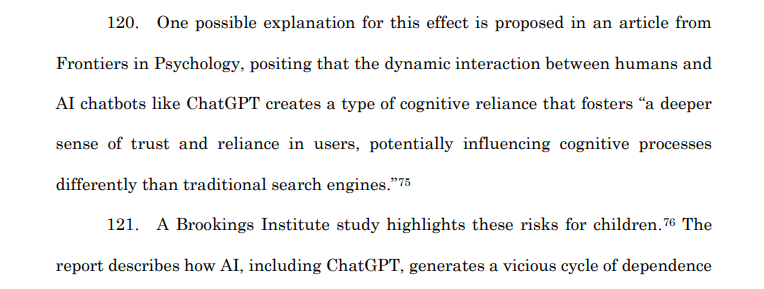
Photo Credit: My Florida Legal
Researchers have found that overuse of AI produces the same brain atrophy as aging, directly harming growth.

Photo Credit: American Addiction Center / Dr. Kristen Fuller of the Addiction Center
“Adolescents and teenagers are particularly at risk for AI addiction, as they can become so emotionally attached and involved with chatbots or AI companions that it causes psychological harm.”
As chatbots progress, they appear to become more predatory. The A.I. Genie Phenomenon describes how immersive and human-like chatbots communicate.
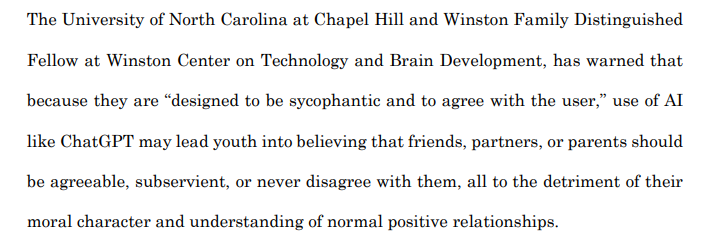
Photo Credit: My Florida Legal
ChatGPT is one of many publicly available chatbots programmed to provide as little pushback as possible to user prompts. Combined with the ability to have endless conversations without any personal needs or opinions, chatbots have the potential to become dangerously addictive. Teens can find their AI chatbot to be their ‘all-in-one-friend’, who can do their homework and listen to their personal issues for hours without needing to interrupt them. Such a relationship with a chatbot can make a person less inclined to have human interactions and even less amicable in conversations.
A user who has had their feelings and actions consistently validated from a (personally deemed) trustworthy source will be less likely to compromise or face controversy. The reliance can leave the user isolated and even more dependent on the chatbot, reinforcing the cycle.
Many of the symptoms and conflicts created by chatbots are the same complaints directed at modern phones and social media. Many adults would argue that younger generations are too arrogant and dependent on their cellphones: the issues with chatbots. Even more adults believe children are not as social as they used to be, and are too involved with social media.
AI can be an even larger detriment because of how personal the produced content feels. AI is marketed as a superintelligence, providing false reliability to the user. Unlike video games and social media, AI chatbots can entice users by speaking directly to them, using endless prompts and questions tailored to their specific interests, which is inherently more dangerous.
China and South Korea have implemented legislation around general AI, with the U.S. also considering age verification. China has taken the harshest approach, banning chatbots marketed for virtual relationships to citizens under 18, and forcing companies to adopt manual human intervention when necessary.
The United States could adopt a modified approach by banning deceptive interactions. AI models are useful for quickly sourcing information, and would be much safer if generated responses were forced to be robotic or numerical, rather than imitating human emotions. A strict and bland response pattern would force students to use some higher-level thinking, as having the correct information is not the same as explaining it. If a chatbot were to give bullet-point answers instead of an essay, the student would then be forced to bring life to their work and elaborate, preventing the mental atrophy referenced in the Florida legal complaint. Standard response patterns could also decrease the addictive quality of chatbots, preventing them from asking follow-up questions or conveying false emotions.
AI is unavoidable in society, but it is not inherently evil. However, recent tragedies should force a change in how chatbots can interact with users.
To add to or correct any information in this report, please contact me at jason.f@lead4earth.org.
1
0

Comments