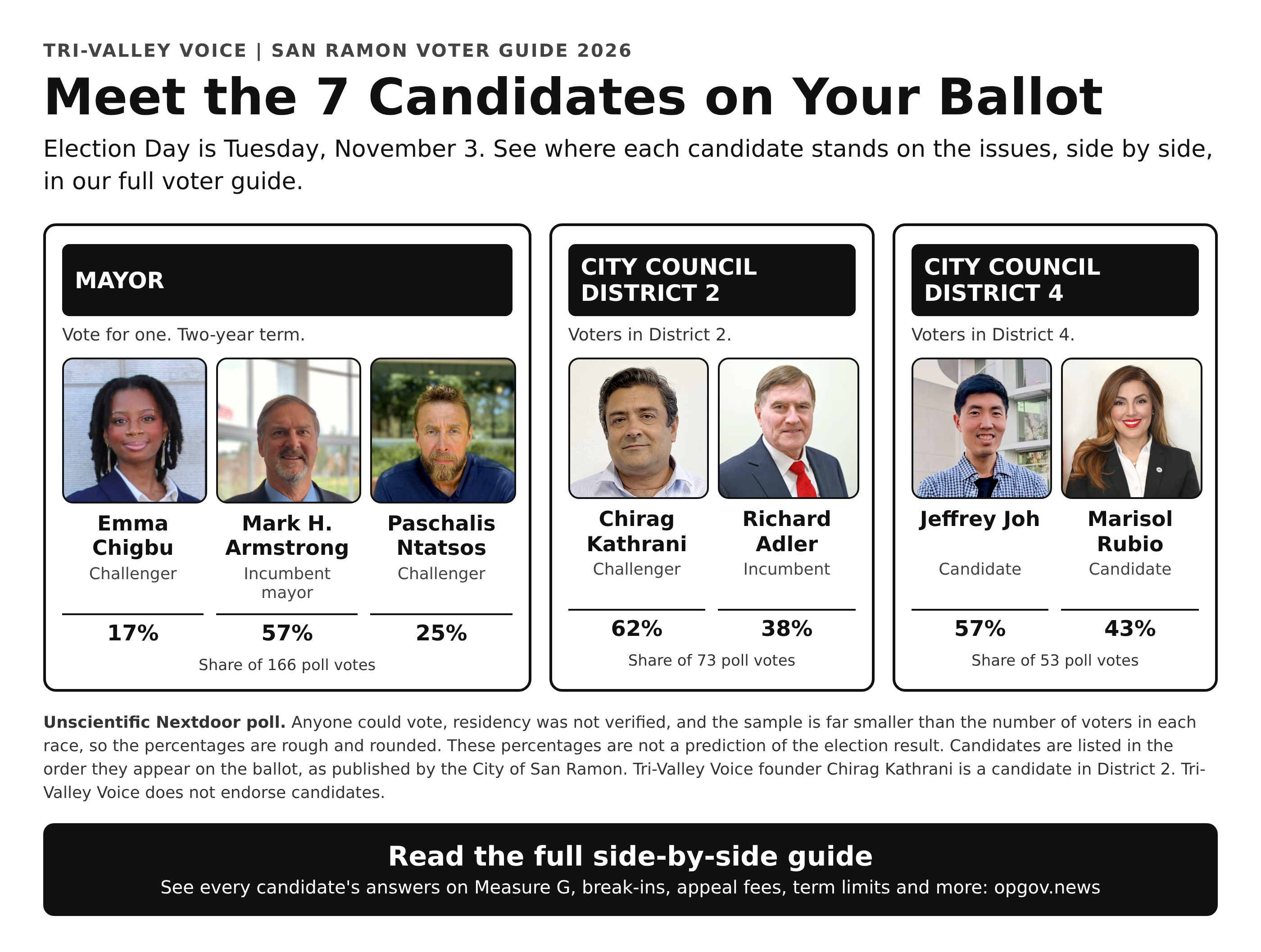
San Ramon voters will fill the Mayor's seat and two City Council seats on Tuesday, Nov. 3.
Three candidates are running for Mayor, and every San Ramon voter can vote in that race.
Two candidates are running in District 2 and two in District 4, and voters choose only in the district where they live.
A note on who made this guide: Tri-Valley Voice is published by OpGov.News, an initiative of Lead For Earth, a 501(c)(3) nonprofit. OpGov.News founder Chirag Kathrani is a candidate in the District 2 race, and his positions are reported here as he stated them. Tri-Valley Voice does not endorse candidates. Candidates are listed in the order they appear on the ballot, as published by the City of San Ramon.
Positions below are summarized from notes of three candidate forums (Sept. 30, Oct. 2 and Oct. 7), not from campaign statements. Where a candidate did not attend the forum at which a topic came up, we say so. That does not mean the candidate has no view. At the Muslim Community Center forum, recording was restricted because some candidates were uncomfortable being recorded.
What the mayor and council do
The City Council has five members: the mayor, who is elected citywide for a two-year term, and one member from each of four districts, each elected for four years. The mayor is one of five votes and presides at council meetings. The council decides the city budget and fees, zoning and development rules, the General Plan, and appeals of some planning decisions. Residents can speak during public comment at council meetings, or write to the City Clerk at cityclerk@sanramon.ca.gov or call (925) 973-2539.
Measure G
Measure G is a 1999 voter-approved rule on hillsides and open space. It required a four-out-of-five council vote and three public hearings for General Plan changes. In 2025 the council changed the city code to require only a simple majority and "one or more" hearings. The city attorney says Measure G applied only to the 2020 General Plan. Critics say it should still apply. The city's 2023 hearings on General Plan 2040 were described as "required by Measure G," and the city website still describes the rule.
Mayor.
Emma Chigbu did not attend the Sept. 30 or Oct. 2 forums where it was discussed.
Mayor Mark H. Armstrong voted not to open the item for discussion when a past mayor and a council member asked, and did not attend the Sept. 30 forum.
Paschalis Ntatsos strongly advocates restoring Measure G.
District 2.
Kathrani says he has spoken at every council meeting and promises to save open spaces and restore the law protecting them. Councilmember Richard J. Adler acknowledged shortcomings in the deletion at a forum, but voted not to open it for discussion when the deletion was considered. He did not attend the Sept. 30 forum.
District 4.
Jeffrey Joh said at the Sept. 30 forum that Measure G should have been discussed.
Councilmember Marisol Rubio did not raise it for discussion, though she could have moved it from the consent calendar to the agenda. She avoided the topic on Oct. 7 and did not attend the Sept. 30 forum.
Appeal fees
Residents pay a fee to appeal a city decision they disagree with. Fees are currently uncapped.
Mayor.
Chigbu did not attend the Sept. 30 forum.
Armstrong voted to keep fees unlimited, said appeals stopped after fees were made unlimited, and did not attend the Sept. 30 forum.
Ntatsos wants fees lowered and made reasonable.
District 2.
Kathrani promises to bring fees to $300, as in neighboring cities.
Adler voted to keep fees unlimited, said appeals stopped after fees were made unlimited, and did not attend the Sept. 30 forum.
District 4. Joh wants to cap fees at $300, as in neighboring cities. Rubio said that the lack of appeals shows San Ramon is a great city.
Sunset Development oversight
The "Kings Ordinance" lets Sunset Development projects skip City Council and Planning Commission review. Critics say opponents must then use the appeal process, where fees are uncapped.
Mayor.
Chigbu did not attend the Sept. 30 forum.
Armstrong voted yes on the ordinance, while did not attend Sept. 30 forum.
Ntatsos would vote to bring public oversight to all projects, with no special treatment for Sunset Development.
District 2.
Kathrani would vote to bring public oversight to all projects, with no special treatment for Sunset Development.
Adler voted yes on the ordinance, while did not attend Sept. 30 forum.
District 4.
Joh believes in checks and balances and wants all projects to face public hearings at the council and Planning Commission.
Rubio voted yes on the ordinance, while did not attend Sept. 30 forum.
Break-ins and theft
Mayor.
Chigbu said she agreed with Armstrong and wants more police staff as residents arrive.
Armstrong praised the police department and cited a drone and license-plate readers funded by $5.6 million in grants.
Ntatsos proposed floor cameras and information sharing, and, given the city's deficit, micro-grants for businesses.
District 2.
Kathrani said the 1% sales tax increase was pitched on public safety while the city remains in deficit, and questioned how the money was used.
Adler cited 70 sworn officers, or 2.2 per 1,000 residents.
District 4.
Joh advocated crime prevention through design and said he has met with business owners and police on joint solutions.
Rubio focused on mental health work at the police department, cited the $5.6 million retail theft grant and advocated more safety technology.
Term limits
Supporters of term limits note that many past council members served about 25 years.
Mayor.
Ntatsos strongly supports term limits and says they are needed to create new leaders.
Chigbu and Armstrong did not attend the Sept. 30, forum where it was asked.
District 2.
Kathrani supports term limits of eight years. Adler did not attend the forum where it was asked.
District 4.
Joh opposes term limits because many races go unchallenged. Rubio did not attend the forum where it was asked.
City finances and local business
Mayor.
Ntatsos said fees for small businesses in city recreation programs rose 14%, discouraging participation.
Chigbu and Armstrong did not attend the Sept. 30 forum.
District 2.
Kathrani said he has helped build more than 10 businesses and called for city-supported entrepreneurship programs for young people, including links to resident senior executives. Adler did not attend the Sept. 30 forum.
District 4.
Joh proposed attracting larger tech companies and expanding retail in Gale Ranch and Dougherty Valley, and hopes finances improve enough to repeal the 1% sales tax increase early. Rubio did not attend the Sept. 30 forum.
Development and traffic
Mayor. Armstrong said new development fits the city core and that traffic infrastructure is planned. He said Orchard housing is in the master plan as the city nears its urban growth boundary, and noted that similar numbers of people traveled the area when Chevron and Bishop Ranch hosted offices. He cited the Iron Horse crossing, which he said cuts waits on Bollinger Canyon Road.
Chigbu worried about traffic from development, said proposed mixed-use housing would benefit the city, and said new residents without new schools will worsen school traffic.
Ntatsos favors properly planned development with resource and environmental studies before projects are approved, and said traffic effects are unknown until projects are finished. He wants congestion measured instead of vehicle miles traveled.
District 2.
Kathrani stressed the combined impact of each project and said the city should follow the general plan and build mixed-use housing. He said the applicant for the DMU-N project owned only 1% of the land yet was considered valid. He said thousands of Bishop Ranch townhomes will add traffic on Bollinger Canyon Road and cut Dougherty Valley off from I-680, and wants a combined traffic study.
Adler defended his approvals in the city core and briefly acknowledged residents' unhappiness with development, but said state mandates are being followed. He cited the Iron Horse crossing.
District 4.
Joh wants a real downtown, not a mall called a downtown, and called the city center a "cheese grater," citing Walnut Creek as a model. He proposed shuttle services for seniors and workers to ease expected traffic.
Rubio highlighted infill filling the city core under her leadership. At the Muslim Community Center forum she acknowledged residents' unhappiness and worried the city could be sued if the council does not approve all projects. She focused on an added Iron Horse Trail lane for biking and walking, with bike speed limits.
An unscientific Nextdoor poll
A separate poll on Nextdoor drew a small number of votes. Anyone could vote, residency was not verified, and the samples are far smaller than the number of voters in each race, so the results are not a prediction of the election.
Mayor, 166 votes: Chigbu 29, Armstrong 95, Ntatsos 42.
District 2, 73 votes: Kathrani 45, Adler 28.
District 4, 53 votes: Joh 30, Rubio 23.
Kathrani, a candidate in District 2, is the founder of Tri-Valley Voice.
How to vote
Return your ballot by Tuesday, Nov. 3. Drop it off by 8 p.m. on Election Day, or mail it with a postmark of Nov. 3 or earlier. Drop-off locations and ballot status are available from the Contra Costa Elections Division.
0
0

Comments