Photo Credit: YouTube
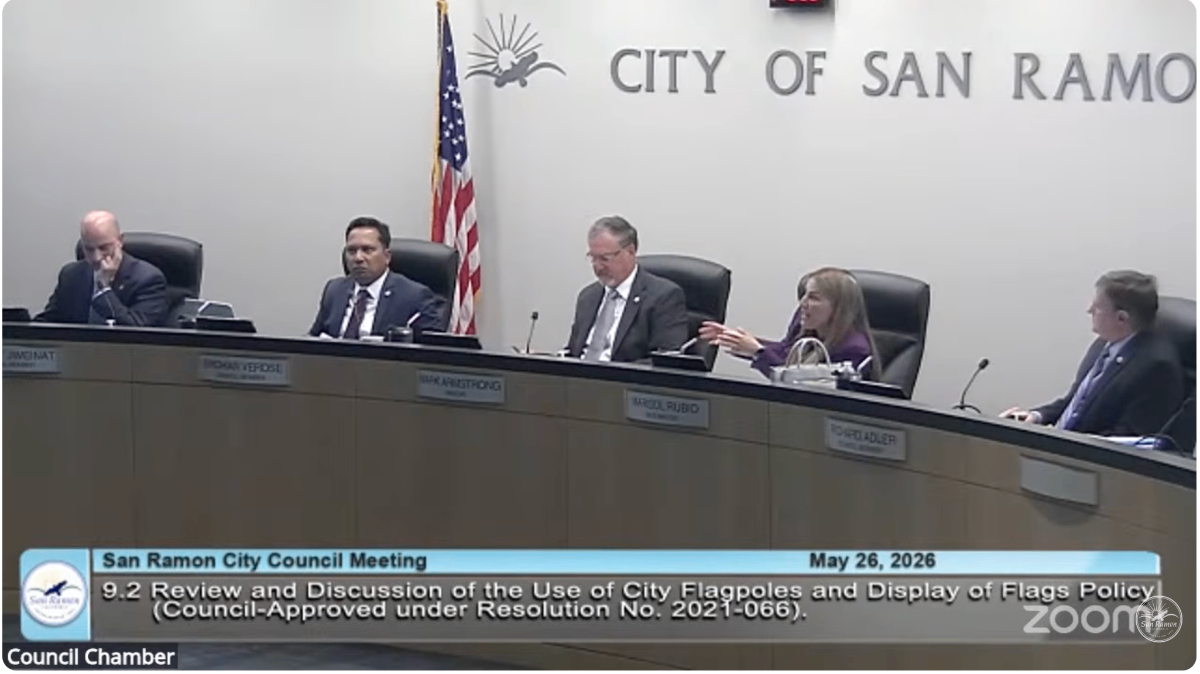
(SAN RAMON, CA.) – During its May 26 meeting, the San Ramon City Council rejected a policy that would have permanently approved commemorative flags to fly, opting instead for a strict annual review. The decision follows local disagreements over diversity symbols and flag etiquette.
The debate was sparked by a scheduled review of Resolution No. 2021-066, the city’s framework governing commemorative flags on municipal property. The meeting quickly devolved into an argument over which symbols best represent San Ramon.
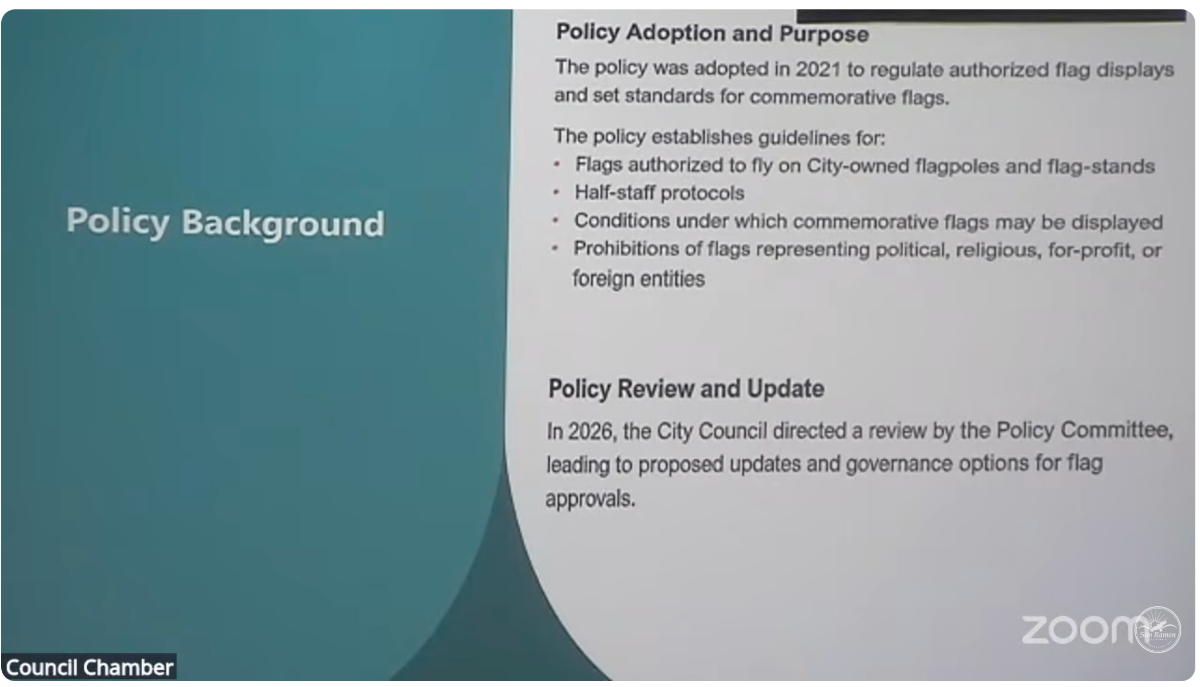
Photo Credit: YouTube
During public comment, speakers stepped up to the mic to support the Pride flag being raised. Chapter President of PFLAG Danville-San Ramon Valley Anuradha Gupta urged the council to explicitly name the Pride flag in the policy to protect it from changing political climates.
“We are painfully aware that the LGBTQ community is the most vulnerable to being attacked,” Gupta stated, requesting that the flag be raised in perpetuity to avoid what she called a “harrowing approval each year.”
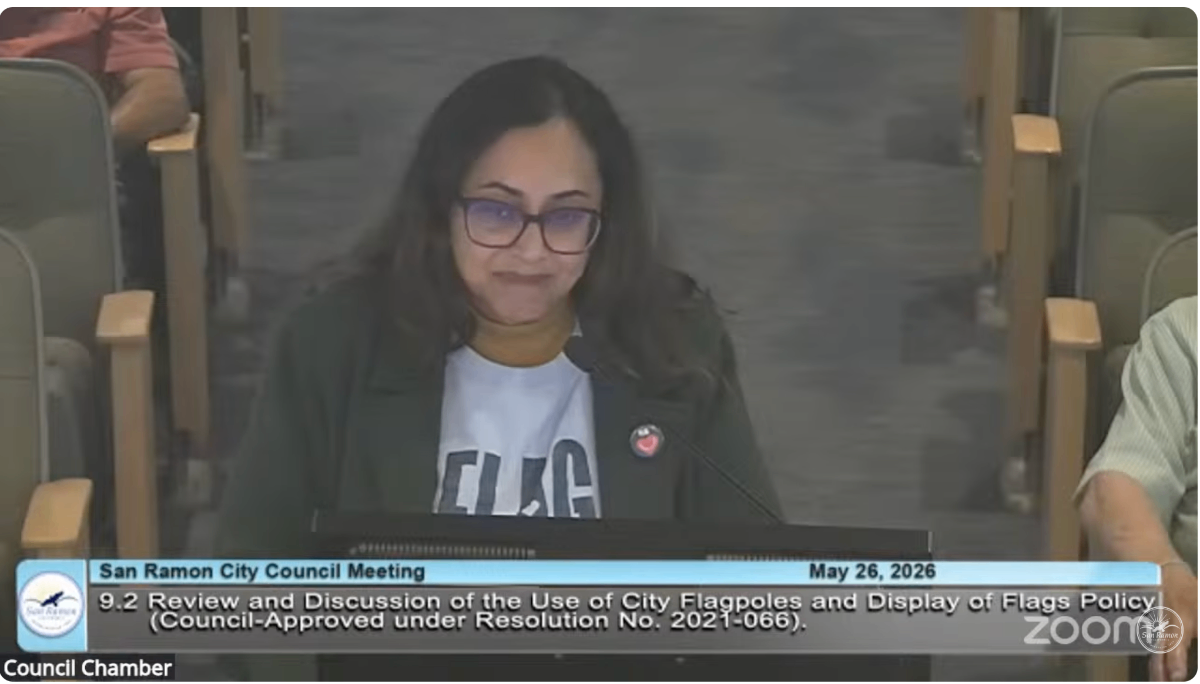
Photo Credit: YouTube
For some residents, the flags are a vital symbol of safety. “Pride flags save lives, represent persistence, love, and freedom for all,” resident Dan Frank told the council, citing a national rise in anti-transgender violence and a recent shooting at the Islamic Center of San Diego.
On the other hand, some residents pushed for strict neutrality. Longtime San Ramon resident Garry Chaban proclaimed that government flagpoles should be reserved exclusively for the American, Californian, and San Ramon flags. “I happen to be a Polish, Russian, Italian, German, Swedish American,” Chaban said. “Do I get to fly each of those flags on their holidays? Not everyone agrees with what's being flown out there...you better set a standard, or you're all going to pay the price.”
Once public comment closed, the council turned its attention to legal wording and national politics.
Vice Mayor Marisol Rubio fought for an expansive policy to keep the city’s options open for flying “historically and commonly celebrated commemorative flags.” Pointing to the federal government’s removal of Pride flags from federal buildings, Rubio voiced that local municipalities have to step up. “We are living in atypical times,” she said, calling on the council to “show courage” in protecting vulnerable groups.
City Attorney Martin Lysons quickly cut in, warning that “historical” phrasing was dangerously vague. “At that point, the council would be asked to interpret it on an ad hoc basis…or you can decide to define that with a little more precision,” he said, adding that without it, city staff would be left without clear operational guidelines.
Mayor Mark Armstrong agreed, arguing that loose wording would create an operational nightmare and lock future councils into endless policy disputes. The council then voted 5-0 to approve an updated policy that eliminates the vague language, tying future flag displays exclusively to “nationally and state designated awareness and heritage months.”
The new rules raised immediate practical questions about months with overlapping cultural celebrations. To accommodate flying two heritage flags simultaneously, Councilman Sridhar Verose proposed a rotation system that would swap the flags' positions halfway through the month.
That idea didn't sit well with Vice Mayor Rubio, who objected to dividing a heritage month in half. “I really disagree with the 15 days...because that's just undermining the whole purpose of [us] celebrating a month,” she said, reasoning that these displays are meant to honor a community's history and lived experiences. “To even consider that... is a little insulting in my humble opinion.”
Mayor Armstrong raised a different concern, this one rooted in traditional flag etiquette. He insisted that a double-stacked flagpole display creates an accidental hierarchy. “Somebody's not going to feel like they're the winner. Somebody's going to feel like they're the loser,” Armstrong said, warning that the top position naturally implies greater importance and could alienate the groups involved.
To keep labor costs down and avoid weekend scheduling conflicts, the council directed staff to split the flag display time evenly. Under the new rule, overlapping flags will swap positions at the halfway mark of their run. The motion passed 4-1, with Mayor Armstrong casting the only 'no' vote because of his lingering concerns over creating an accidental hierarchy.
Before moving on to the next item on the agenda, the council voted to implement Option 2, which would require all commemorative flags to undergo a review every January instead of being permanently approved.
When City Manager Steven Spedowfski tried reading the straw poll tallies into the record to clarify direction for staff, a dispute ensued among council members over whether the votes were truly unanimous. The back and forth exposed a growing frustration on the council over how to handle public opposition.
Councilman Robert Jweinat expressed his frustration, calling attention to the fact that residents advocating for a neutral flagpole were being ignored. “I just didn't get an answer to a very sincere, simple question,” Jweinat said. “What about the people...that raised the question? What if some people just don't want anything up there?”
In response, Mayor Armstrong announced that the new January workshop will give those residents the opportunity to show up and voice their concerns.
Despite a tense end to the meeting, the council directed staff to add “Government Speech” citations to the policy's preamble. The change clarifies that city flagpoles are not public forums for private expression, banning religious, political, and for-profit banners.
The updated policy now moves to the consent calendar for final approval in the coming weeks.
If you have any questions or comments, please email me at kathleen.p@lead4earth.org or comment below.
0
0

Comments