(SAN RAMON) – History was made in San Ramon last night.
At least that is what OpGov.ai founder Chirag Kathrani will tell you, which is why I want to lay out a few things before you read further.
Since OpGov.ai began reporting on San Ramon, the media outlet has covered many local concerns that have collectively garnered nearly 125K hits. That says something, just like Kathrani does below. The publisher said he came home after the meeting below and was up until 2 a.m. composing what you are about to read, and reveals how an AI platform and a real-time reporter can confirm everything he says is true.
So here we go.
Directly after you read his very detailed and organized point of view (POV) of last night’s meeting, this reporter confirms the accuracy of his statements.
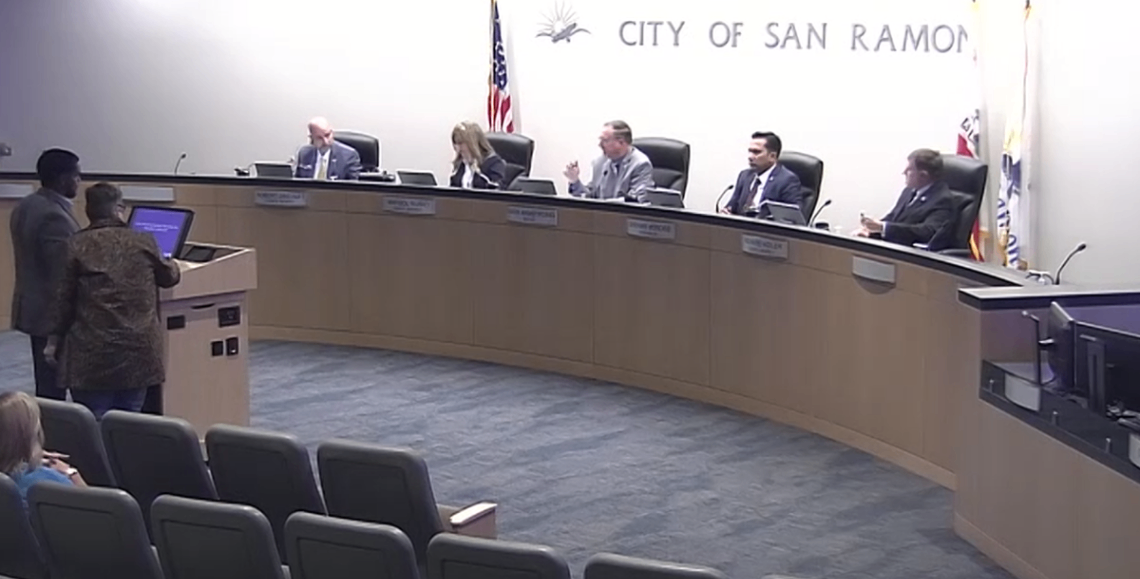
San Ramon City Council holds special meeting to consolidate three committees into one
Kathrani begins with “For the past several meetings — and for years before that — I’ve pointed out that decisions have often been unilateral. But this time, another piece of history was made for the first time, a former elected official was addressed respectfully, and his opinion made a difference.
In San Ramon, the City usually makes a proposal, and the Council has only two options: (1) accept it, or (2) move it to the next hearing and then pass it later in the consent calendar with no discussion. This pattern has been repeated in two major decisions:
1. Developer-Specific Development Agreement update: Both the City and the Planning Commission declined to discuss an issue concerning Sunset Development. Six residents spoke, and one Council Member initially abstained, saying it felt wrong to change policy in favor of a developer — but changed his mind at the next meeting after 65 people spoke.
2. Text Amendment removing Measure G references: Measure G is the voter-approved law protecting our Hillsides and Open Space. In the first meeting, the Council did not even ask staff why Measure G was being deleted. In the next meeting, the Council passed the controversial text amendment through the consent calendar, even after being reminded that doing so was illegal.
During my campaign, I said I might not know every detail of each item, but one thing was clear: for four years, every decision had been unanimous — and that speaks for itself.
But today, history was made. Many of us have fought for years to establish the Climate Action Task Force and later the Sustainability Committee, which regularly advises the Council on implementing sustainability across our city. Yet these committees have not truly been heard. It was again emphasized in the meeting that they “advise only”.
Further, a proposal suggested merging the Open Space Advisory Committee and Transportation Action Committee into a single quarterly meeting, cutting public engagement to a minimum. (e.g the total number meetings will be reduced from approximate 36 to just 4 a year)
Last November, several other committees were dissolved almost overnight for “not meeting often,” but in this case, Bob Peoples, Chair of the Open Space Advisory Committee, spoke up. He explained that meetings had been canceled for seven months despite ongoing work, and he strongly urged keeping his committee active.
Because of these cancellations, the Open Space Advisory Committee could not share its view when the controversial text amendment removing Measure G was passed — even after 25 people spoke against it. The Transportation Advisory Committee was also silent, perhaps unaware it was even on the agenda. It was confirmed by the following linkedin message to Member of the Transportation Advisory Committee.

The Sustainability Committee was also caught off guard; members realized that the new structure would add responsibilities while potentially reducing participation from nonprofits. (Notably, Seth Adams from Save Mount Diablo, who serves on the Open Space Advisory Committee, recently sued the City of Dublin over Measure II — a measure misleadingly named for open-space protection.)
After the Mayor pushed to delay the workshop, Council Member Richard Adler supported the proposal. However, Council Member Rubio then spoke passionately, pointing out that no public comment had been made opposing the formation of the Sustainability Committee.
For the first time, current elected officials also gave respectful attention to former Mayor Greg Carr, who completed his three-minute pitch. At the previous Council meeting, Mayor Carr and 25 community members had asked to open discussion on the text amendment but were denied.
This time, both the Vice Mayor and Council Member Adler changed their positions and joined Council Member Rubio in approving the creation of a Sustainability Advisory Committee all by itself.
Thanks to all community members who spoke or wrote to the Council, Kathranis ends his early a.m. letter.
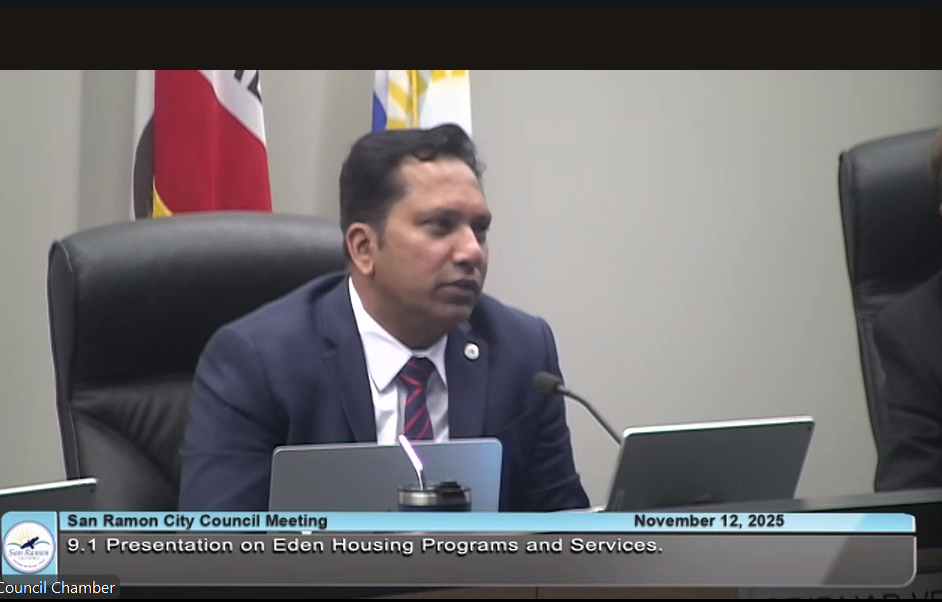
Vice Mayor Sridhar Verose at Nov. 12 meeting
Now it’s time to confirm whether the community members' concerns align with Kathrani’s POV and if there are even further concerns locals should note.
So let’s begin.
The platform points out the suggested consolidation, which dominated the discussion.
Though “staff presented the consolidation as a measure to improve efficiency, align with council priorities, and streamline public engagement," the notion was rejected, facing “significant public and council pushback, with critics arguing it would dilute specialized expertise, reduce community engagement opportunities, and lacked prior consultation with the affected committees.”
Yet, the council approved the establishment of the Sustainability Advisory Committee as a standalone entity, regardless of the concerns you are about to read, beginning with Bob People, Chair of the Open Space Advisory Committee (OSAC).
Peoples said the OSAC "should not" be folded into one, rather noting consolidation would substantially reduce and eliminate long-standing citizen involvement on open space protection and use, according to the OpGov.ai platform.
Furthermore, People's "claimed the staff report contained erroneous or misleading assertions about OSAC's activity and that OSAC has been very active but held back by staff," according to the platform.
Next, Kyle Levy, a member of the Parks and Community Services Commission, called the move a drastic approach.
"It just is," Levy said directly to the council, adding he agreed with Mayor Mark Armstrong's suggestion to get committee input on how they feel they are being utilized.
OpGov.ai noted that Levy argued that eliminating two committees would decrease opportunities for community engagement and reduce the number of citizens who learn about city processes and build trust in government, advocating for a more measured approach.

San Ramon officials take in many citizen concerns on Wednesday, Nov. 12.
Then came former San Ramon Councilmember/Mayor Greg Carr, who has frequently expressed his concerns at town hall. On the other side of the dais, Carr suggests that officials consider installing a countdown timer for speakers, ideally under the Mayor's sign, to help them maintain their train of thought.
His comments and concerns also refer to a previous council meeting, where Carr was allowed nearly a minute past the public comment time limit, yet Brian Swanson was pulled away from the podium by the police chief right after his three minutes expired.
But back to last night.
Carr defined “sustainability” with true fairness, noting officials must meet present needs without compromising the ability of future generations to meet their needs.
OpGov.ai reports Carr “argued the city's focus should be on balancing the budget, creating relevant programs, and increasing commercial development for revenue.”
That was just the first time Carr was at the podium. He got back up.
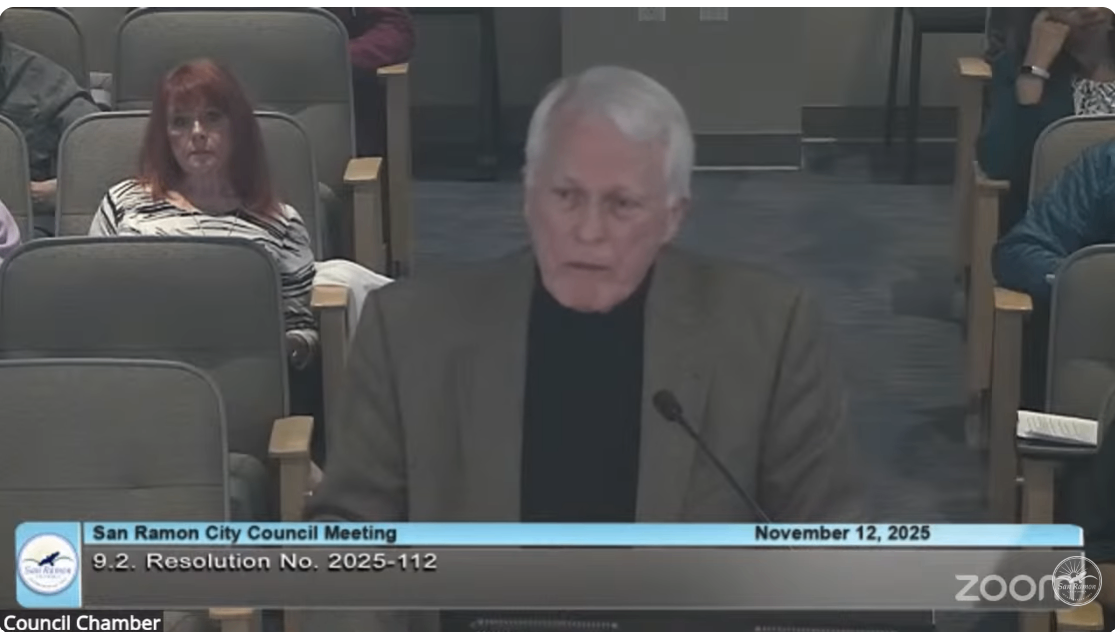
Former Mayor/Councilmember Greg Carr advises officials at special meeting
The second time Carr “criticized the staff report for proposing a single multidisciplinary body for three or more groups, calling it 'a lot of stuff to do.'”
"The staff should have no decision-making ability," Carr said.
Bottom line, Carr felt that five members, plus two alternates, were “way short” for the breadth of expertise required across open space, climate action, transportation, and land use. The former mayor said he wants to see committee restructuring, more public meetings, and committee members testifying publicly.
Like Carr, former San Ramon Councilmember Jim Blickenstaff has also been attending town hall meetings recently, speaking alongside Carr and other locals at notable gatherings.
The former elected official stated that the idea simply does not work.
"There are three components of the future in the city," Blickenstiff said, adding that the combination diminishes the citizens' voice specifically with open space, which he deems is "really a priority with them."

Councilmember Robert Jweniat engages with the public at the meeting Nov. 12
Chris Demibiczak, member of the Climate Action Plan Task Force, provided meaningful inputaccording to the platform, noting, "while acknowledging fiscal and efficiency arguments and some overlap, he viewed open space, transportation, and climate action as three distinct areas requiring specialized expertise.
"A lot of my points were made by others tonight," Demibiczak said, adding he feels strongly about each being distinct. "That is something we want to think about."
Resident Diana Korpi believed that combining the three committees would lead to dilution, noting they are not cohesive, according to the OpGov.ai platform, adding she "argues" five members overseeing such diverse areas would not benefit the city or residents.
She did argue.
"It is vital that we protect what citizens value," Korpi said, adding that elected officials must consider what makes San Ramon a desirable place to raise a family.
The notion of combining three committees lack cohesiveness, not to mention, Korpi said, "I just don't see the correlation."
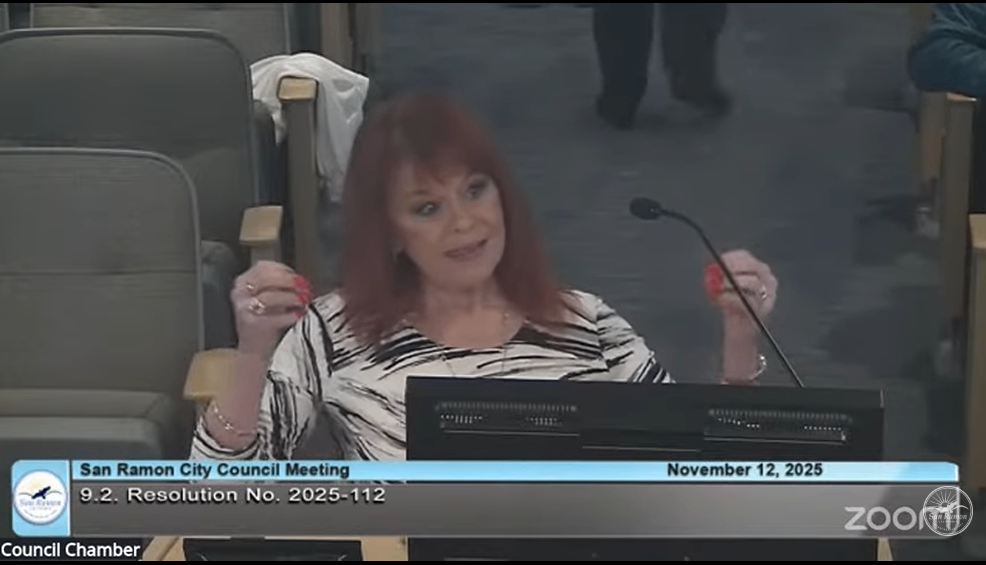
Resident Diana Korpi opposes the consilidation of three committees into one
With criticism came some consent, seen with John Larson, a 22-year resident, and Luz Gomez, a 45-year resident. Larson believed the work of the other two committees could productively continue within a broader committee, even if rebranded, according to the OpGov.ai platform.
Furthermore, Gomez noted that he is someone with statewide expertise in sustainability and affirmed the need for this committee, structured under the term "sustainability," to handle the "enormous, dynamic, and growing" work.
While he applauded the city for moving forward with this "evolve and re-prioritize," all his praise was silenced by Korpi's cry out.
“We need to listen to what the community needs,” Korpi said.
OpGov.ai reports that Richard Oldham submitted a written public comment, but the content was neither read aloud nor included in the transcript or attached PDF.
So, there you have it: Kathrani’s POV and that of other concerned citizens. If you agree or disagree, OpGov.ai welcomes your thoughts by emailing me at reporterangelaunderwood@gmail.com.
0
0

Comments