(San Ramon, CA) San Ramon bought into that system in a single vote. On April 28, 2020, the City Council authorized more than $1.2 million for 35 Flock Safety readers, 12 stationary readers and 46 surveillance cameras, described by police as a virtual fence around the city. The council has not taken the subject up in open session since.
Three mechanisms explain how these programs drift.
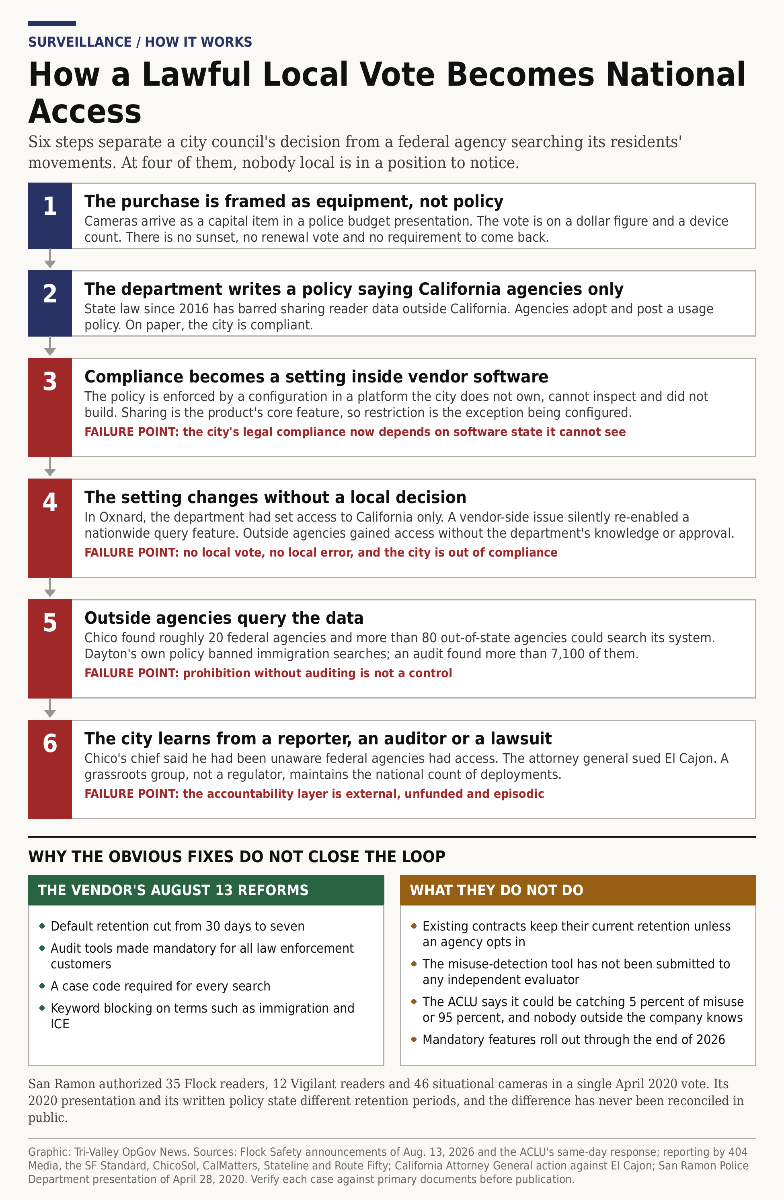
The first is that sharing is the product. The reason to join a network of more than 100,000 cameras is that a plate seen in one city can be found in another. California's Senate Bill 34 bars agencies from sharing reader data outside the state, so compliance means switching off that function using controls the vendor built. In Oxnard, the department had set access to California only. A vendor-side issue silently re-enabled nationwide queries, and outside agencies gained access without the department's knowledge. No councilmember voted for that.
The second is that logging and auditing are different jobs. Dayton, Ohio barred immigration searches by policy, and an audit in May found more than 7,100 of them. Chico shut off federal and out-of-state sharing in July after a news outlet requested records, and its police chief indicated he had been unaware that roughly 20 federal agencies could search the city's data. Attorney General Rob Bonta sued El Cajon in February over its sharing settings.
The third is that a city's paperwork and its configuration are separate objects. San Ramon's 2020 presentation said data would be held two years in one system and 30 days in another. The department's written policy says a minimum of one year. The difference has never been reconciled publicly.
Flock announced changes on Aug. 13, cutting default retention from 30 days to seven and making audit tools and search case codes mandatory. Existing contracts keep their current retention unless an agency opts in, and the features roll out through the end of 2026. The ACLU responded the same day, noting that no independent evaluator has tested the company's misuse-detection tool, so how much it catches is unknown.
Expansion runs through the vendor rather than the council. Flock now also sells drones, audio detection and a product built to move from a plate to a person. None of that required a local vote.
Cancelling is harder than buying. These are subscriptions with no residual asset, and Richmond restored its readers in March after disabling them, with staff citing rising crime.
The cameras are not useless. Berkeley police reported that after 52 were installed, readers were used in 121 cases and contributed to 58 arrests. Most such figures come from departments and vendors describing cases the technology assisted, which is not the same as a measured effect on crime, and inaccurate reads have contributed to wrongful stops and arrests.
A council could require review on a fixed cycle, an annual outside read of the search logs, and disclosure of what its system is actually configured to do rather than what its policy says. None of that settles whether the cameras are worth having.
In San Ramon the first question is smaller. Two city records state different retention periods for the same data. Somebody should ask which one is true.
0
0

Comments