Photo Credit: YouTube
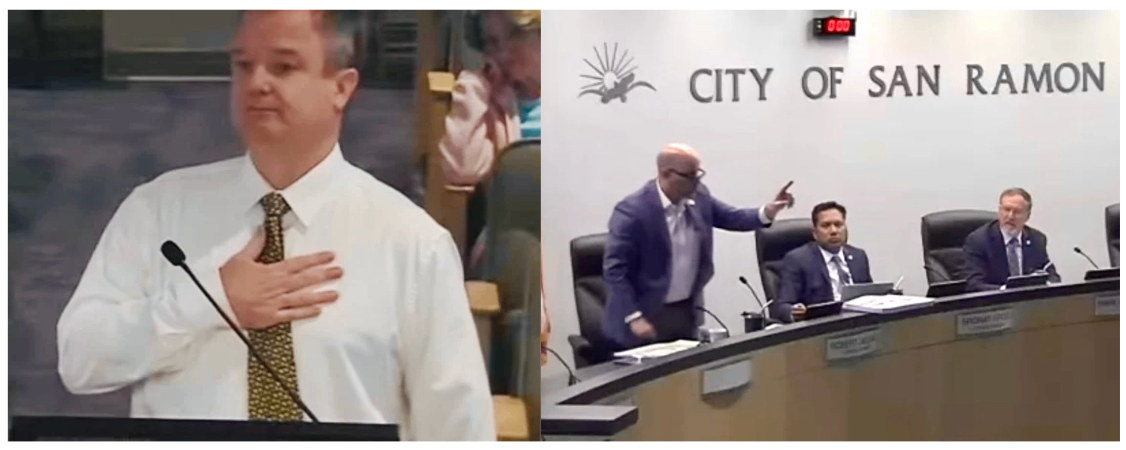
(SAN RAMON, CA.) – The San Ramon City Council held a special meeting on Apr. 7 to discuss the Public Hearing of the Orchards Development Project. The objective of the Public Hearing was to hear the appeal made by lifelong San Ramon resident Brian Swanson regarding the approval by the Planning Commission of the Orchards Development Project.
Sunset Development Company purchased the Chevron Corporation Office Park located at 6001 Bollinger Canyon Road back in 2022. Between 2022 and 2023, there was a series of public study sessions on the potential redevelopment of the property.
On Feb. 3, 2026, after receiving public comments, the Planning Commission closed the public hearing, deliberated, and approved the Orchards Development Project applications. Within the 10-day appeal period following the Planning Commission’s approval, the City received an appeal on Feb. 12, 2026 from Swanson opposing the Planning Commission’s action related to eight specified points.
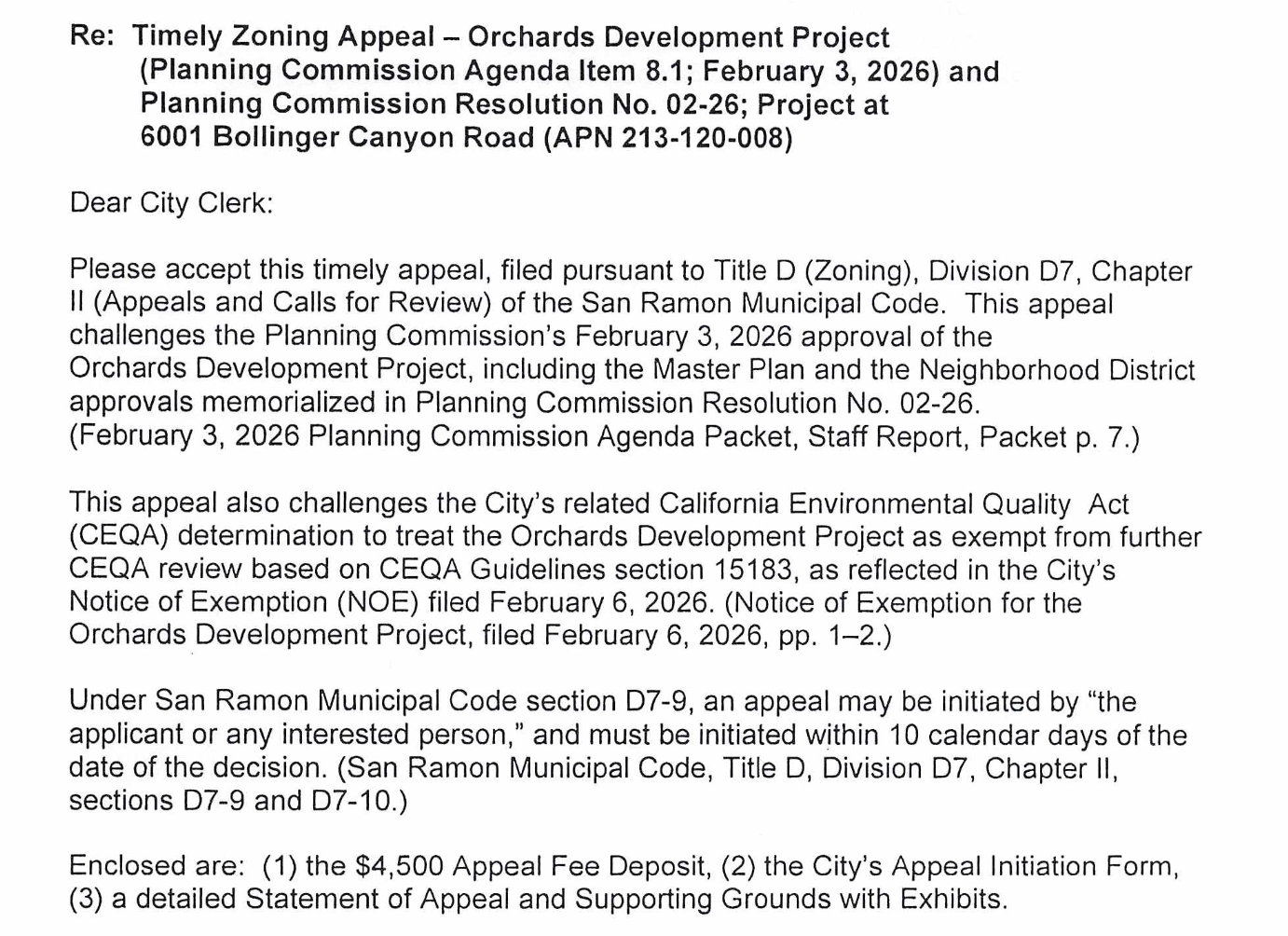
Photo Credit: Screenshot of email from Swanson to City Clerk
This meeting began with the staff presentation, given on behalf of Planning Division Manager Cindy Yee. As stated on the Planning Services website, “The proposed development project would demolish the former Chevron office park; subdivide the property to create three Districts on approximately 92 acres for Mixed-Use, Multi-Family, and Single Family/Townhomes uses; a master plan to construct 2,510 residential units over the course of 20 years; a development plan for the Neighborhood District consisting of 368 units and 58 accessory dwelling units, and develop associated private roads, parking and landscape.”
Yee concluded her presentation by recommending that the council deny the appeal filed by Swanson and approve the Orchards Project.

Photo Credit: City of San Ramon
The council allowed Swanson to step up to the mic and give his appeal speech, extending his 15-minute time allotment to further discuss his reasoning.
He stated that the purpose of his appeal was not to measure whether the project was desired by residents, per se, but whether the CEQA (California Environmental Quality Act) “review for the approvals granted was current, adequately explained and supported by substantial evidence in the record before the planning commission approved the project.”
Swanson questions of the validity of the current EIR (Feb. 2026) in comparison to the Dec. 2023 EIR.
“The orchard section 15183 checklist treats the December 2023 adopted general plan EIR as the prior EIR for comparison,” Swanson says, “The key question is whether the later checklist and appendices clearly and with evidence show the approvals granted in February 26 remain covered by the December 2023rd adopted general plan 20 240 EIR.”
He continues to question why the EIR plan 2024 did not account for vehicle miles travelled, or VMT, citing the city’s filed statements of overriding considerations.
“The city adopted statements of overriding considerations acknowledging significant and unavoidable VMT impacts both at the project level and cumulatively while describing future transportation demand management or TMD effectiveness as uncertain.” he says. “A statement of overriding considerations does not erase an impact. It acknowledges that the city is approving despite a significant effect.”
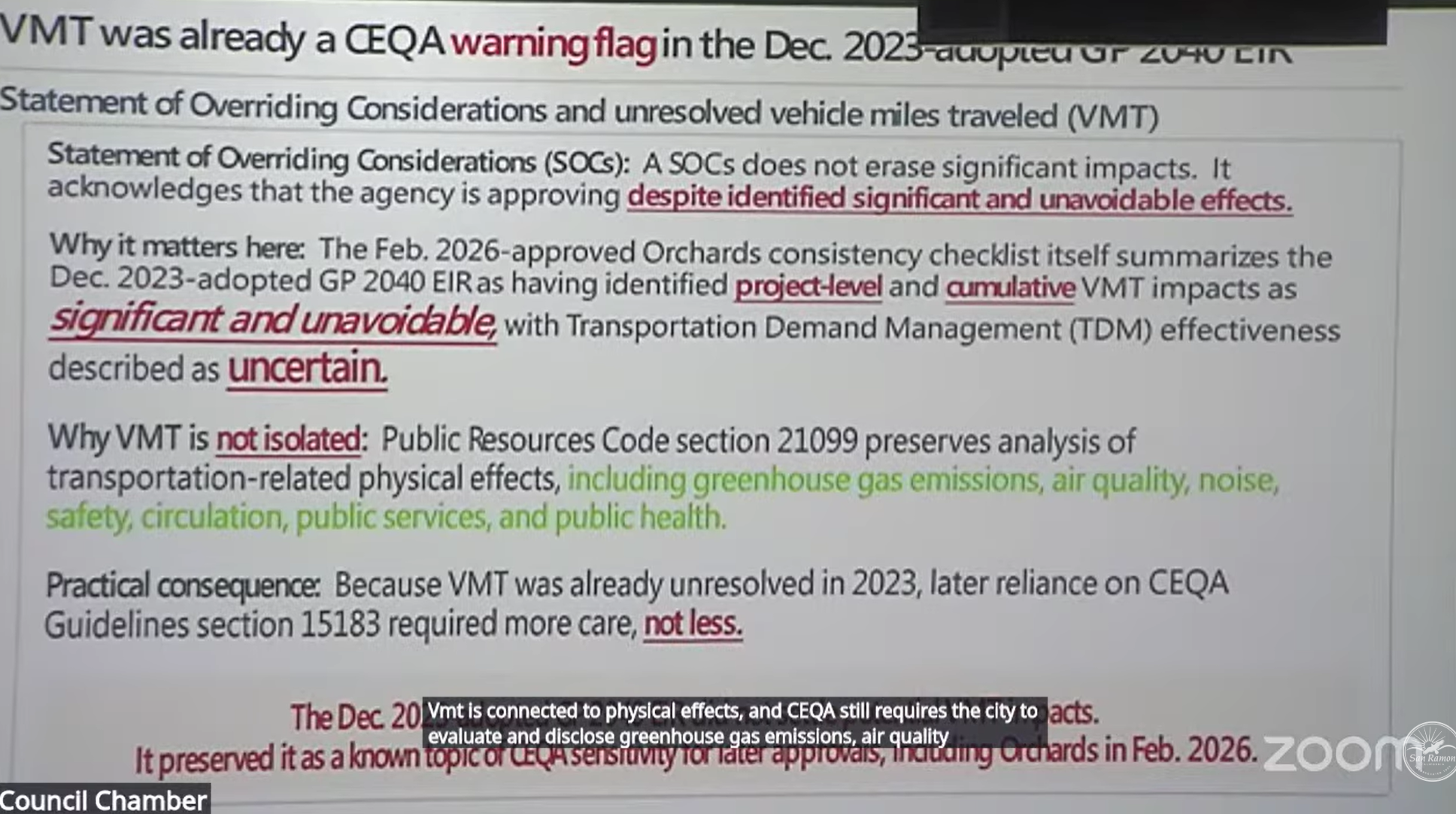
Photo Credit: YouTube / Brian Swanson / City of San Ramon
He goes on to include that CEQA still requires the city to analyze, document, and disclose environmental factors such as projected pollution, noise, public services, and other related effects, as well as why no further review was sought during the approval process.
Swanson’s appeal presentation also included the questioning of CEQA approval of so many ongoing and near future projects near the Orchards project site, and why a cumulative study did not address the impacts of all the combined current and future projects over the coming decades.
“Even if the physical baseline is fixed, the section 15183 inquiry still asks whether the record evaluated today's offsite and cumulative setting” he says, stating that the record should reflect any effects that changes made later than the 2023 study suggests.
His concern highlights both transparency and accountability by the current council, stating, “If the city is approving a long-term framework now while deferring some district details later, the record must clearly show what was evaluated and why no further review was warranted.”
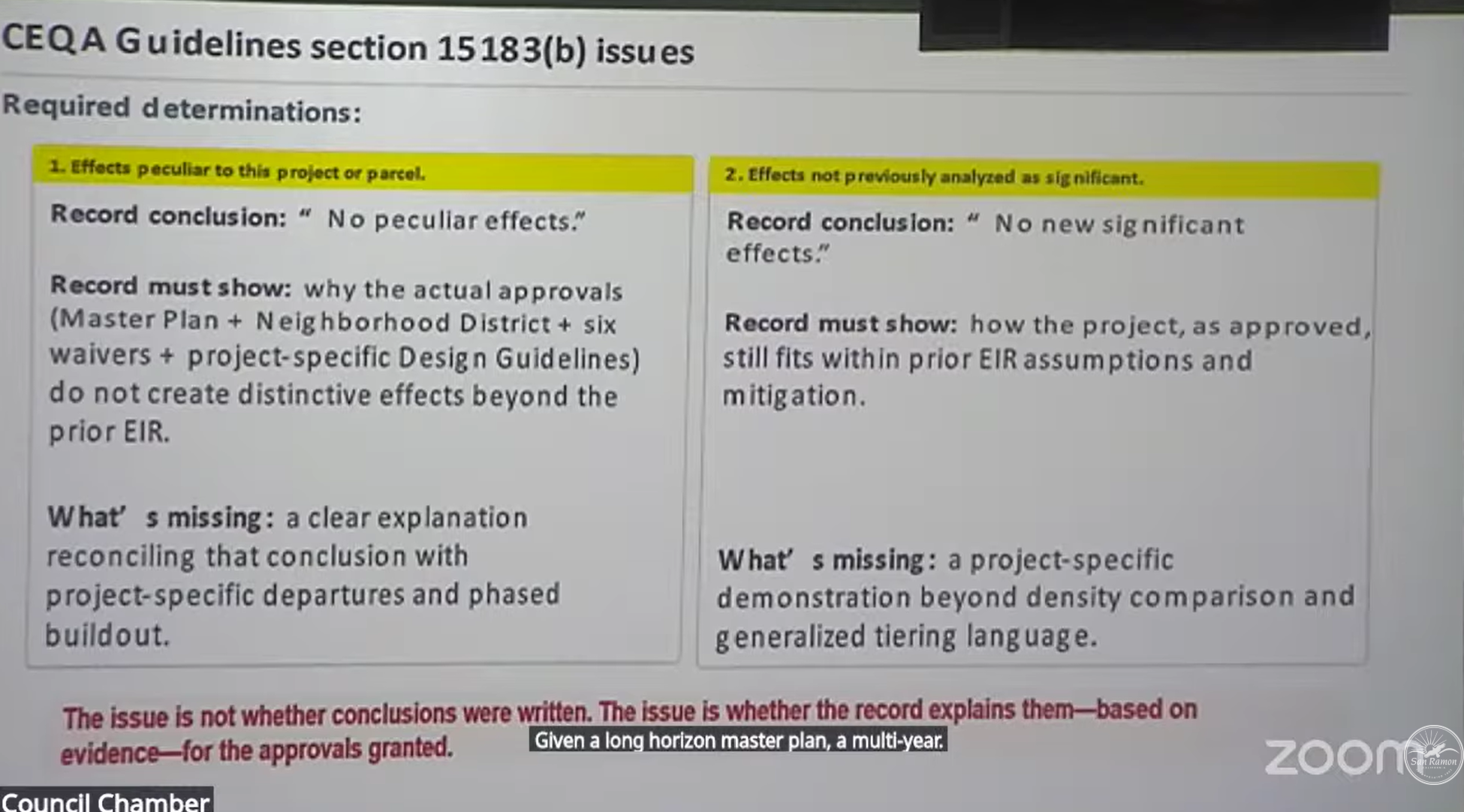
Photo Credit: YouTube / Brian Swanson / City of San Ramon
Councilman Robert Jweinat became very heated, standing up at one point and throwing stacks of documents on the desk, shouting back and forth with Swanson.
Orchards Applicant Representative Stephanie Hill presented her slideshow including the benefits of the current development plans, but addressed none of the eight points from Swanson’s presentation.
Vice Mayor Rubio engaged with Hill to discuss the purported benefits of the development, but did not ask questions pertaining to Swanson’s presentation; nor did any of the other councilmembers.
After the presentation by Swanson was given, Mayor Mark Armstrong opened the floor to public comments. Many residents took to the mic to raise their concerns.
Our very own OpGov.News reporter Angela Underwood first published an article back on Dec. 17, 2025 on the proposed Orchard Development, and how at that meeting, residents voiced their concerns against the project. “Residents oppose development, elected officials don’t care, and before you know it, construction signs line the streets,” Underwood reports.
Former Mayor Greg Carr spoke first addressing how the appeal “had eight points…I would like to see us go back to that, address each of the eight appeal points.”
Those eight points were addressed in the meeting agenda, but not revisited during the meeting itself.
Bollinger resident Kirsten Dunatov stepped up to the mic for the first time, extremely concerned about the traffic issues this development will cause.
“Traffic is terrible already and I can’t imagine what’s going to happen when all this housing comes in.” Dunatov ends by saying, “It just seems like we raise issues and nobody listens to us.”
Three more speakers expressed their support for Swanson’s appeal and reiterated their concerns, while others expressed their support for denial of the appeal.
After public comments closed, Mayor Armstrong went on to repeat everything that was already stated by the Planning Commission: “I am inclined to support the Planning Commission’s decision and deny the appeal.”
Once the public hearing was closed, Swanson was allowed a short time to provide any rebuttal.
“What you've done here is created an appeal cost moat, a financial moat, and have allowed Sunset to implement its development program fast and furious without any regard to CEQA.” he says, following up on his previous statements.
After two members of the council spoke on the conclusion that Swanson did not provide enough evidence to support his claims of lack of proper studies and transparency alongside other crucial missing factors, Council Member Adler states that they must have a basis for denying the project.
“We can't just say if we were to deny it that there is a basis to deny it, but [we] must also find that there is no reasonable basis for approval. (...) It's a much higher threshold for denial than the traditional rational basis has previously applied to for other projects in the past,” Adler says.
Vice Mayor Rubio spoke on the general consensus of the council, but also addressed her concerns with the lack of young people in San Ramon, which may impact future workforce and population growth.
As it stands, the Orchards project qualifies for a density bonus, as at least 15% of its projected housing units are deed-restricted to qualify as affordable housing.
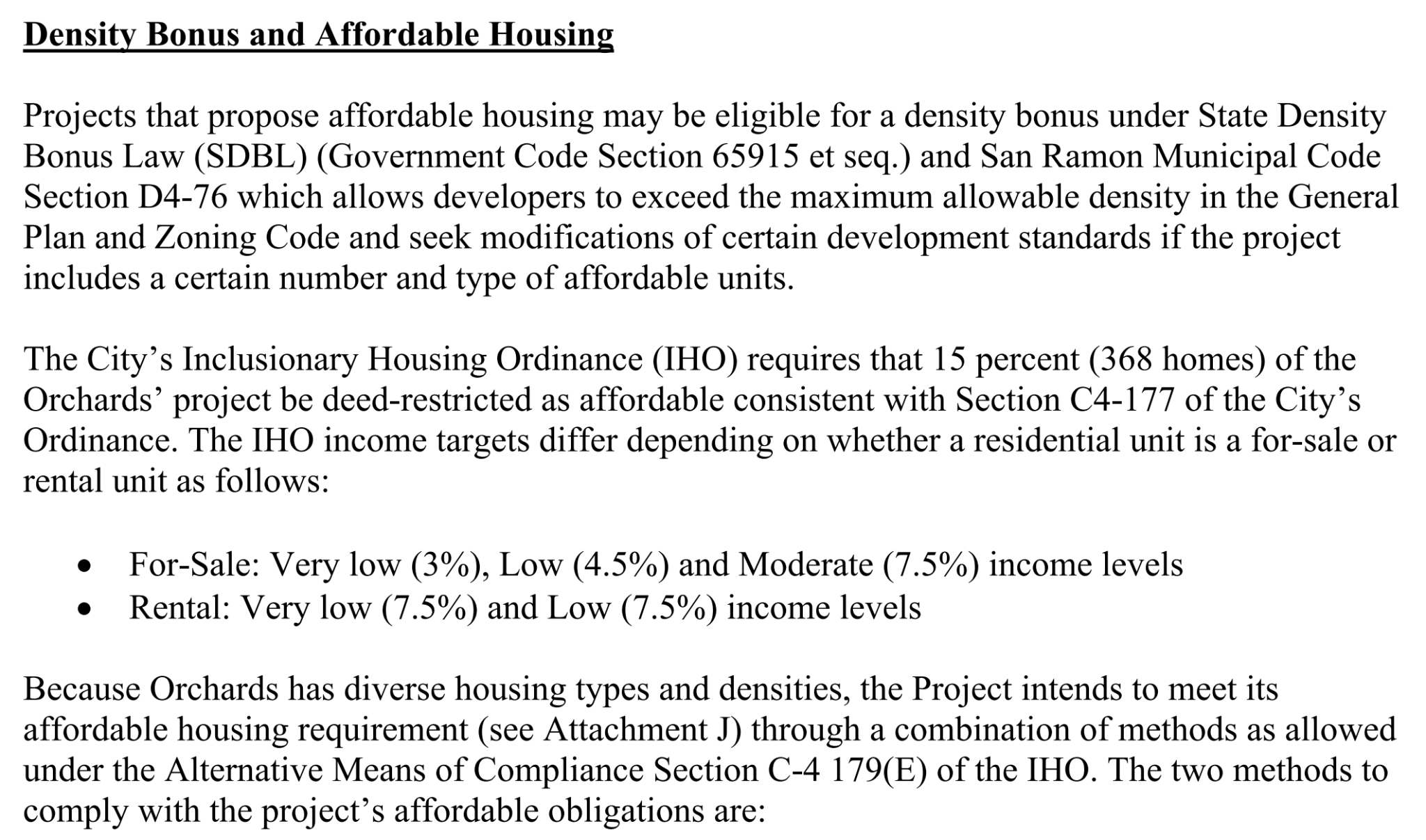
Photo Credit: City of San Ramon
Adler states, “I guess what I'm saying is it kind of goes beyond just looking at it as housing. We really have to look at the greater impacts and as was mentioned in terms of utilities, everything has to go through sort of a screening process.”
Though council members state their concerns with denial of the project altogether, none addressed the specific concerns Swanson had in terms of whether current studies reflected more recent changes, and how that may affect the city and its residents going forward.
Councilmember Jweinat acknowledged the effort Swanson put into his appeal, but regressed with a blanket statement that countered Swanson’s original goal: for more data, more transparency, and more due diligence.
“(...) My takeaway was, ‘We don’t want housing,’” says Jweinat, “So, Mayor, I agree with you. I don’t think there’s enough sufficient evidence here to warrant approving the appeal.”
All council members decide that there is not enough evidence given by the appellant and the resolution was with the motion unanimously passing to deny the appeal filed by Swanson.
The city’s summary on the appeal, available in the agenda for this special meeting, states that a denial was recommended before the appeal took place.
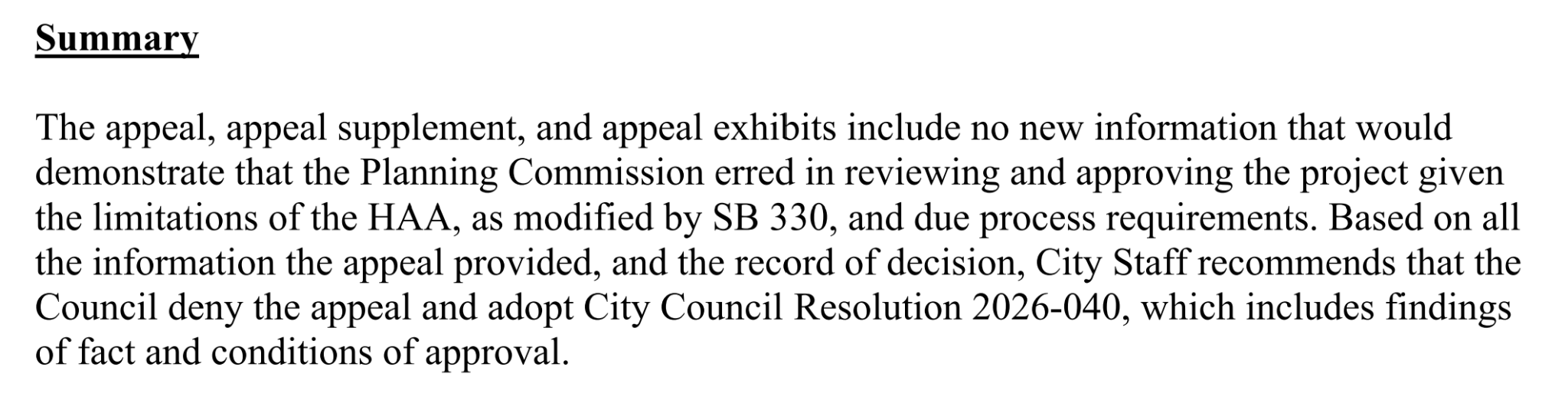
Photo Credit: City of San Ramon
I was able to reach out to Swanson via email and attached to this article is a screenshot of what he shared exclusively with me.
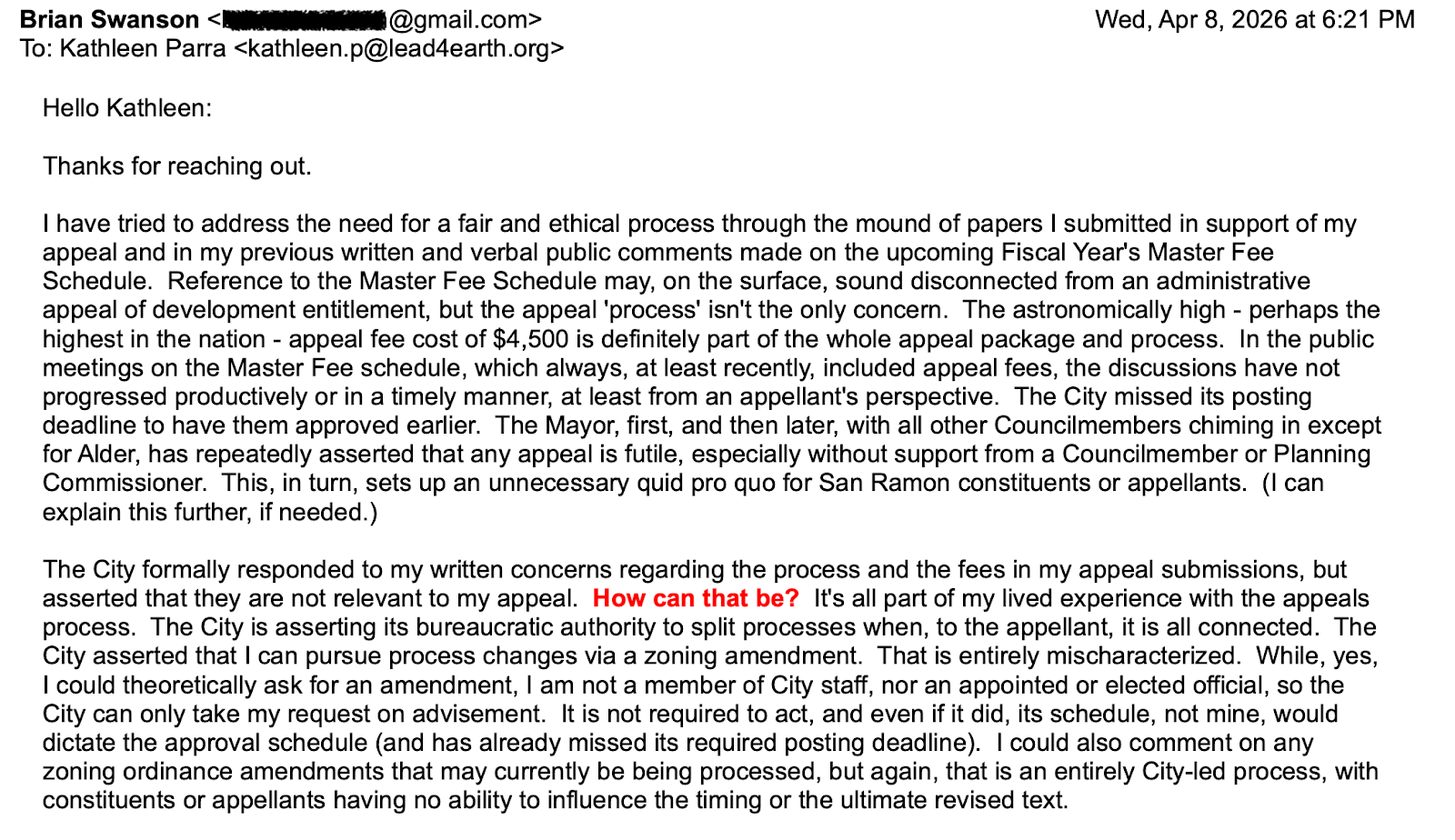
Photo Credit: Screenshot of email Swanson shared with me
“I've addressed all the issues and provided the required details. Council members chose not to read or comprehend what was written, any parts of my presentation, or the accompanying slide deck.” One line in particular that stood out was the fact that he admitted, “I was not surprised by the unanimous decision to deny my appeal.”
Even though the appeal was denied, Swanson says he will not let this set him back. He personally shared with me his submitted written public comment to be read during the Architectural Review Board Meeting on Apr. 9. Updates to be added when that meeting concludes and how the public reacts to these ongoing discussions.
If you have any comments or questions, please email me at kathleen.p@lead4earth.org or comment below.
0
0

Comments