(SAN RAMON) -- After cancelling numerous Open Space Advisory Committee (OSAC) meetings in a row, the Planning Commission here has the authority to post a last-minute special meeting on Monday.
Leave it to San Ramon to hold an 11th-hour meeting right before Christmas, making it inconvenient for residents to attend amid the holiday hustle and bustle.
Will be held at
San Ramon Community Center
12501 Alcosta Blvd. at 4:00 PM
That is just a concern among many for Bob Peoples, OSAC board member.
During a recent Zoom meeting with OpGov reporters and OSAC Chair Bob Peoples described the committee’s role as protective but collaborative, focused on long-term stewardship rather than short-term disputes.
The conversation focused on land protection, Measure G, and the future role of the committee, but Peoples repeatedly returned to one point: preserving open space in San Ramon requires collaboration.
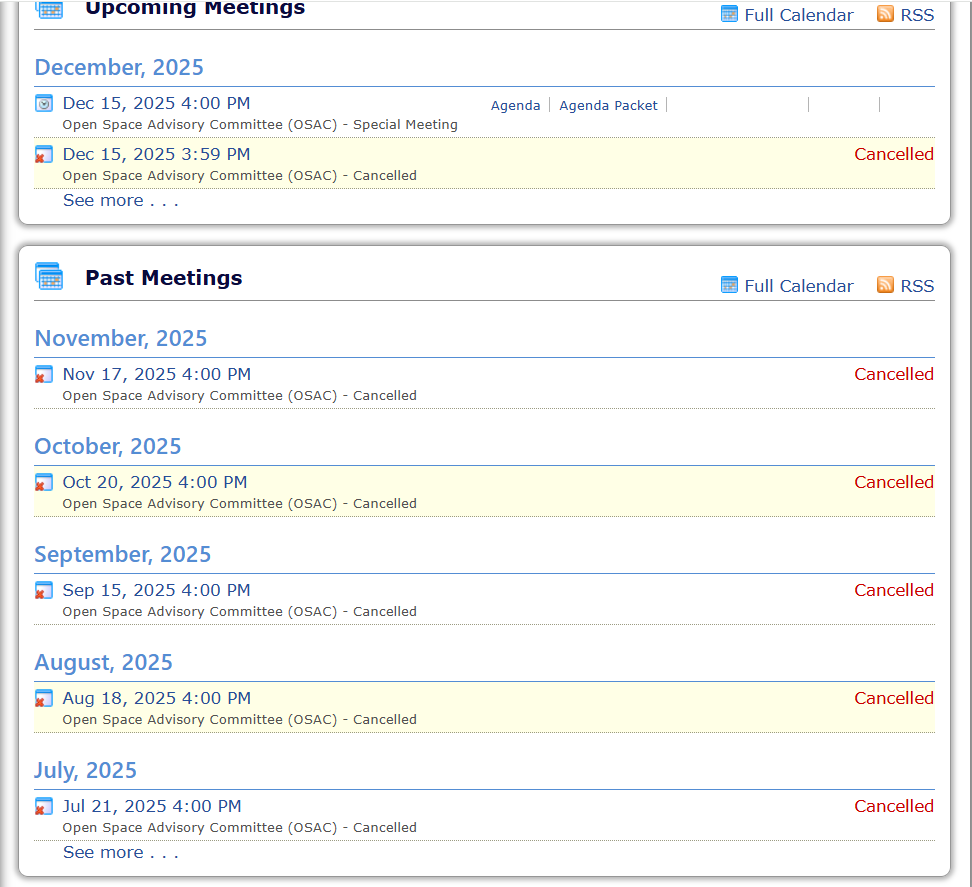
San Ramon Open Space Advisory Committee showing one cancelled meeting after another in the last few months (Photo: San Ramon website)
Much of that experience, city officials say, is shaped by policies and protections quietly guided by the Open Space Advisory Committee (OSAC).
The volunteer advisory body, known as OSAC, works behind the scenes to help the city preserve open land, maintain wildlife corridors, and ensure that growth does not erase the outdoor spaces residents value most.
“The committee has come to see the city planning staff… and the work that they do as partners in trying to protect open space,” Peoples said.
Peoples, who joined OSAC in 2021 and has served as chair for about three years, described the committee as relatively young compared with other city advisory bodies, but one that is building on decades of prior policy and voter action. Measure G, passed in 1999, established strong protections for ridgelines and open space, setting the framework OSAC now advises on.
“Anything that we’ve done is building on a lot of those efforts,” Peoples said. “Land protection is a very, very long-term game. It’s not something that’s one and done.”
For Peoples, that long-term view means maintaining working relationships with developers and landowners, even when priorities differ. He said many of San Ramon’s protected lands exist today because development projects were paired with negotiated conservation outcomes.
“That’s historically been the way we have acquired a lot of this land that’s already protected,” Peoples said, pointing to past arrangements that resulted in land being donated to East Bay Regional Park District or otherwise permanently preserved.
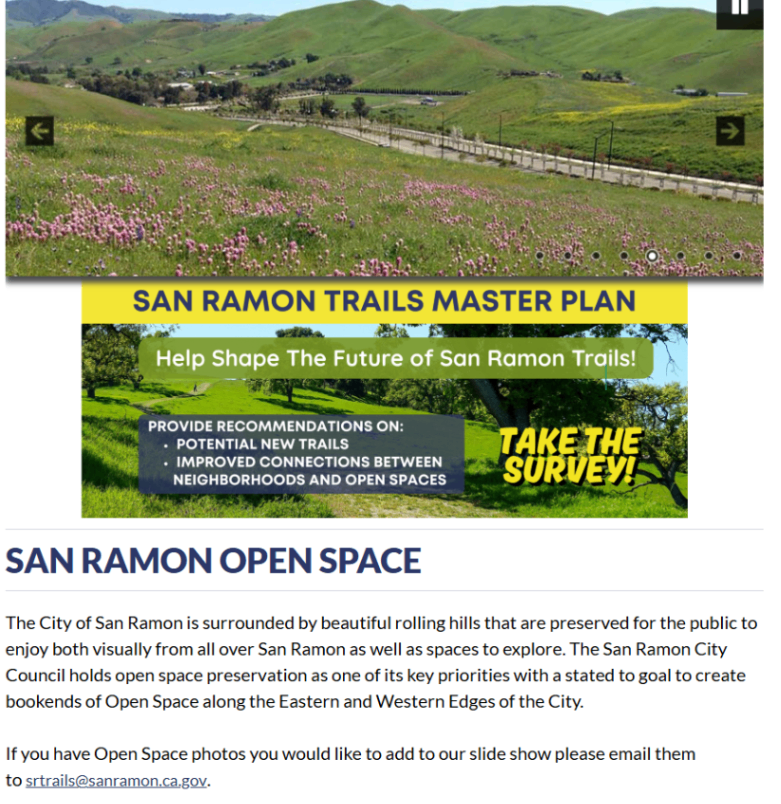
(Photo: San Ramon Open Space Advisory Committee government website)
The committee’s approach, he said, is advisory rather than ideological. OSAC does not oppose development outright, nor does it take a position on who owns land, public or private, as long as open space remains protected.
“One of the key things in that document is that it makes the case that we really don’t care who owns the open space as long as it’s maintained as open space,” Peoples said, referring to the committee’s 2022 vision document submitted to the City Council.
That perspective matters as San Ramon faces housing pressures and ongoing General Plan updates. Peoples acknowledged the tension but said framing the issue as a battle between development and conservation misses the reality of how decisions are made.
“There isn’t animosity; there’s urgency,” Peoples said. “And urgency doesn’t mean hostility.”
OSAC’s work often happens behind the scenes, reviewing parcels contiguous to city boundaries, assessing wildfire risk in open space, and coordinating with regional partners. The committee also organizes public hikes and educational events, which Peoples said help demystify land-use issues and keep discussions grounded.
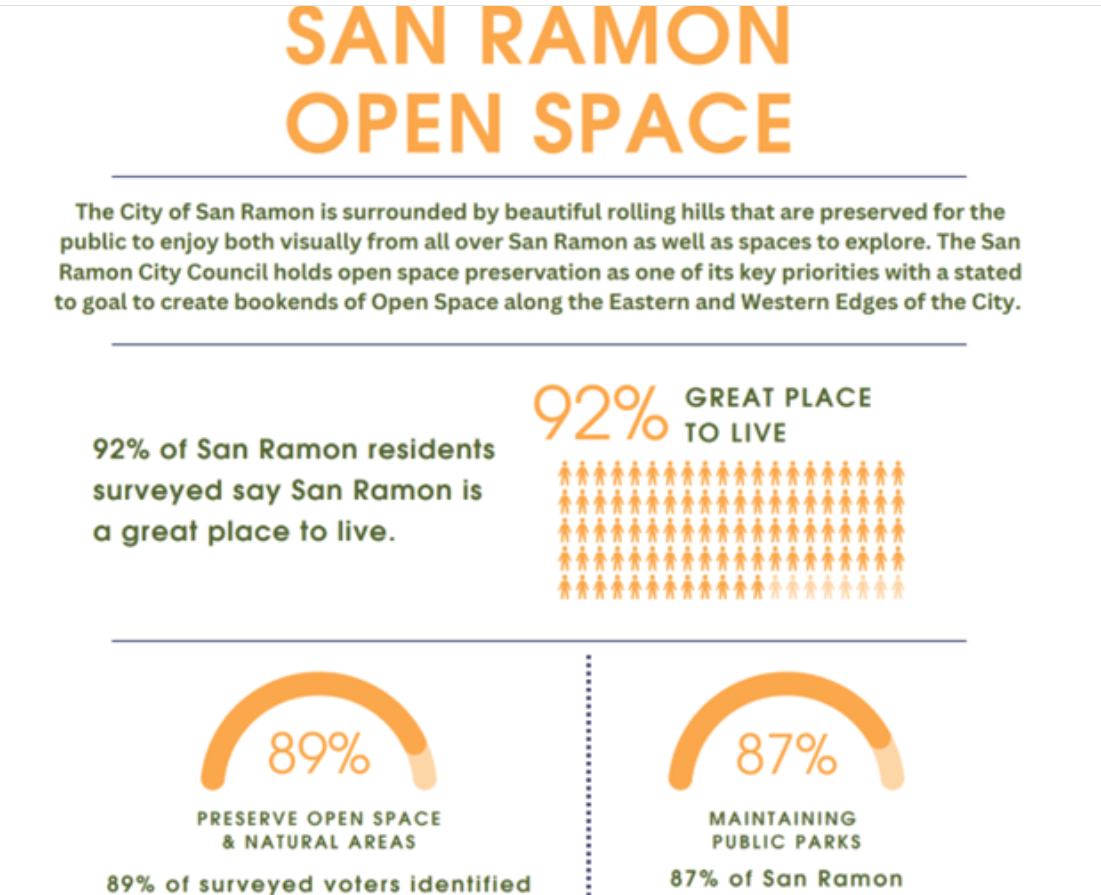
(Photo: San Ramon Open Space Advisory Committee government website)
“We lead hikes, host events and keep the conversation civil,” he said. “That trust matters.”
The committee’s collaborative posture aligns with broader national guidance on citizen advisory bodies. The National League of Cities notes that advisory committees are most effective when they engage early with stakeholders and focus on problem-solving rather than opposition, particularly on land-use and housing issues.
Peoples also pointed to emerging tools that could help bridge gaps between economic development and conservation. He referenced the concept of “natural capital,” developed by researchers at Stanford University’s Natural Capital Project, which assigns measurable economic value to ecosystem services such as flood control, recreation, and wildfire mitigation.
“It’s a powerful tool,” Peoples said. “It gives decision-makers another way to understand what open space is actually providing.”
The Natural Capital Project has promoted these methods nationally as a way for governments to better integrate nature into planning and budgeting decisions, particularly in fast-growing communities.

VIA: Science Direct
Concerns raised during the meeting were not limited to development. Peoples mentioned that OSAC meetings were canceled multiple times in 2025 making it hard to keep up with the ongoing development, even as the committee’s annual work plan remained active. He also questioned recent changes to how Measure G is being interpreted.
“It’s in the realm of advice,” Peoples said of OSAC’s role. “But we can bring it to the attention of the city, because it is such a powerful tool.”
Despite those concerns, Peoples said the committee’s goal is to remain constructive and relevant, not combative. Folding OSAC into a broader sustainability committee, he argued, could dilute its focus and reduce meaningful public engagement at a time when land-use decisions are becoming more complex.
As San Ramon continues to grow, Peoples said the city’s success will depend on its ability to balance housing needs, development interests and long-term open space protection, a balance that requires dialogue, not division.
“You don’t protect land in isolation,” he said. “You protect it by working with everyone who has a stake in it.”
The agenda packet for the special meeting is vague to say the least, leaving many questions as usual when it comes to San Ramon government matters.
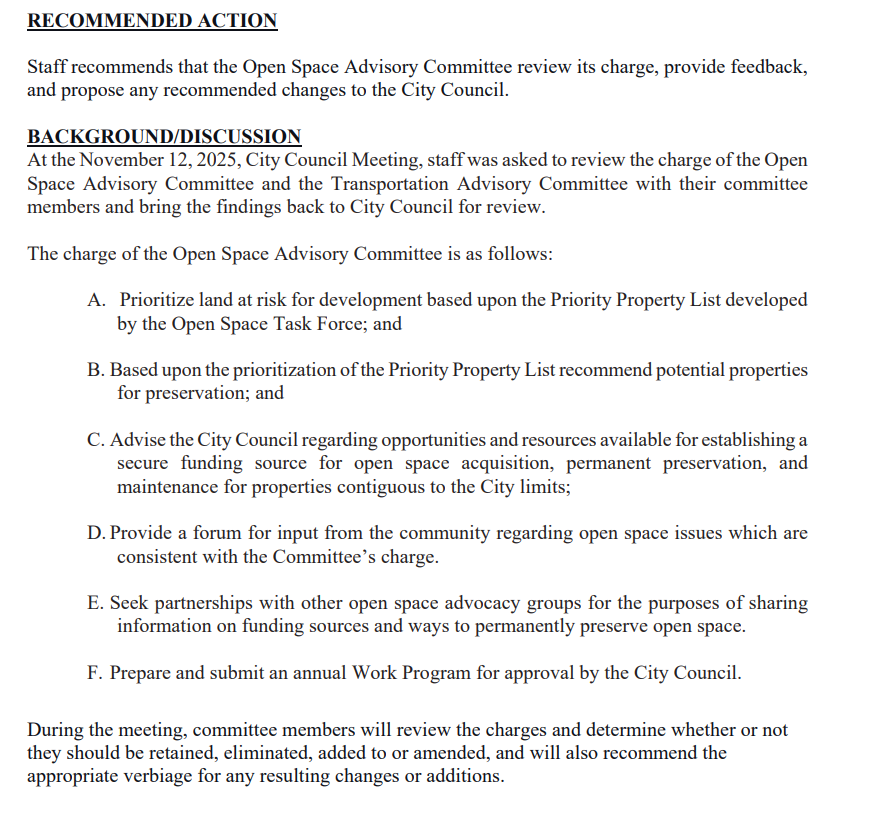
Agenda packet for Monday, Dec. 15 meeting
Any San Ramon resident concerned about the future of open space here is encouraged to attend the meeting at the San Ramon Community Center, 12501 Alcosta Blvd. Terrace Room at 4 p.m.
For any comments reach out to: ananya.s@lead4earth.org.

Comments