SAN RAMON, Calif. — San Ramon's updated Bicycle Master Plan calls for approximately 30 miles of bike lanes physically separated from vehicle traffic, a type of bikeway the city does not currently have. The City Council unanimously adopted the plan Oct. 13 in a 5-0 vote.
The Bicycle Master Plan update, prepared with consulting firm Fehr & Peers, revises the city's original 2018 plan. Adoption does not authorize or fund construction. Instead, the plan establishes long-term priorities to guide future street improvements and grant applications.
The biggest change reflects updated federal and state roadway design guidance. That guidance generally recommends separating bicyclists from vehicle traffic on roads where speeds are 35 mph or higher or traffic volumes exceed approximately 6,000 vehicles per day.
Those conditions apply to many of San Ramon's major streets. As a result, the updated plan prioritizes physically separated bike lanes, known as Class IV facilities, and off-street paths over conventional painted bike lanes.
San Ramon currently has approximately 72 miles of bikeways, including off-street paths such as the Iron Horse Trail, standard bike lanes, buffered bike lanes, and signed bike routes.
If fully implemented, the plan would expand the network to approximately 80 miles. Of that total, 30 miles would consist of separated bike lanes, while another 8.4 miles would be
designated for either separated lanes or shared-use paths. The mileage of conventional painted lanes would decrease as existing facilities are upgraded.
Proposed locations for separated bike lanes include Windemere Parkway and East Branch Parkway in Dougherty Valley, along with Fostoria Way across Interstate 680.
Sections of Alcosta Boulevard and Bollinger Canyon Road are also identified for potential upgrades to protected bike lanes or shared-use paths.
The plan notes that some improvements will require additional studies to determine available roadway space, design feasibility, construction costs and funding.
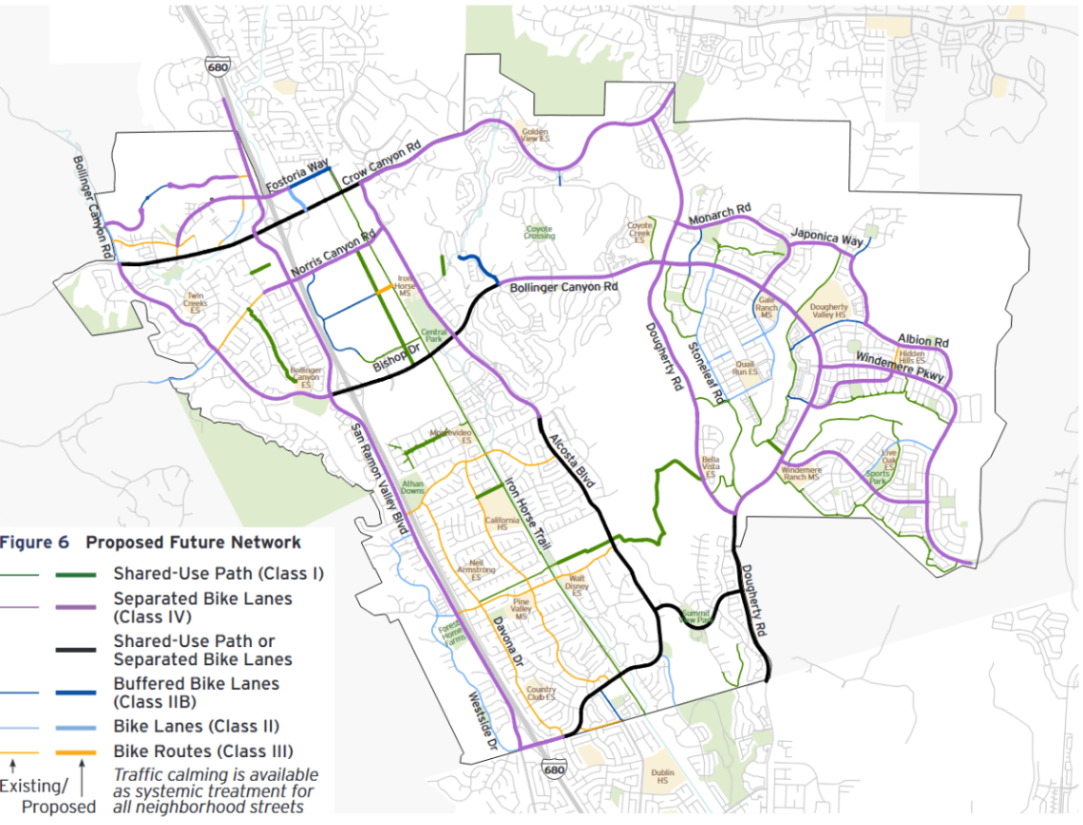
Image credit: City of San Ramon Bicycle Master Plan Update
According to the plan, many improvements could be completed without removing existing parking or vehicle travel lanes, although additional study would be needed.
On streets with existing buffered bike lanes, for example, painted buffer areas could be replaced with concrete curbs or landscaping to provide physical separation between bicyclists and vehicles.
The plan does not propose new signed bike routes. Instead, it recommends traffic-calming measures on neighborhood streets, consistent with the city's goal of maintaining 25 mph speed limits and low traffic volumes on local residential roads.
Construction costs could be substantial.
The plan's preliminary estimates, expressed in 2026 dollars, place separated bike lanes at approximately $1.3 million per mile and off-street paths at approximately $5.1 million per mile. Standard painted bike lanes are estimated at $280,000 per mile.
Reconstructing a four-way intersection with protected corners is estimated to cost approximately $1.5 million.
At those rates, constructing 30 miles of separated bike lanes alone would cost roughly $39 million, excluding intersection improvements, land acquisition and ongoing maintenance.
City staff reported that adopting the plan would have no immediate impact on the city's general fund.
For future construction, the plan identifies potential outside funding sources, including federal transportation safety and air-quality grants and California's Active Transportation Program.
It also notes that competition for state funding has increased as available resources have declined.
The city collected community feedback through an online map and survey that received approximately 250 responses in 2024. Additional outreach took place at community events, including the Art and Wind Festival.
The city's Transportation Advisory Committee recommended the updated plan in September 2025.
The next step is funding consideration. City staff will submit the proposed bicycle project list for review as part of the city's fiscal 2026-31 five-year Capital Improvement Program.
Individual projects would still require further review, approval and funding before construction could begin.
For corrections or additional information about this report: leave a comment below.
0
0

Comments