SALT LAKE CITY -- The Salt Lake City Council’s October 21 formal session consisted of administrative approvals, policy discussion and moments of deep frustration from residents confronting the city’s zoning and development challenges.
The meeting opened on a positive note, as Mayor Erin Mendenhall and the Council adopted a resolution recognizing October as Italian-American Heritage Month.
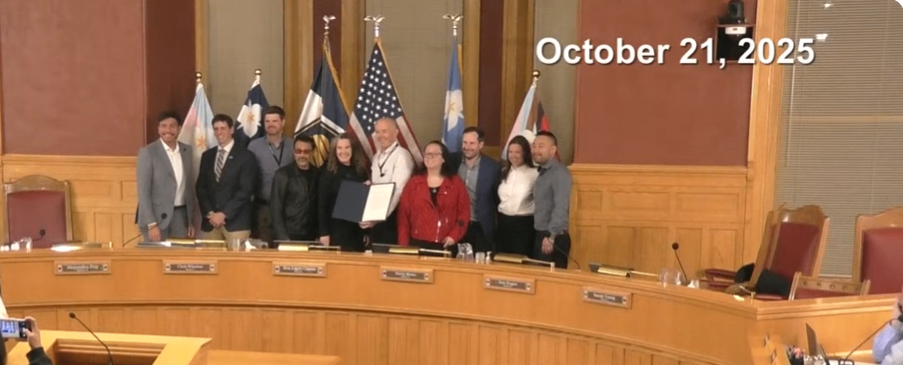
Salt Lake City Officials proclaim October Italian-American Heritage Month
After that, the Council moved several grant applications, covering outdoor recreation, law enforcement, cybersecurity, and the Jordan River restoration, to a future agenda. Jeff Olsen, chair of the Fair Park community council, in particular, supports these grant applications, advocating for more “green space” throughout a constantly developing urban environment.
“This would provide green space for the people in these buildings," Olsen said about apartment complexes throughout the city.
The council adopted an ordinance proposed by Policy Analyst Brian Fulmer, modifying the residential buffer prohibition text amendment. The planning committee initiated the proposal to review land uses prohibited within 1,000 feet of residential districts.
Discussions began with a proposed utility installation exemptions amendment ordinance, intended to ease restrictions on utility projects and standardize language across land-use tables. Public comments from resident Cindy Cromer prompted the Council to delay the vote. Cromer mentioned the need for clearer design guidelines and more public involvement for projects in parks.
Cromer’s testimony emphasized past instances where community input prevented wasteful spending and protected green spaces.
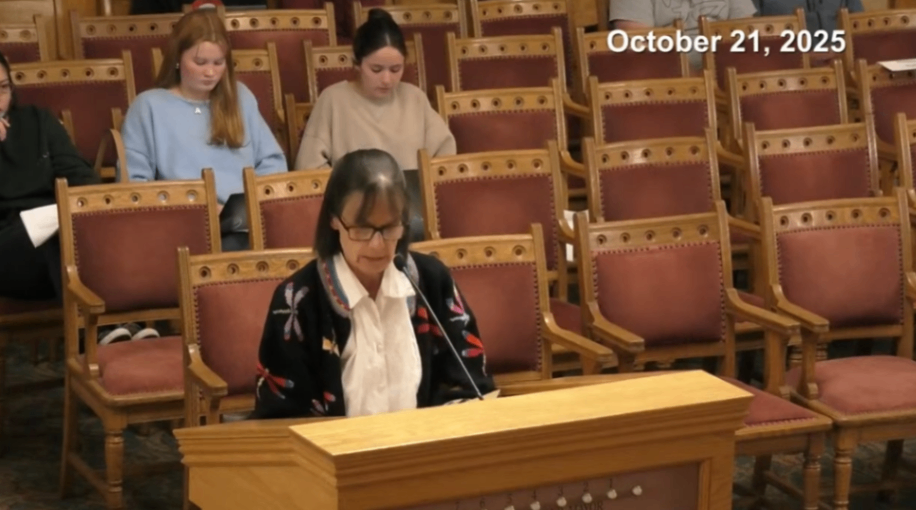
Resident Cindy Comer shares concerns regarding zoning density at the Oct. 21 meeting
Comer said she barely made it out of the last rezoning three decades ago.
“Speaking as an owner of five properties in the RMF35 zone and a 'survivor' of the 1995 zoning rewrite, Cindy Cromer argued against the common perception that RMF zones were anti-density,” the OpGov.ai platform reports.
Brian Fulmer presented an ordinance for a Patriot Rail street vacation near 6500 West on the eastbound side of I-80. The plan would vacate the undeveloped public right-of-way, allowing Patriot Rail to assume ownership of the land adjacent to the freeway.
Council Member Darin Mano, who governs District 5, spoke in strong support of this ordinance. After Michael Sanders, council policy analyst, presented a Budget Amendment for fiscal year 2025-26, consisting of 34 proposed changes totaling over $71 million in revenues and $137 million in expenditures.
Council Member Chris Wharton highlighted the city's efforts to support federal partners at the airport affected by the government shutdown, including assisting with food and other expenses as they work without pay.
The motion passed unanimously.
After, the most controversial decision of the night involved a partial street vacation request for a single-family residence at 1101 West 400 South. Council Members Victoria Petro and Sarah Young dissented, expressing concern that rigid zoning rules and slow reform were unfairly stalling small-scale development, especially on the west side.
Young said about the motion, "So, this one is so challenging because there didn't really seem to be a mechanism by which we could create a solution around the 400 South side of the street segment."
However, she ended with an optimistic tone for future discussions, saying, "Now, I know that we have future policy conversations coming that should open up some additional efforts, but noting that we hope to continue the conversation to reach that space in the future."
Public comments further reveal residents' frustration with inaccessible council members and a lack of code enforcement. Petitioner Eric Sansom for 1101 West, who spent three years navigating city processes to build a modest home, saw his request partially denied in a 4–2 vote, with one absent.
Sansom addressed the council, expressing his frustration with the three-year entitlement process to develop his own home. Sansom emphasized the difficulty in contacting council members for a meeting, as well as pursuing other administrative processes without success.
Millcreek resident Josh Sherman described a tow-truck business operating illegally in a residential area for over a year, despite repeated complaints to city departments, saying his neighborhood has been "significantly impacted" by adjacent property, which is operating a tow truck company out of a rental home.
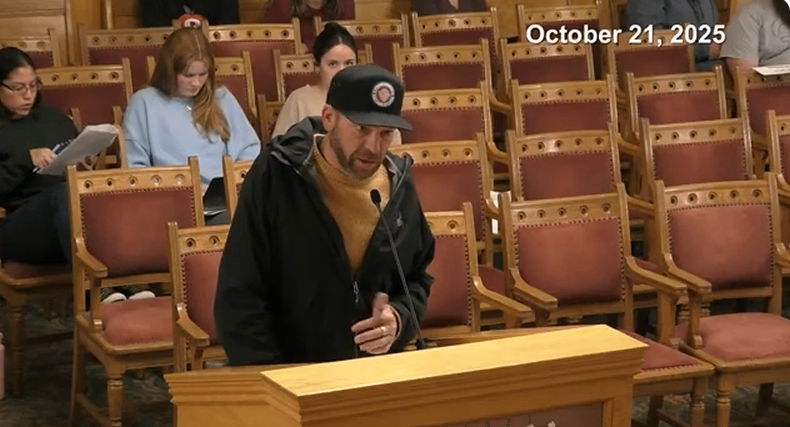
Jason Sherman says city fails to stop a tow truck company operating out of a rental home in his neighborhood
"The issue persists to this day," Sherman said of the matter not resolved through ordinance or other processes.
, and Annie Isacson expressed gratitude to council members for their help in achieving landmark status for her historic building.
Jason Seaton, commenting on the "4 South project," criticized the city's variance process, claiming it's set up "against variances" despite being a legal tool, explaining his project aimed to align the front of their building with the existing structures on 400 South, rather than acquiring additional land.
Seaton said he spent thousands of dollars and nearly three years on the process, only to be frustrated. Despite tension in public testimony, elected officials moved forward with unanimous approval of several key items, including the Salt Lake County Hazard Mitigation Plan, which includes information such as demographics, a hazard profile, and identified necessary/potential mitigation projects to minimize damage and loss of life.
They also approved the Salt Lake Central Housing and Transit Reinvestment Zone Interlocal Agreement, which outlines the participating taxing entities, tax increment participation rates, the term of tax increment collection, and the planned utilization of tax increment funds in the project area. A $40,000 Economic Development Loan Fund award to Rich's Burgers N Grub, helping create two to four new jobs in the next year and retain eight current jobs.
The meeting closed with plans to revisit the stalled utility exemptions ordinance and zoning text amendments at the next session on Nov. 18, signaling ongoing efforts to reconcile policy with public concerns.
0
0

Comments