(SACRAMENTO, CA.) — Sacramento Councilmember Roger Dickinson is calling on the city to examine whether its Office of Violence Prevention should remain within the Sacramento Police Department (SPD) as residents seek greater scrutiny of grant spending and city leaders evaluate how Sacramento coordinates and measures its violence-prevention efforts.
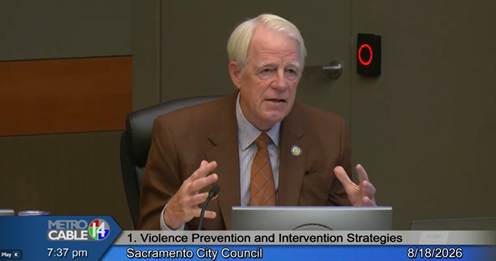
Councilmember Roger Dickinson at the Aug. 18 City Council Meeting. (Credit: Metro Cable 14 YouTube.)
During a lengthy Aug. 18 City Council discussion, Dickinson questioned whether placing the Office of Violence Prevention, or OVP, within the Police Department hampers Sacramento’s ability to build community partnerships. Other council members pressed staff about coordination, community involvement and how the city determines whether its violence-prevention investments are producing results.
“I do think that the location of the Office of Violence Prevention in the Police Department hampers that effort to bring all organizations and people who are important together,” Dickinson said.
Dickinson encouraged the city manager to examine whether OVP would be better placed elsewhere in city government, including potentially within the City Manager’s Office.
The suggestion echoed concerns raised by several violence-prevention advocates during public comment.
Shelley Hudson, who identified herself as a 25-year Sacramento Police Department employee and a violence-prevention advocate with Moms Demand Action and NorCal Gun Violence Prevention, called for an independent audit of all OVP grants and contracts.
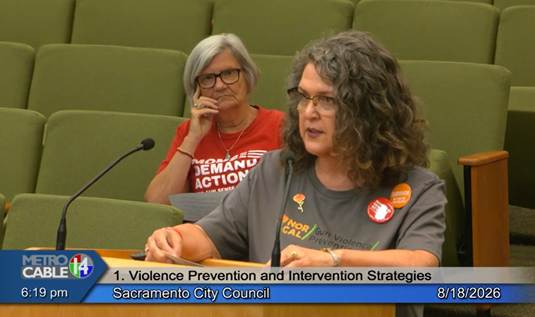
Speaker Shelley Hudson, violence-prevention advocate with Moms Demand Action and NorCal Gun Violence Prevention. (Credit: Metro Cable 14 YouTube.)
Hudson said recent reporting by The Sacramento Bee raised concerns about accountability and oversight and argued that, if the reporting is accurate, the public deserves answers.
“Accountability was not optional,” Hudson said of her years with the Police Department. “Those standards protected the integrity of the department and public trust.”
Hudson called for an independent review of financial practices and compliance requirements, with the results made public. She also urged the council to restore OVP as an independent office separate from the Police Department.
“Violence prevention is different kind of work,” Hudson said. “It depends on community relationships, credibility, trust and ability to reach young people and communities that may not view enforcement as trusted partner.”
“Violence prevention requires community trust,” Hudson added. “An independent office can better rebuild that trust.”
Cheryl Davis, who identified herself as a longtime Moms Demand Action volunteer, similarly called for greater financial scrutiny while emphasizing her support for increased public investment in violence intervention.
Davis thanked Mayor Kevin McCarty and Dickinson for supporting Assembly Bill 28, which she said increased statewide funding for violence intervention fivefold in one year. Sacramento received $5 million from that funding this year, Davis told the council.
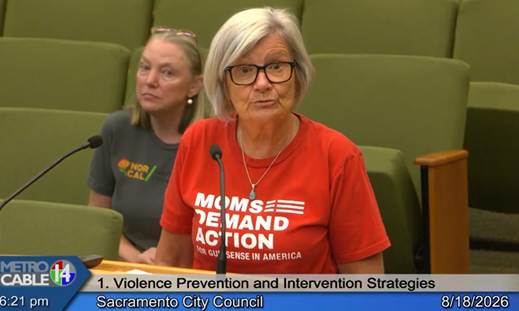
Speaker Cheryl Davis, longtime Moms Demand Action volunteer. (Credit: Metro Cable 14 YouTube.)
“Violence is preventable when treated as public health crisis, not criminal inevitabilities,” Davis said.
Davis argued that Sacramento’s earlier violence-prevention model demonstrated what community-based intervention could accomplish. She said no teenager in Sacramento was killed by homicide in 2018 or 2019, when OVP operated under the City Manager’s Office, and attributed that outcome to credible mentors, intervention teams and trauma-informed care working together.
Davis argued that moving OVP under the Police Department subsequently damaged trust with some of the young people the programs are intended to reach.
She also cited allegations raised in recent Sacramento Bee reporting about OVP-funded organizations and called for a financial and contract-compliance review.
“These are violence prevention dollars and meant to save lives,” Davis said. “I ask you [to] restore what worked.”
The allegations cited by Hudson and Davis stemmed from outside reporting and were not established as findings by the City Council during the Aug. 18 meeting.
City officials, however, defended Sacramento’s existing oversight of violence-prevention grants.
Dr. Nicole Clavo with the Office of Violence Prevention described multiple layers of financial review before reimbursements are approved. According to Clavo, supporting documentation is reviewed within OVP before going through additional scrutiny by the city’s Finance Department.
Clavo described a system in which invoices and supporting documentation are checked before payments are approved.
When asked whether she was confident that grantees had complied with the contractual terms of their grants, Clavo said she had a “very high degree of confidence.”
Staff also outlined requirements for organizations seeking city funding, including nonprofit status, state good-standing checks, insurance requirements and verification that organizations are registered city suppliers. Proposals undergo panel review and scoring before funding recommendations are made.
Vice Mayor Karina Talamantes focused on another accountability question: whether city departments are coordinating when they fund community organizations.
Talamantes asked how often OVP works with the city’s Youth, Parks and Community Enrichment Department, or YPCE, on existing programs.
Clavo said she has reached out to determine whether the departments are funding the same organizations and, if so, what each organization is receiving money to provide.
“Just to see what we are funding each organization for to make sure that we have that accountability practice,” Clavo said.
YPCE staff said the departments communicate through programs including Sac Town Nights and the Sacramento Children’s Fund, where violence prevention is one of the goals, but acknowledged there is room for improvement.
“We could improve collaboration,” a YPCE representative told the council.
Talamantes also praised YPCE’s reporting of demographic information about program participants and asked OVP to provide similar information. Clavo responded that OVP collects demographic data, including participants’ ages and ethnicities, in its complete reports.
Talamantes then asked Clavo to explain her vision for the office’s next steps, including what service levels it hopes to reach.
Clavo said she would like to see paid and unpaid community organizations work more collaboratively across the city and expand the services and training available to community-based organizations.
The city is also conducting a broader examination of how Sacramento approaches violence prevention.
Amy Williams, chief of staff to the city manager, told council members that the City Manager’s Office, OVP and YPCE have been working with an outside consultant since early this year to develop a community violence-reduction strategy.
Williams said the consultant was selected through a competitive process and specializes in this type of analysis, data and research across the country. The approximately nine-month process is expected to conclude this fall.
The work began with a baseline assessment that included a comprehensive document review, site visits, examination of existing programs and interviews with internal and external stakeholders, Williams said.
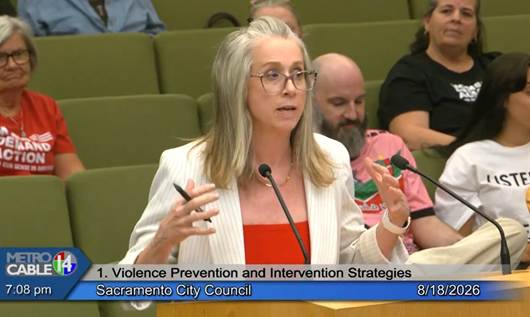
Speaker Amy Williams, chief of staff to the city manager. (Credit: Metro Cable 14 YouTube.)
“We wanted to know comprehensively what are we doing, how to tell the story, how to do this better, where are gaps?” Williams said.
The consultant has since moved into what Williams described as a landscape analysis, comparing Sacramento’s existing efforts with evidence-informed models and practices used elsewhere in the country.
“They are looking at opportunities to strengthen alignments and point out gaps,” Williams said.
Williams said two deliverables have already been provided to the city, with a final strategic action plan expected this fall.
“I think we will end up with something very concrete, something time bound and with steps,” Williams said. “We see opportunity to do better.”
Councilmember Mai Vang welcomed the update but questioned whether community organizations doing violence-prevention work were sufficiently involved in developing the strategy.
Vang said she wanted to ensure community stakeholders and grantees experienced in the work were helping shape the plan rather than being presented with a strategy after it was developed.
“Without making sure [it’s] informed by community, I am worried [about] a plan not bought by the community,” Vang said. “I hope this consultant is working with stakeholders developing this strategy plan. That is crucial.”
Williams responded that the consultant’s review extends beyond OVP and YPCE. She said approximately 35 city staff members were interviewed to examine how other departments, including transportation and fire, intersect with the city’s youth and violence-prevention work. Current community-based organizations were also interviewed.
“I know how important this is,” Vang said. “We want to do this right and get good data and good choices.”
But Dickinson raised another fundamental question about Sacramento’s investments: How does the city determine whether violence-prevention programs actually cause violence or crime to decline?
Dickinson pointed to a Friday-night arts and basketball program in North Highlands that coincided with a decline in juvenile crime on Friday nights.
“Did that program mean there was a causal connection to that? I don’t know for sure,” Dickinson said.
Dickinson then asked how the city plans to measure the success of Measure L-funded programs, particularly those focused on youth violence prevention.
The questions come as millions of dollars flow into Sacramento’s violence-prevention efforts.
Davis told the council Sacramento received $5 million this year through increased statewide violence-intervention funding.
Clavo separately explained during the presentation that approximately $2.175 million represents annual funded investment associated with the city’s violence-prevention efforts, while a separate $5 million award is restricted, multiyear funding and should not be viewed as part of OVP’s regular annual operating budget.
OpGov.News reports despite calls for greater scrutiny and Dickinson’s suggestion that the city examine OVP’s placement within the Police Department, the council did not vote to move the office or order an independent financial audit.
(Credit: Metro Cable 14 YouTube.)
The Aug. 18 item was presented for the council to receive information and provide feedback. At the conclusion of the discussion, Mayor Kevin McCarty noted there would be “no vote on this topic.”
The Sacramento Office of Violence Prevention is housed within the Sacramento Police Department. For more information on the topic, review the 2026 Sacramento Police Department Violent Crime Reduction Strategy.
If you’d like to add or correct anything in this report, feel free to reach out to me or leave a comment below. Submit Sacramento tips and story ideas to Sarah Denos at sarahkdenos@gmail.com.
0
0

Comments