(SACRAMENTO, CA.) — Sacramento officials are introducing a new late-night strategy aimed at reducing violence and disorder in Old Sacramento by limiting vehicle access during the district's busiest overnight hours.
Beginning this weekend, the Sacramento Police Department will implement what officials are calling a weekend "Cooling Period," restricting most vehicle traffic into the Old Sacramento Waterfront every Friday, Saturday and Sunday beginning at 10 p.m.
According to city officials, the goal is not simply to redirect traffic but to reduce late-night cruising, vehicle congregation, and opportunities for large crowds to gather after bars and restaurants close, making the area easier for officers to monitor and respond to incidents.
The initiative was developed in partnership with the Downtown Sacramento Partnership following a recent early-morning stabbing and what officials describe as a pattern of criminal activity occurring after businesses close.
Rather than shutting down the district, the strategy is intended to reduce vehicle congestion while allowing people to continue visiting Old Sacramento on foot.
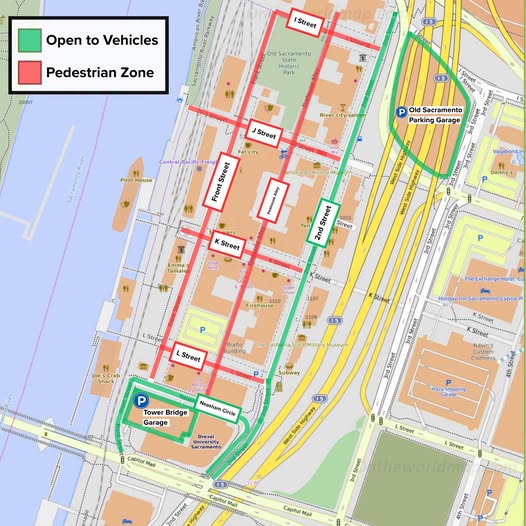
(Credit: Map of downtown Sacramento provided by Sacramento Police Department Facebook post.)
Motorists will still be able to reach 2nd Street from Capitol Mall and I Street, but vehicle access beyond 2nd Street into the waterfront will be restricted during the overnight period. The Old Sacramento Parking Garage and Tower Bridge Garage will remain open, and visitors will continue to have pedestrian access to businesses. Vehicles already parked inside the restricted area will still be allowed to leave.
"Old Sacramento Waterfront requires immediate city-backed tactics to prevent future incidents to the best of everyone's ability," said Michael Ault, executive director of the Downtown Sacramento Partnership.
Ault said similar approaches have been used successfully in entertainment districts across the country to manage crowds after businesses close.
"This safety tactic is common in successful entertainment districts across the country," Ault said. "Evolution is important to the success of Old Sacramento Waterfront, so we must adopt best practices to manage the space safely."
According to the Downtown Sacramento Partnership, many recent late-night incidents have occurred after businesses close, when people remain in the district and vehicles congregate in the area.
The new strategy also builds on a series of safety initiatives the partnership says it has implemented over the past five years, including advocating for a downtown police bike patrol hub, expanding private security, investing in connected public safety technology and improving lighting throughout downtown.
"This traffic management plan is one of several steps we're taking to improve public safety in Old Sacramento during the busiest late-night hours," Sacramento Police Department spokesperson Allison Smith said. "We want people to know this is a safe place to visit and enjoy, while sending a clear message that criminal activity and violence will not be tolerated."
Police said juvenile curfew laws will continue to be strictly enforced during the weekend operations.
Interim Police Chief Zachary Bales said the department will continue evaluating the plan and adjusting staffing and enforcement strategies as needed.
"We remain committed to working alongside residents, businesses, and community partners to address concerns, strengthen public safety, and hold those who commit crimes accountable," Bales said.
Local business owner Sean Derfield, who operates two businesses in Old Sacramento and plans to open a third, said he believes reducing nighttime vehicle traffic will improve both safety and the customer experience.
"Taking back these streets after hours directly improves safety, cuts down on noise, and lets local venues operate without the headache of chaotic street crowds," Derfield said.
The announcement quickly generated dozens of comments on the Sacramento Police Department's Facebook page, revealing divided public opinion over whether limiting vehicle access will meaningfully reduce violent crime.
Some commenters argued the city should instead expand foot and bicycle patrols, enforce existing laws more aggressively and increase police visibility after dark.
"How does this help the crime?" one commenter wrote, while another questioned, "So parking is what's causing all the violence?"
Others supported the concept, with several advocating for Old Sacramento to eventually become a permanent pedestrian district similar to other historic tourist destinations.
Some business supporters backed the plan, saying reducing vehicle traffic could discourage disruptive behavior and create a more enjoyable atmosphere for visitors. Others worried the restrictions could discourage customers if they perceived the area as less accessible or less safe.
Story image credit: Stephen Leonardi, pexels.com.
If you’d like to add or correct anything in this report, feel free to reach out to me or leave a comment below. Submit Sacramento County tips and story ideas to Sarah Denos at sarahkdenos@gmail.com.
1
0

Comments