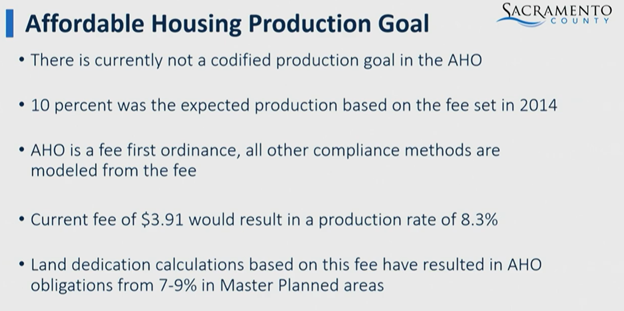
(SACRAMENTO COUNTY, Calif.) — Sacramento County supervisors are weighing changes to the county’s affordable housing ordinance after staff reported the program was producing affordable housing at an estimated rate of 8 percent, below the 10 percent benchmark under review.
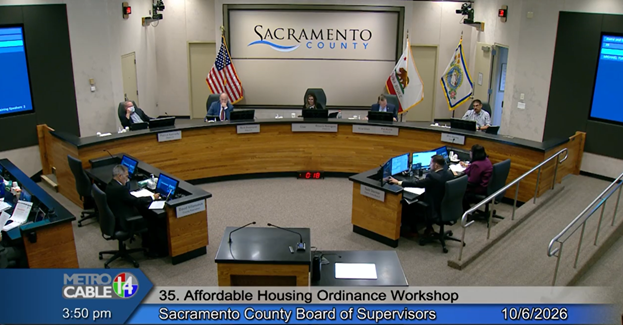
Sacramento County Board of Supervisors - October 6, 2026/ Image Metro Cable 14 YouTube.
The Oct. 6 meeting examined whether the county’s existing policies are generating enough affordable housing while allowing new residential development to remain financially feasible.
The ordinance applies to new residential development in unincorporated Sacramento County. Developers generally must pay an affordability fee or meet their obligation through approved alternatives, including dedicating land, constructing affordable units or entering into an agreement with the county.
Credit:
Sacramento County Board of Supervisors - October 6, 2026/ Image Metro Cable 14 YouTube.
The county’s published fee was $3.91 per habitable square foot as of March 27. The ordinance requires fees to be adjusted annually based on a construction-cost index. Collected fees can be used to acquire land for affordable housing, build or rehabilitate affordable units, or help subsidize housing for extremely low-income households.
Supervisor Phil Serna of District 1 cautioned that increasing the fee could discourage development, undermining the county’s ability to produce both market-rate and affordable housing.
“Before setting a new fee, I would want to understand the total fee burden and how it affects the market’s ability to produce housing,” Supervisor Phil Serna said. “If you don't have a market-rate project, 15 percent of zero is zero.”
Serna cautioned that higher fees could affect development feasibility and urged the county to consider the cumulative cost of fees to both developers and homebuyers, many of whom finance their purchases through mortgages.
“I'm very reluctant to change the fee from where it's at,” Serna said, emphasizing the importance of keeping multifamily projects financially feasible.
During the workshop, staff discussed whether the county should retain the existing fee or adjust it to support a defined affordable housing production goal. A fee of $5 per square foot was among the possibilities discussed, while staff said its analysis examined options up to $7.50 per square foot. Those figures were discussion points, not adopted fees.
The workshop also examined the county’s owner-builder exemption, which allows qualifying homeowners to build a single-family home without paying the affordability fee, subject to conditions. Staff said reviewing the exemption is part of the county’s housing policy requirements and noted that administering it can be burdensome.
Public commenters urged supervisors to strengthen the ordinance. Julio Lamas, executive director of the Sacramento Housing Alliance, called for a production goal of 10- to 15-percent and policies intended to expand affordable housing opportunities.
“We urge the board to strengthen the ordinance so it increases affordable housing production while advancing fair housing,” said Julio Lamas, executive director of the Sacramento Housing Alliance.
Lamas said more than 50,000 low-income renters in Sacramento County lack access to affordable housing. He urged supervisors to establish a goal of producing 10- to 15-percent affordable housing, arguing that a nine- or 10-percent target would not adequately address the county’s unmet need.
“We recognize the concerns raised in the feasibility analysis, but we do not believe that analysis should serve as a ceiling on what the county can achieve,” Lamas said.
The alliance also recommended adjusting future fees based on the average subsidy needed per affordable unit rather than construction costs, expanding affordable housing in high-resource neighborhoods, and prioritizing extremely low-, very low- and low-income households.
For large development projects, the group recommended a 50-50 split, with affordable housing funding and land dedication supporting development in high-resource areas.
Other commenters supported a production goal of nine or 10 percent, a fee structure that would charge less for smaller homes and changes to the owner-builder exemption. They argued that these measures could help generate more affordable housing while encouraging construction of smaller, less expensive homes.
The discussion reflects a central challenge for the county: setting affordability requirements strong enough to produce additional affordable homes without making new development financially impractical.
No new fee or ordinance amendment was adopted at the workshop. Staff will continue evaluating potential changes for future consideration.
If you’d like to add or correct anything in this report, feel free to reach out to me or leave a comment below. Submit Sacramento County tips and story ideas to Sarah Denos at sarahkdenos@gmail.com.
0
0

Comments