(SACRAMENTO, Calif.) — The Sacramento City Council advanced a series of agreements Nov. 10 intended to move forward development of the Sacramento Railyards, including an expansion of the city's Enhanced Infrastructure Financing District and agreements related to digital billboards.
OpGov.News reports the council considered four related agenda items involving infrastructure financing and signage agreements tied to the broader redevelopment project, which includes a planned Kaiser Permanente hospital, a future Sacramento Republic FC stadium and entertainment district, and redevelopment around Sacramento Valley Station.
The agreements build on a 2024 term sheet and a 2025 comprehensive project agreement between the city and development partners.
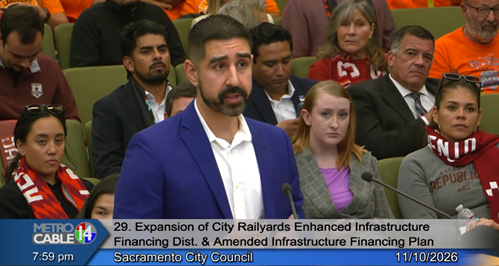
Marco Gonzalez, senior development project manager with the Sacramento Economic Development Department, outlines proposed financing and billboard agreements intended to advance redevelopment of the Sacramento Railyards during the Nov. 10 City Council meeting. (Credit: Metro Cable 14)
Marco Gonzalez, a senior development project manager with the Sacramento Economic Development Department, told councilmembers the agreements are intended to move the 2016 Railyards plan closer to implementation.
“In 2016, a new Rail Yards plan was approved by City Council. The staff has been working with our development partners to bring this plan to fruition,” Gonzalez said.
He described four tools intended to advance development: digital signage, the proposed 2026 Enhanced Infrastructure Financing District, a master agreement and an infrastructure financing plan.
The package also includes legal agreements to advance digital billboards at the Railyards and other locations throughout the city.
Gonzalez said the project is expected to attract more than $320 million in private investment and generate more than 13,000 jobs, while helping reconnect the central city. He also described the financing district as a source of resources for infrastructure and other improvements.
An Enhanced Infrastructure Financing District, or EIFD, allows participating local agencies to dedicate a portion of future property tax growth within a designated area to finance eligible public infrastructure.
The mechanism does not create a new property tax.
The Railyards redevelopment has been years in the making. The city adopted its original specific plan in 1993, followed by an update in 2007 and another plan update in 2016.
The 2016 plan update envisioned a mix of residential, commercial and public uses. Compared with the 2007 plan, it reduced the projected number of housing units from 10,000 to 12,500 to a range of 6,000 to 10,000. Planned retail space also decreased from approximately 1.4 million square feet to about 514,270 square feet, while planned parks and open space declined from 41.2 acres to 30 acres.
The 2016 environmental review identified potential impacts involving air quality, noise and traffic. It also found that the proposed 30 acres of parks and open space would not meet the city's identified demand under its park standards.
During public comment, residents and labor advocates questioned whether the development agreements would provide enough affordable housing and community benefits to offset the public investment and support the people who live and work in the area.
Several speakers called for a community benefits agreement that would include 25 percent affordable housing, an anti-displacement fund, a neighborhood grocery store and stronger labor standards.
A member of the Laborers' International Union of North America Local 49 said the current Railyards deal prioritizes profits over people, arguing that its affordable housing commitments fall short of community needs.
“The current deal includes $222 million with just 6 percent affordable housing while creating thousands of low-wage jobs,” the Local 49 member said. “The Railyards deal should include 25 percent affordable housing, including housing for seniors, hotel housekeepers and stadium workers.”
The speaker also called for protections against displacement and better employment opportunities for construction workers and permanent employees, including concession workers, broadcasters and hotel workers.
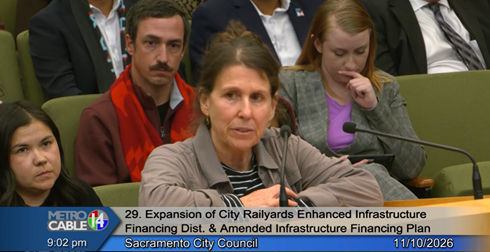
Jennifer Wood, an Oak Park resident and volunteer with the Coalition Against Project 2025, urges the Sacramento City Council to postpone votes on the Railyards financing and billboard proposals during public comment Nov. 10. (Credit: Metro Cable 14)
Jennifer Wood, an Oak Park resident and volunteer with the Coalition Against Project 2025, urged the council to postpone the vote on the Railyards and billboard proposals.
“My understanding is that neighborhood residents rejected this exact agreement a year ago and were not consulted before the vote was placed on tonight’s agenda,” Wood said. “As an Oak Park resident, I saw what neighborhood associations were able to negotiate with the AGU Square development. This deal deserves that much, if not more. The deal on the table will further increase income inequality locally.”
Other speakers supported the project, pointing to its potential to attract private investment, create jobs, support local businesses and bring more activity downtown. Supporters also described the EIFD as a financing tool that could help pay for infrastructure needed to make development possible.
Councilmembers raised questions about the billboard agreements and the level of public notice provided before the vote.
Vice Mayor of the City of Sacramento Karina Talamantes, said the locations of the proposed citywide billboards were not made available with enough advance notice.
“I will be voting in favor of the billboards within the Railyards Enhanced Infrastructure Financing District (EIFD), but I will be voting against the citywide billboards. We just found out the locations last week, and I believe we should have received advance notice,” Talamantes said, adding “I also have not been able to get a dollar amount for how much these billboards are worth.
“Based on a previous billboard study, one billboard in my area was estimated to generate about $250,000 in annual revenue. This proposal includes 12 billboards. At that rate, that's $3 million annually,” she said. “Over 35 years, that's a $105 million investment by the city in billboard signage.”
“We are investing significant public resources in economic development projects, and that's Okay. But to me, the most important thing is to be transparent with the public,” Talamantes added.
Councilmember Lisa Kaplan expressed support for moving the long-delayed project forward, invoking a Chinese proverb: “The best time to plant a tree was 20 years ago, but the second time is now.”
“And I think the Railyards is now,” Kaplan said.
Kaplan also questioned what options would remain for increasing affordable housing if the city and developers could not reach agreement on additional units.
The council considered the Railyards financing and billboard proposals as separate agenda items. The expansion of the city's existing Railyards Enhanced Infrastructure Financing District (EIFD) and its amended infrastructure financing plan received an 8-0 vote.
The Railyards digital billboard master lease passed 7-1, with Councilmember Mai Vang opposed and Councilmember Caity Maple absent.
The financing district proposal is expected to move next to the EIFD Public Financing Authority for further consideration, with Dec. 1 identified by staff as the next scheduled step.
If you’d like to add or correct anything in this report, feel free to reach out to me or leave a comment below. Submit tips and story ideas to Sarah Denos at sarahkdenos@gmail.com.
0
0

Comments