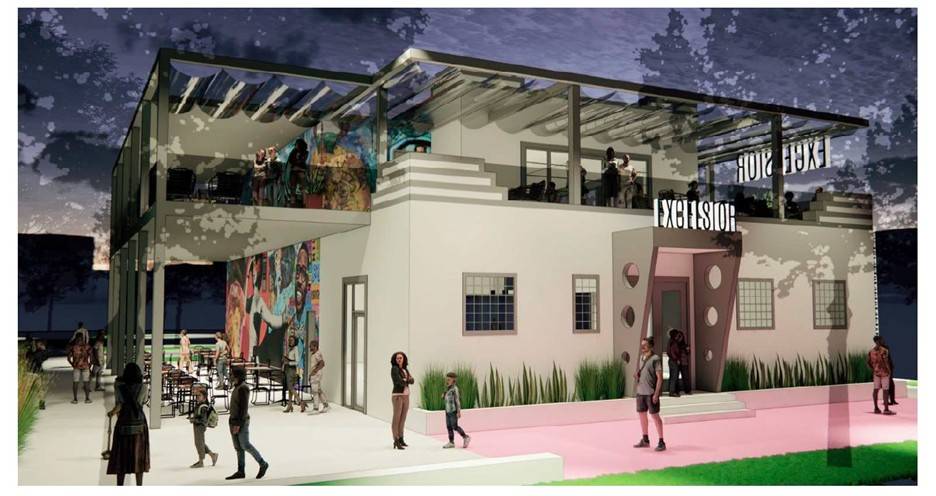
Future design of the restored Excelsior Club, blending its historic façade with modern features, honoring Charlotte’s most iconic Black cultural landmarks (Photo: City of Charlotte)
CHARLOTTE – The historic Excelsior Club, long a cultural and political landmark for Charlotte’s Black community, is poised for revival through a $1.5 million public-private partnership between Mecklenburg County and developer Sean Kennedy.
The project aims to restore the long-shuttered venue on Beatties Ford Road while catalyzing economic growth in one of Charlotte’s most historically significant corridors.
The county’s contribution, drawn from unspent interest on American Rescue Plan Act (ARPA) funds, will support the restoration and redevelopment of the site into a modern cultural hub featuring community programming, small business opportunities, and live entertainment spaces.
Commissioner Susan Rodriguez-McDowell of District 6 said that while she supports investment in underfunded areas, she had reservations about the project’s timing, given the ongoing financial strain for many residents.
“It almost pushed me a little toward voting for it because it’s not actually tax dollars,” Rodriguez-McDowell said. “But the timing gave me pause. People are struggling with housing and food insecurity — I just questioned whether this was the best use of funds right now.”
Her remarks reflect a broader conversation about how local governments balance cultural preservation with the immediate needs of their communities, especially amid economic uncertainty.

A site plan shows the Excelsior Club’s proposed layout, including parking and a community gathering space (Photo: City of Charlotte)
Despite differing opinions on the allocation of funds, community advocates say the Excelsior Club project represents a once-in-a-generation opportunity to preserve a site central to Charlotte’s civil rights and cultural history.
James Mitchell, a local historian and preservation advocate, said the investment is about more than restoring a building — it’s about reclaiming a legacy.
“Commissioner Rodriguez-McDowell raises an important point about fiscal responsibility,” Mitchell said. “But the Excelsior isn’t just any private business. It’s where Charlotte’s Black leaders once strategized and built movements that shaped our city. If we don’t act now, we risk losing that living history forever.”
Founded in 1944 by entrepreneur Jimmie McKee, the Excelsior Club became one of the first Black-owned private social clubs in the South. It hosted renowned figures including Louis Armstrong, James Brown, Thurgood Marshall, and Shirley Chisholm, serving as a hub for civic organization and cultural expression during segregation.
After its closure in 2016, the club faced demolition before community advocates and developers intervened. Its restoration now forms part of Charlotte’s Corridors of Opportunity initiative, which focuses on revitalizing historically underinvested neighborhoods through equitable development.
Mitchell said that while oversight is essential, projects like the Excelsior can help rebuild trust between public institutions and historically marginalized communities.
“Public-private partnerships have to be done carefully,” he said. “But when they’re done right, they show that our history is worth investing in, and the Excelsior can become both an anchor for new opportunity and a monument to what this community has already built.”

An aerial view highlights the 0.84-acre Excelsior Club property along Beatties Ford Road (Photo Credit: City of Charlotte)
The restoration is expected to begin in 2025, with plans for the venue to reopen as a multipurpose cultural center. County officials say the project will generate jobs, attract tourism, and strengthen economic activity along Beatties Ford Road — while preserving the soul of one of Charlotte’s most important landmarks.
0
0

Comments