(CHARLOTTE) — Charlotte City Council votes Monday to adopt seven Community Area Plans and delay seven others after hours of emotional debate over equity, planning timelines and community trust.
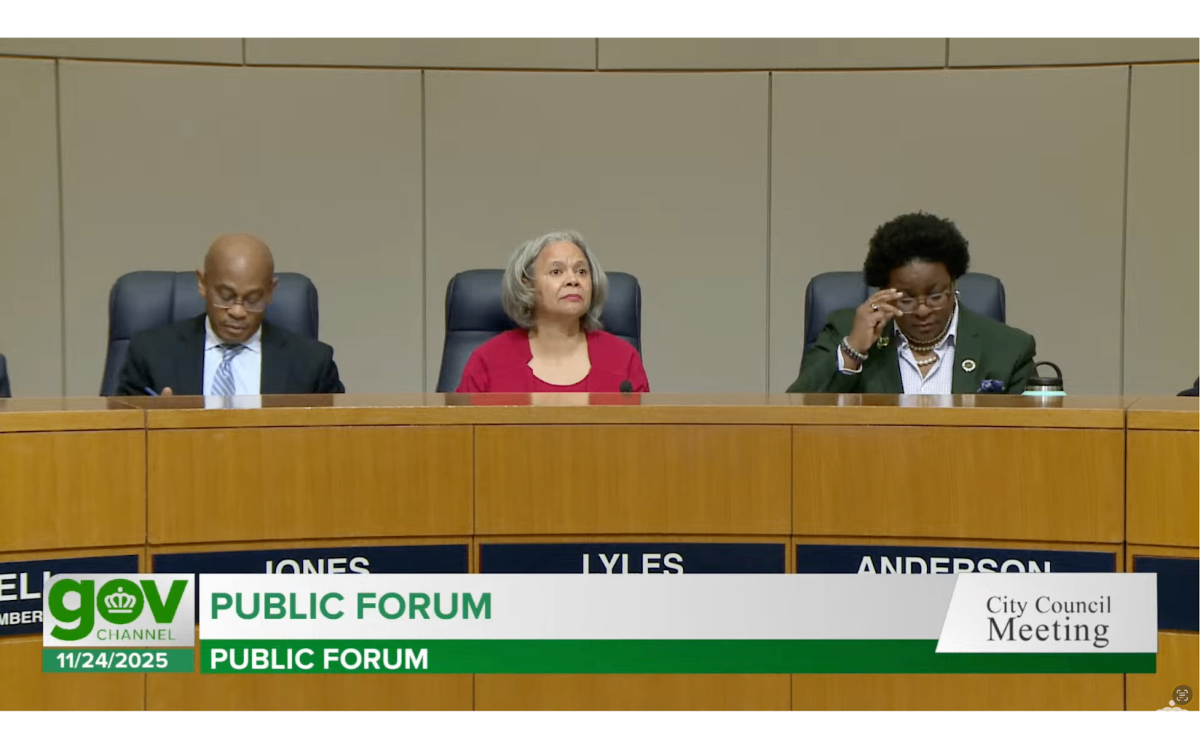
Mayor Vi Lyles listens as residents deliver public comments on bicycle safety, immigration concerns, and the future of the city’s Community Area Plans during Monday’s meeting.
The decision shapes how the city guides development in more than a dozen neighborhoods and becomes the most contentious action of the Nov. 24 business meeting.
Council approves CAPs A, E, G, H, I, J, and K, and deferred B, C, D, F, L, M, and N until March 23, 2026. Council Member Malcolm Graham opposes the motion, arguing that delaying half the plans leaves entire geographies without guidance. Others say communities need more time, especially in areas with deep mistrust of city planning processes.
“Staff started this project about two to three and a half years ago, focusing on how we can really call out what matters most and ensure that our community’s growth benefits everyone,” Planning Director Monica Holmes said.
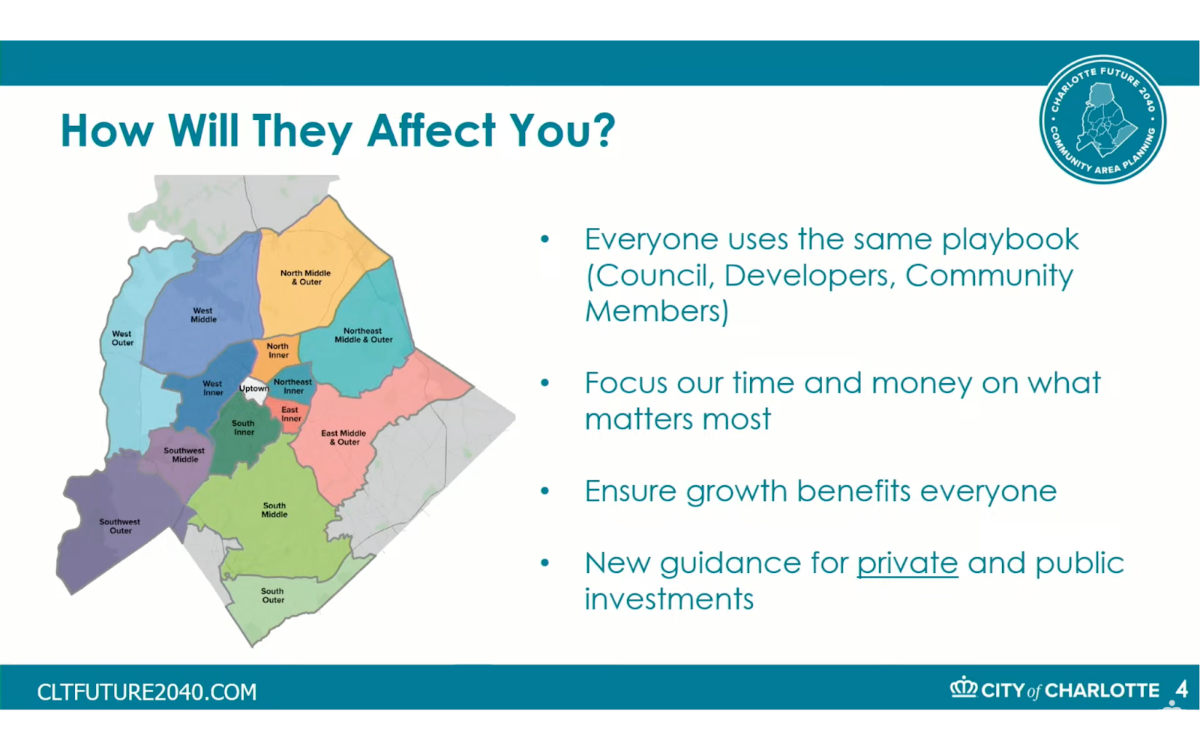
A city map shows the 14 Community Area Plan geographies, explaining how new plans aim to grow, align decision-making, and ensure community benefits.
Public testimony leading into the vote underscores the divide. Reverend Janet Garner Mullins of the West Boulevard corridor urges Council to vote on each plan individually instead of bundling them, saying her neighborhood needs long-overdue environmental justice protections.
“Policy without people is just paperwork. Planning without legacy is erasure,” Reverend Mullins said.
Before the CAPs debate, Council unanimously approved the historic designation of the Kelly M. and Margaret G. A. Alexander House, securing long-term preservation for the civil-rights era home.
Council also voted to close an unused alleyway between Liggett Street and Bullard Street after staff confirmed the closure will not impact access for nearby properties.
Three annexations move forward with no public opposition. Emerson Pond brings 120 duplex and triplex homes into District 5. Garrison Industrial Phase 2 enables light-industrial expansion near I-485. River South, the largest at 119 acres, allows 241 homes under the broader River District master plan.
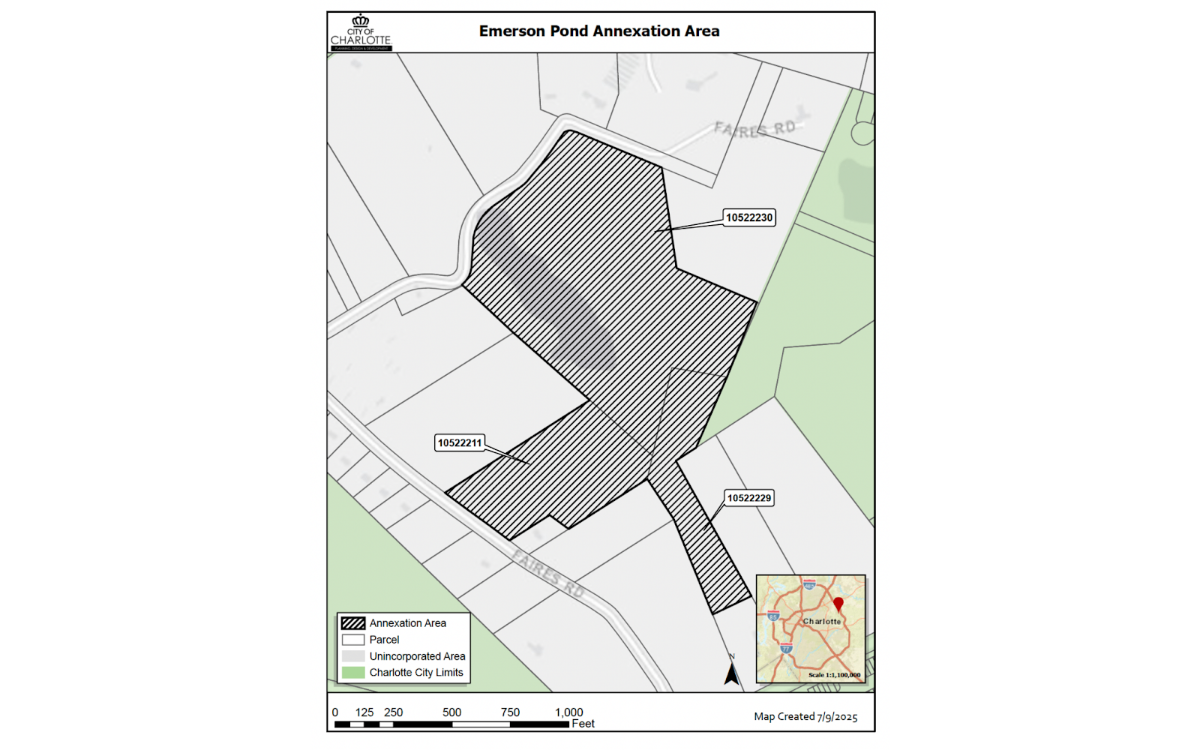
A city map shows the Emerson Pond annexation area in eastern Mecklenburg County for 120 duplex and triplex homes; the third annexation advanced without public opposition.
The meeting’s public forum centers heavily on bicycle safety, road design, and immigrant protections following recent federal enforcement actions. District 3 resident and Bike Advisory Committee member Lauren Patterson urges the city to increase biking investments, saying unsafe conditions disconnect residents from transit even when they live close to it.
“Biking is the happiest form of transit, but right now, it doesn’t feel safe in Charlotte,” Patterson said.
Committee member Frank Divine criticizes the council for keeping bicycle funding flat at $4 million despite voters approving a major transportation bond.
“It is a disgrace that we do not have the funding or urgency to build protected bike lanes,” Divine said.
District 2 resident Matt Wesler shares that his dog was killed by a driver on Eastway Drive, describing it as part of a larger pattern of roadway violence.
“Please don’t repeat the mistakes of the last few decades. Prioritize the people outside the cars,” Wesler said.
Other speakers focus on service delivery. Resident Jacob Krinsky reports progress on his proposed 311 technology upgrades and offers to pilot a solution “at cost.”
“Just start small and succeed fast,” Krinsky said.
Chay Abdullah speaks about the revival of Cedar Grove, once abandoned but now a community preservation site honoring dozens of veterans.
“We found not six veterans buried there, but fifty-five,” Abdullah said.
Immigrant-focused comments grow especially emotional. Council Member-elect Jadira Johnson-Lopez describes community fear after CBP operations in District 5 and praises the leadership of affected youth.
“They showed a level of leadership adults should learn from,” Johnson-Lopez said.
Charlotte International Cabinet Chair Maggie Cummings urges the city to continue its visible support.
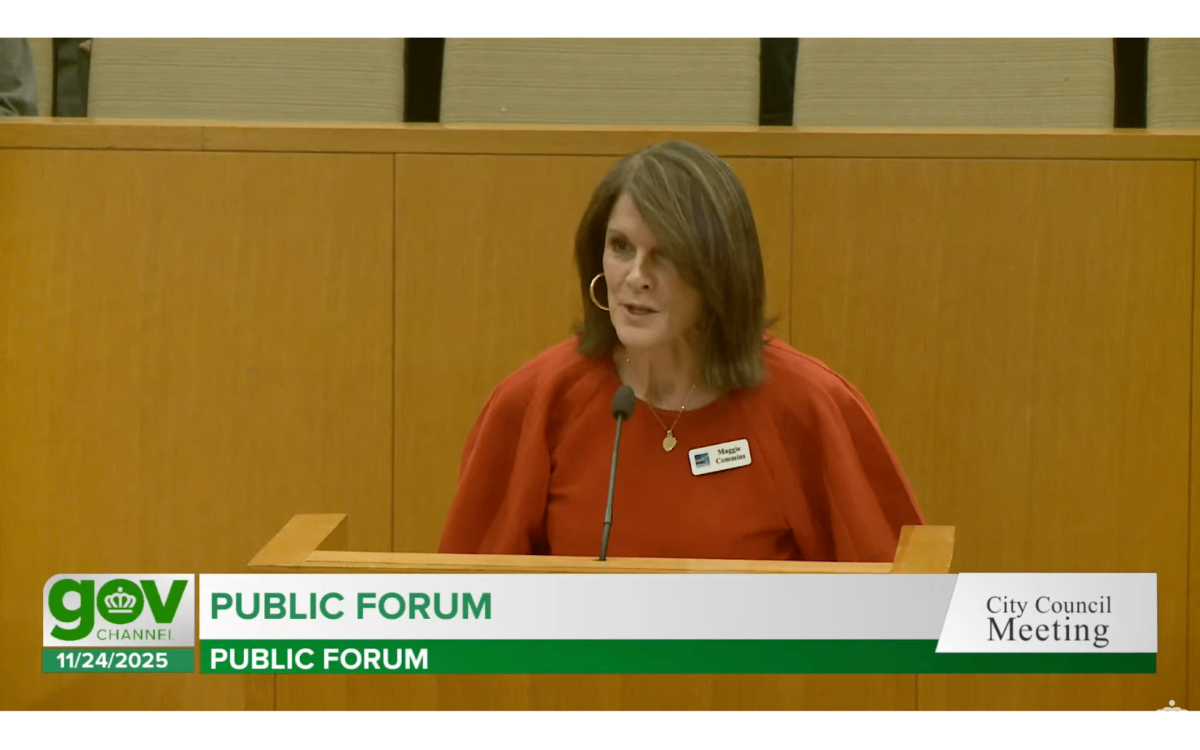
Charlotte International Cabinet Chair Maggie Cummings urges the council to continue supporting immigrant families after recent federal enforcement actions.
“Our immigrant community is scared, and they need you to keep showing up,” Cummings said.
University student and ESL teacher Donna Elisa Schmid tells Council that her students described their lives as a “horror movie” after witnessing enforcement actions.
“To them, life became a horror movie,” Schmid said.
Council later approves a two-year, $1.2 million bridge inspection contract with WSP USA, Inc., along with a five-year agreement with Motorola Solutions, Inc. to launch CMPD’s Drones as First Responders Program. The Charlotte-Mecklenburg Police Foundation donates $1 million toward the effort.
Council also accepts a $21,500 federal grant for National Register nominations for McCrorey Heights and Oaklawn Park, and authorizes up to $25 million in improvements to the NASCAR Hall of Fame, including modernized classrooms, expanded studio space, and improved visitor flow.
The conversation intensifies again during appointments to the Metropolitan Public Transportation Authority Board, where concerns emerge over the scoring and selection process. Council ultimately appoints Emma Allen, Corine Mack, and William Cameron Pruette to fill the remaining seats.
Council Member LaWana Mayfield closes the night by calling for updates to the city’s ethics policy to ensure transparency when elected officials may financially benefit from city investments.
“We cannot move forward without a clear and ethical framework,” Mayfield said.
Victoria Osborne can be reached at victoria.o@lead4earth.org.
0
0

Comments