(SAN FRANCISCO, CA) —Rental scams have now evolved beyond grammatically creative listings and demands for application fees prior to viewing, as San Francisco resident Alvin Tran lost $18,600 when schemers used a legitimate open house to convince him they were the property's owner.
Historically, rental scams have a notorious modus operandi, including an apartment priced well below market value and owners who claim to be out of town or unavailable for a phone call. Then there is the chief red flag: a request for money before the scheduled viewing.
Photo Credit: MoveBayArea.com, example of a typical Craigslist rental scam.
However, with rents in San Francisco skyrocketing, while the median one-bedroom now rents for $4,180, up 22.9% from a year ago according to Zumper — scammers have more incentive than ever to inventively defraud prospective renters.
The lost $18,600
Alvin Tran was scammed last week (beginning Monday, 27th, 2026) on a Craigslist listing for a two-bedroom place in the Duboce Triangle.
The apartment also had an authentic Zillow listing. Open house timings were blocked out in the descriptions of both listings, which the victim personally attended, noting its high attendance levels.
"The person showing (the apartment) was the actual owner," the victim said in a Reddit post. "His name matched the one in the emails I’d been receiving, so I thought everything checked out.”
After the showing, however, the application process continued exclusively through the Craigslist contact. The renter submitted an application, provided financial documents, signed a lease agreement, and wired $18,600 covering the first month's rent, last month's rent, and a security deposit.
Communication was ongoing for several days, with nothing to rouse the victim's suspicion. The supposed landlord discussed utilities, internet service, mailbox access, cleaning, and confirmed a key handoff on move-in day.
However, when Tran arrived to collect the keys, nobody appeared. Calls, emails, and text messages from the ‘landlord’ stopped. Tran was concerned, stating he thought that an emergency had occurred.
Trying to understand what had happened, his suspicion now roused to the scam, Tran contacted the person behind the authentic Zillow listing.
According to the victim, the legitimate property owner confirmed that he had hosted the open house, but he had never created the Craigslist advertisement, signed the lease, corresponded at all with the renter digitally, or received any sum of money.
Instead, the scammers apparently copied the legitimate listing, monitored the real open house, and impersonated the landlord only after the prospective tenant had already verified the apartment existed.
"I never would've thought someone could use a legitimate open house like that," Tran stated.
Was anything suspicious in hindsight?
OpGov.News reached out to Alvin Tran, who wanted to share his story to help other prospective renters. We wanted to know if there were any red flags he could recognise in hindsight. Looking back, he identified only a handful of subtle warning signs.
Some emails arrived around 3 am Pacific Time, rousing suspicion they may have originated from another time zone. The scammers communicated using a phone number that appeared as a green-bubble SMS on iPhones rather than iMessage, which, while not typically unusual on its own, tickles alarm sensors in retrospect. The email address seemed pretty generic, noted Tran, rather than being tied to a property management company or having the subtle nuances and quirks of a personal email.
“Other than that, they were very careful and sophisticated”, Tran said. “I was able to see the unit in person and talk to the real owner, and since they somehow found out the owner's real name, the signature in the email matched the owner's name; no red flag was raised.”
“99% of people would have fallen for this scam,” said one Reddit commenter on Tran's original post.
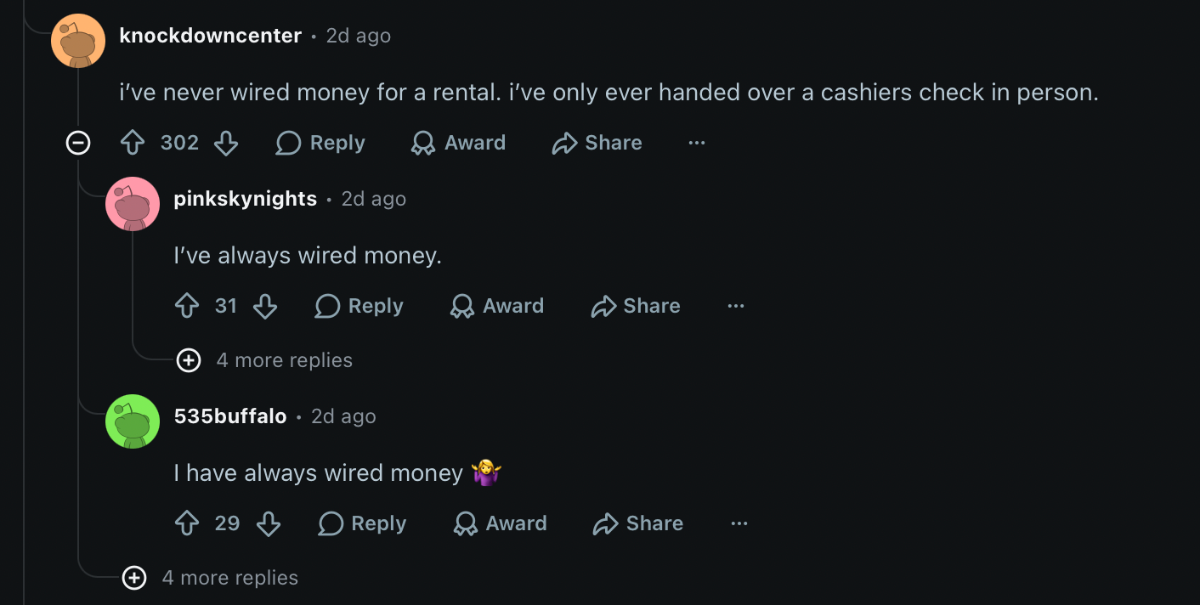
Photo Credit: Reddit
Other posters advised being wary of wiring money and always giving a cashier’s check in hand for the first month’s payment. However, even this appears not to be uniquely important, with other Redditors stating that wiring money in tenancy circumstances is typical for them.
Is there hope of receiving money back?
The victim has since launched multiple investigations into the fraud. Firstly, a wire recall and fraud investigation through Bank of America, contacted the receiving bank, filed reports with the San Francisco Police Department and the Federal Trade Commission, and submitted complaints to the FBI's Internet Crime Complaint Center (IC3).
He also assembled communications, lease documents, walkthrough videos, banking records, and a written statement from the legitimate property owner confirming the impersonation, and communicated this information with attorneys.
One potential investigative lead stood out, which was that the wire transfer was sent to a business account associated with an active Florida Limited Liability Company (LLC). Whether that company is involved in the fraud or is potentially another victim whose identity or banking information was exploited remains unknown.
“There has been no updates or success yet,“ says Mr. Tran, as of Monday, August 3, 2026. “I got notified that the police report was approved today, moving from a temporary report to an incident report; however, there's no one assigned to the case yet.”
How prevalent are rental scams?
Broadly, scams are stereotypically targeted towards older demographics. However, rental scams are leeches of the young. People ages 18-29 were three times more likely than older adults to report losing money to a rental scam, according to the Federal Trade Commission.
The case underscores a broader trend. The FTC states that Americans have reported nearly 65,000 rental scams since 2020, losing approximately $65 million. While Facebook has become the largest source of reported fake listings, Craigslist continues to account for a substantial share of cases.
An NYU study found that, in an investigation of 24,787 Craigslist-flagged rental ads, 10.2% were conclusively shown to be spam, while 19.5% could not be conclusively identified.
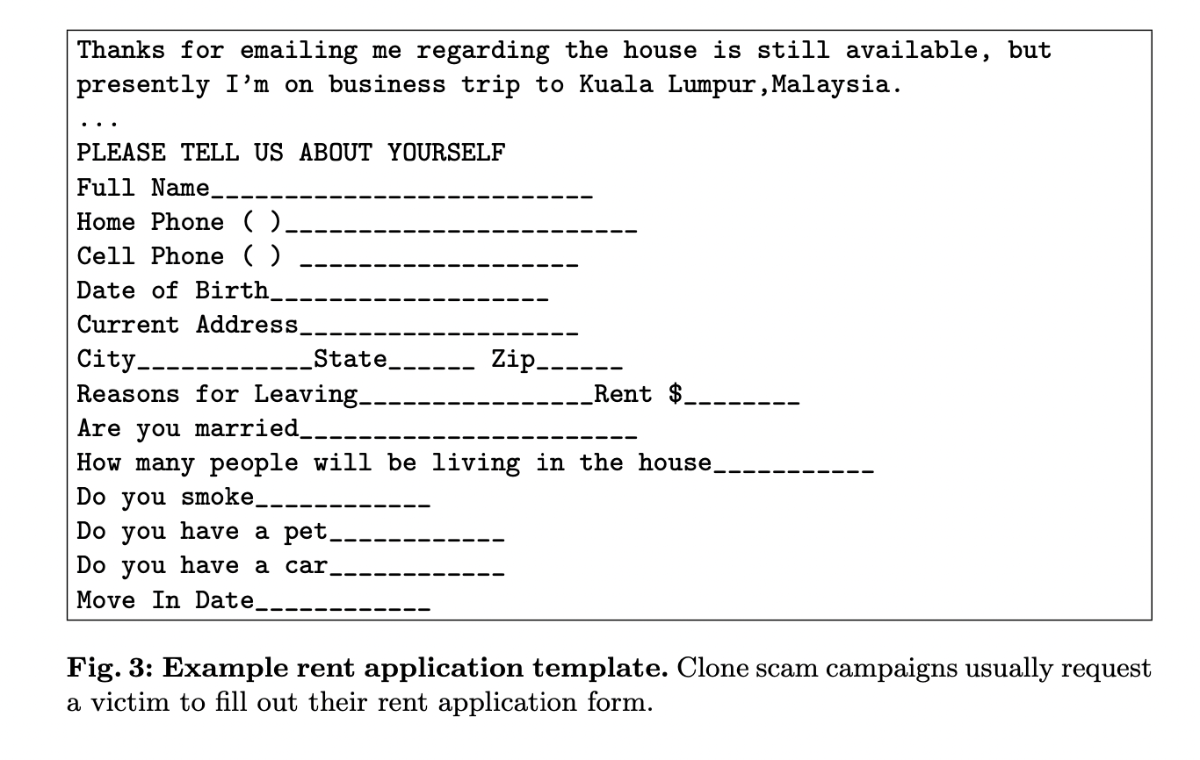
Photo Credit: NYU study on Craigslist rental scams.
While there are plenty of cases of exploitation, including of someone as diligent and careful as Alvin Tran, hope is not lost for prospective renters who keep a vigilant eye. Some recommended tips include:
Verifying ownership through public records or a property management company
Being on the lookout for telltale signs such as sketchy grammar or landlords who are out of town
Avoiding landlords who seem like they are trying too hard to unnecessarily prove their identity with excessive photos
Avoiding wiring deposits before seeing the property AND confirming the recipient's identity
Stay safe, renters.
0
1

Comments