(SACRAMENTO COUNTY, CA.) — For many in Sacramento and Citrus Heights, this isn’t just a policy debate—it’s a painful reminder of something they thought was long behind them.
For the rational public, the legal system is starting to feel like a revolving door. In a state where multi-century prison sentences were once viewed as permanent, recent decisions by the California Board of Parole Hearings suggest that these terms may be treated more as suggestions than mandates.
On March 25, Sacramento County Sheriff Jim Cooper officially announced a new ballot initiative, "Protect Our Kids: Reform Prop 57," aimed at ending specific parole loopholes for violent sex offenders.

(Credit: Sacramento County Sheriff Jim Cooper announcing "Protect Our Kids: Reform Prop 57.")
This move follows a series of controversial decisions to grant early release to notorious individuals—a trend that local officials and survivors describe as a failure of the justice system, and rightfully so. Sheriff Cooper’s effort is driven by two high-profile cases that have reignited fear across the community: David Allen Funston and, most recently, Gregory Vogelsang.
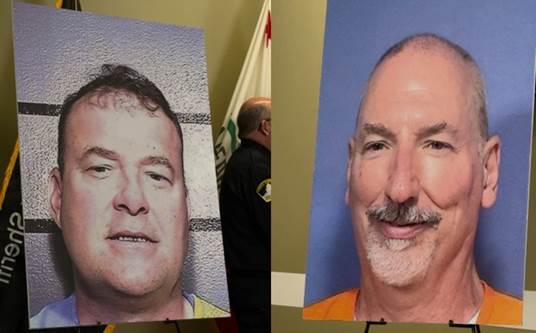
(Left to right: Gregory Vogelsang and David Allen Funston: Serial child predators whose combined sentences exceed 400 years, yet California's 'Elderly Parole' system considers them fit for our streets.
Photos: Sacramento County Sheriff’s Office.)
As I most recently reported for OpGov.news, Vogelsang, now 57, was originally sentenced to 355 years to life in prison for a series of horrific crimes committed in Citrus Heights between 1995 and 1997. Investigators found that Vogelsang molested at least six boys, ages 5 to 11, using calculated grooming tactics to exploit families. He built trust with parents by buying gifts and hosting sleepovers before abusing that access. The details of these crimes remain chilling; in one instance, a child was lured into a vehicle under the pretense of picking out a gift, only to be driven to a residence and repeatedly assaulted despite his pleas for the man to stop. Another victim, a family friend, was abused over the course of years during weekend stays at Vogelsang’s home. During the initial investigation, deputies even discovered victims' underwear in Vogelsang’s possession, which he admitted to keeping for sexual stimulation.
Despite the severity of these acts and the original 350-plus-year sentence, the California Board of Parole Hearings recently granted Vogelsang "elderly parole" after he served only 27 years. This decision has drawn significant criticism, especially on social media, particularly because evaluations indicated a high risk of recidivism. Psychological evaluations documented that as recently as 2020, Vogelsang admitted he remains primarily attracted to boys ages 5 to 11 and was still masturbating to these fantasies. Even after determining he posed a greater risk to the public than 80 percent of other sexual offenders, the board still approved his release. The outrage surrounding Vogelsang is compounded by the fact that his case is not an isolated incident, but rather part of a pattern of near releases involving other convicted predators.
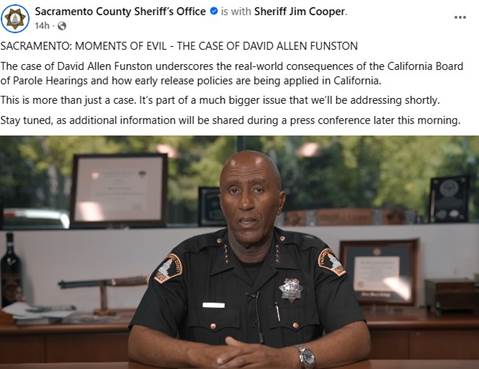
(Sacramento County Sheriff Jim Cooper makes an announcement on social media about their new video Moments of Evil – the Case of David Allen Funston.)
Enter David Allen Funston, now 64, who was once described by a Sacramento judge as "the monster parents fear most." Convicted in 1999 of 16 counts including the kidnapping and horrific sexual assault of eight children—some as young as three years old—Funston was handed three consecutive life sentences plus an additional 20 years. The intent of the court was clear: he was never to walk free.
Yet, despite his death-row-length sentence, I reported for OpGov.news back in late February how Funston became eligible for release under California’s Elderly Parole Program. That’s right, a parole board panel back in September 2025 found Funston—a serial predator—suitable for release. Despite a request for review from Governor Gavin Newsom, the full Board of Parole Hearings reaffirmed that grant of parole on February 18. In a scene straight out of a horror movie about hell, Funston was technically "freed" from state prison… thankfully, only to be immediately arrested at the gate. Placer County authorities had issued a surprise warrant for Funston for unrelated child molestation charges dating back to 1996, a move that provides the only current barrier between a predator and the community.
For those who worked these cases, this constant cycle of near-releases is a devastating blow. Retired detective Rick Armando, who investigated these cases in the 90s, recalled the emotional toll of the original investigation. “We had a pattern of these kids being kidnapped and molested,” he said at a recent press conference. “We knew something just wasn’t right.” Sheriff Cooper echoed this sentiment, arguing that the current system has drifted too far from its responsibility to protect. “This has led to the early release for almost any crime, even violent ones,” Cooper said. “They routinely release violent inmates early, even after a jury trial and judicial sentencing.”
The proposed reform is specific: “If a person is a sexually violent predator, they should not be eligible for early parole. They should serve the time as sentenced.” As the initiative moves toward a potential 2028 ballot, supporters say the goal is to ensure that sentences for the state's most dangerous offenders finally reflect the severity of their crimes. “This is not a partisan issue,” Cooper said. “It is a righteous issue. It is a matter of safety. Every child deserves a chance.”

(Image credit: Story image: David Funston - Documentary | Sacramento County Sheriff's Office)
Did You Know?
Sex offenders with multiple prior arrests for child molestation are three times more likely to be rearrested for the same crime compared to those with only one prior arrest, according to the Bureau of Justice. Furthermore, research suggests that persistent sexual interest in children is one of the strongest predictors of long-term recidivism, supporting concerns over parole decisions for individuals with high-risk evaluations. California's "elderly parole" program, which considers inmates as young as 50 who have served 20 years, has been a key factor in these early release decision. For more context on recidivism rates, refer to the U.S. Department of Justice.
Moreover, estimates suggest that between 70 to 90 percent of child sexual abuse cases are never reported to authorities. This "dark figure" of crime remains high because children often do not disclose the abuse for years, or may only tell a friend rather than a protective adult.
Get Help:
If you suspect a child is being abused, you can contact the Childhelp National Child Abuse Hotline at 1-800-4-A-CHILD (1-800-422-4453) for 24/7 confidential support.
Story image: David Funston - Documentary | Sacramento County Sheriff's Office
Submit Sacramento County tips and story ideas to Sarah Denos at sarahkdenos@gmail.com.
0
0

Comments