PLEASANTON, CA — The Pleasanton City Council has not decided how long its water customers will spend paying off $16.5 million in bonds the city intends to issue, and the difference between the two options on the table is about $5.5 million.
At a special meeting Aug. 11 the council approved a resolution declaring the city's intent to reimburse itself out of future bond proceeds for money spent on water capital projects. The measure preserves the city's ability to recover costs incurred from 60 days before the vote until the bonds are issued. No bonds were authorized. That item is scheduled for September.
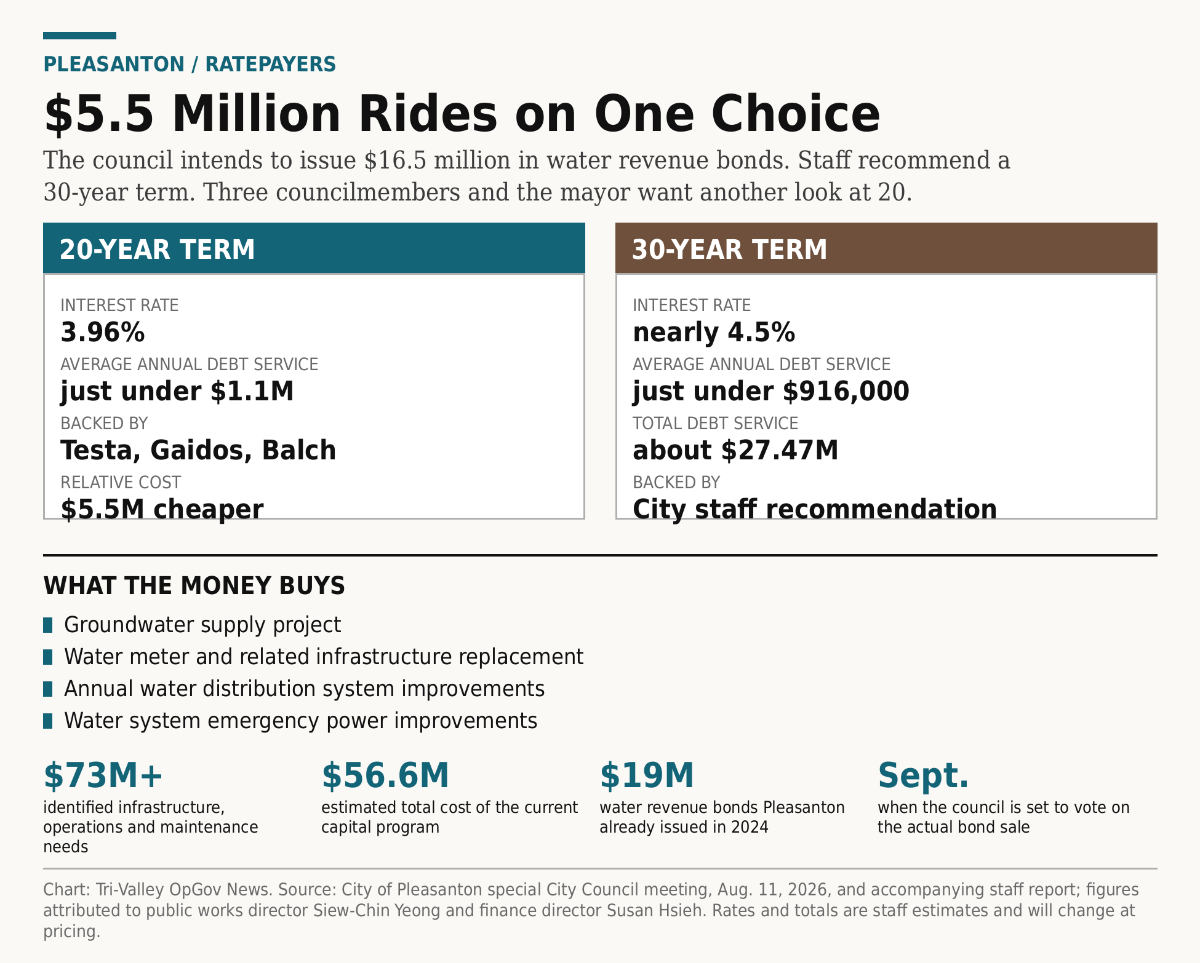
The $16.5 million figure comes out of a Water System Management Plan the council previously approved along with an increase in water rates. Pleasanton issued $19 million in water revenue bonds in 2024.
Public works director Siew-Chin Yeong told the council the capital program aims to replace aging infrastructure to maintain system reliability, improve capacity, meet regulatory requirements and align with the city's strategic plan goal on environmental investment. The work falls under what the city calls the 2026 Water Project, which includes restoring local groundwater production by developing new wells. City staff have been working for several years on strengthening the water enterprise fund and addressing more than $73 million in infrastructure, operational and maintenance needs.
Bond money is earmarked for four projects: the groundwater supply project, water meter and related infrastructure replacement, annual water distribution system improvements and the water system emergency power improvements program. Yeong put the program's total cost at about $56.6 million, with the 2024 bonds and the higher rates covering much of it.
The disagreement is over term length.
Finance director Susan Hsieh laid out two public sale options. A 20-year bond carries an interest rate of 3.96 percent and average annual debt service of just under $1.1 million. A 30-year bond carries average annual debt service of just under $916,000 at an interest rate closer to 4.5 percent, with total debt service around $27.47 million. By Hsieh's figure, the longer term costs about $5.5 million more over the life of the bond.
Staff are recommending 30 years, and the reason given is not cost. A lower annual payment leaves the city room to absorb unexpected capital needs. Hsieh told the council that water system revenues should cover the debt service either way and that there are sufficient funds at the 20-year payment level.
Councilmembers Julie Testa and Matt Gaidos and Mayor Jack Balch each said they want a closer look at the 20-year option before the September vote. Councilmember Craig Eicher pressed the broader point that the city needs to move on the bonds rather than delay, arguing that putting it off makes matters harder later.
Gaidos framed the case for the shorter term around what has already been asked of customers, pointing to the recent rate increases and the balance in the water enterprise fund.
Balch raised a technical argument worth following. He said the interest rate the city actually receives at pricing should come in below the rate assumed in its water rate study and rate plan, and that the savings from the better rate could be applied toward affording the 20-year schedule. Whether that holds depends on where rates sit when the bonds are priced, which nobody in the room could know.
The city's financing team is working on obtaining a credit rating this month. Staff return in September to seek approval of the bond sale, and if it passes the city would finalize offering documents and issue the bonds, with proceeds expected by mid-October.
None of this changes the water rate increase the council has already adopted. All the figures presented Aug. 11 are staff estimates and will move when the bonds are priced.
0
0

Comments