WALNUT CREEK, CA - From opening his independent financial advisory practice to running as an independent political party in his candidacy for California governor, Jon Henderson is ready to create California 2.0.
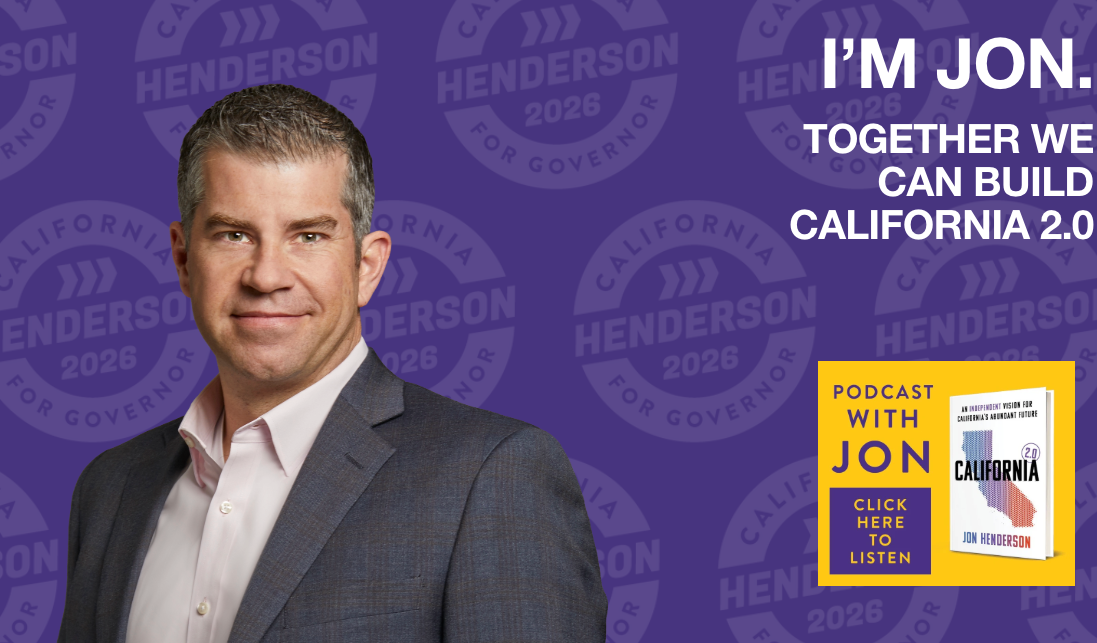
Photo credit: Jon Henderson’s campaign website.
Henderson grew up in So-Cal, in a town called Newbury Park. He attended San Diego State University, and upon graduating, came to the Bay Area, working at Merrill Lynch for 20 years as a financial advisor.
“I left [Merrill Lynch] on the day that COVID-19 started to start my own practice,” Henderson said in an interview with OpGov.News. “I went independent, started my own firm, took on employees, rent, and that was very enlightening to me. We can do so much more as an independent. And so that led me to this point, six years later, running for governor.”
His launch of his own company and tax firm called Echo45 Advisors has taught him important skills that include running multiple systems at once and managing employees, income, and task delegation.
Henderson is a licensed tax preparer and manages money, plans finances, and reviews taxes for many clients. He said that decades of working closely with families have given him a unique understanding of what motivates people and how they make decisions.
“I work with individuals and families, and I hear and see what they really do,” Henderson said. “I know what they do with their money. I know which children they disinherit. I know who they donate to, when they donate, and why they stop donating. I know what drives human behavior. I don't need a poll. I've been doing it for 25 years with hundreds of families from behind the scenes."
That perspective has also shaped his views on politics. Henderson believes that the people’s desires for the future of this country are quite similar on both sides, and that everyone is much more alike than the media would want them to believe.
“Half of my clients are Republican and half are Democrat, and I think they all hate the other half from behind a keyboard,” Henderson said. “But if they met at a party, at my house, at a barbecue, they would all like each other. They would all get along just great.”
According to Henderson, conversations with clients and voters from across the political spectrum convinced him that many Americans share common concerns despite growing political polarization.
“There's been this division, this polarization of the left and the right, where it's almost impossible, I think, for my Democratic clients to vote for a Republican, or my Republican clients to vote for a Democrat,” Henderson said.
When Henderson decided to run as an independent, and when he had conversations with both sides of the political spectrum, everybody seemed to find common ground, until they were given a reason not to.
“I think that's why almost everybody goes right to these divisive issues,” Henderson said. “It’s the first way to figure out which side you're on. But when you come at people from an independent standpoint, and you just listen to everybody, it feels like you're on their side.”
Henderson’s book, “California 2.0: An Independent Vision for California's Abundant Future” was published on Feb. 24 and is 22 chapters of the different plans he would implement for the state, with each one aiming to improve quality of life and reduce the expense of living, due to there being a deflationary component to each plan. He worked with a hybrid publisher called Scribe Media and recorded his audiobook version of it at his home.
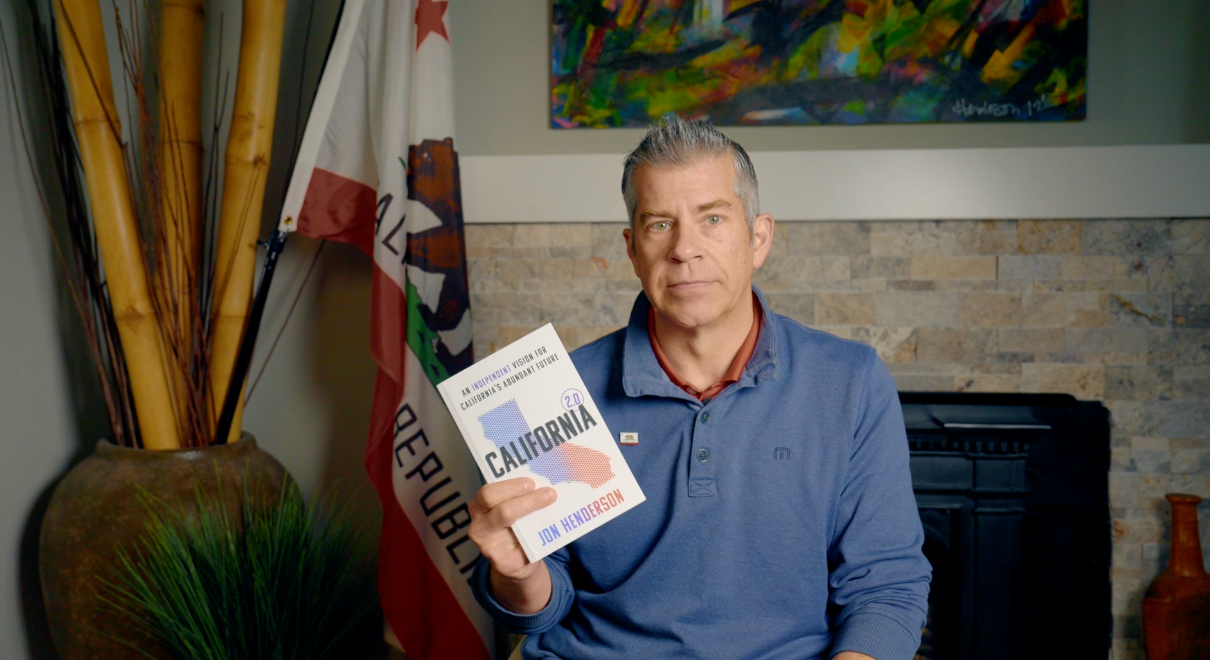
Photo credit: Jon Henderson’s campaign website // Henderson with his book, “California 2.0: An Independent Vision for California's Abundant Future”
Henderson prioritizes three main issues for his campaign- housing, wildfire risk, and trust in government. He believes his solutions for these issues are interlocked, creating a cohesive theme for his campaign that efficiently responds to the respective problems.
Trust in government is one area where Henderson believes significant reform is needed. One of his central proposals is requiring elected officials to place their assets into blind trusts in order to eliminate conflicts of interest.
“I would put my money into a blind trust, and not know what I own,” Henderson says. “A lot of people are so disgusted by the amount of open corruption and insider trading that is going on within Congress, especially with crypto deals. Trump's wealth has gone up exponentially through deals done while in the White House. So if I were elected, I would be the one to work to put an end to that. I would very tangibly require that all California lawmakers put their money into a blind trust and get rid of that conflict of interest.”
Henderson hopes that this step would inspire other states to follow, limiting federal representatives from being corrupt. He argues that public skepticism toward elected officials is justified and believes government should be structured in a way that earns accountability rather than relying on trust.
Henderson further highlighted how California is the fourth-largest economy in the world in spite of its politicians, not because of them.
"[Californians] shouldn't trust any politician," Henderson said. "Why should they trust me? They absolutely should not trust me.”
This counterintuitive statement by Henderson stems from the fact that he believes that even though citizens should not trust him, they should still vote for him, because he’s the one proposing the idea of blind trusts and how people should be having high expectations and requirements for who is in government.
“I think that we have hit a point now in society where the two political parties are so hated and have done such a good job of demonizing each other, that we've kind of created this problem where half the country hates the other half now- it's divided we fall,” Henderson said. “I think that the rise of the independent is actually just getting started, and I think that there's never been more appetite than today for people seeking something outside of the two party duopoly.”
Housing and wildfire prevention form the other major pillars of Henderson’s campaign platform. He proposes a new type of housing stock, in which mass timber and deforestation is used to build more units and combat the risk of wildfires, which have been a predominant issue in California.
By converting usable lumber to glulam beams, which are engineered wood beams made of wood laminations glued together with durable, moisture-resistant adhesives, Henderson believes it would be efficient in increasing housing.
In his book, Henderson mentioned the work of Vaagen Timbers, which he used as an example of innovative construction methods that address housing and environmental challenges at the same time. He noted that the company uses a HewSaw system to process small-diameter trees into lumber, such as two-by-fours and two-by-sixes, which can then be engineered into larger structural units.
“You get something that's basically as structurally and fire resistant as steel with basically zero carbon footprint,” Henderson said. “You're trapping all the carbon into the build and you can create this with state owned wood that you're pulling out of the forest while reducing wildfire risk at the same time.”
Henderson next proposed expanding the use of condominium conversions as a way to address both housing affordability and the financial pressures facing many retirees. Using his experience with a diverse range of clients, he knows many California retirees are “house poor,” owning homes that have appreciated significantly in value while struggling to keep up with rising costs on fixed incomes.
Under his condo conversion system, homeowners with larger properties such as a one-acre lot could subdivide a portion of their land, creating an additional housing unit that could enter the market quickly. Henderson believes that such units could provide an affordable entry point for first-time buyers, potentially costing less than $100,000, while also giving families an opportunity to house relatives.
Because the units would be separately deeded properties, they could eventually be sold independently, helping more people buy homes, build credit, and gain access to stable lifestyles.
Creative:MINT’s owner and brand architect Calvin Jung and controller Kalli Jonsson have had their financial investments handled by Henderson, and designed Henderson’s websites. Both said they were drawn to Henderson because of his background outside of politics and his ability to connect with a broad range of Californians.
“He’s very intelligent,” Jonsson said. “He’s on top of technology. He’s non-ideological, making him appealing to a broad spectrum of voters, representing California as a whole.”
Jung said many voters are still searching for a candidate who feels different from the traditional political field.
“We’re seeing all these people who are running to be governor, whether they’re billionaires or experienced, but we haven’t found anyone who seems to be the one,” Jung said. “So why not Jon?”
Jung also pointed to Henderson’s personal background and family values as reasons for his support.
“Just seeing how he interacts with his mother, his wife’s parents, all those family values matter to us,” Jung said. “He doesn’t come from money- seeing how he has conducted himself, built his career and family, it shows that he’s just like us, and that’s what we want, we want people for us.”
Jonsson said Henderson’s status as a political outsider is ultimately one of his strengths.
“He has the intellect and capacity to do this, even though he is not a career politician,” Jonsson said. “It’s good to throw the citizen politician in there.”
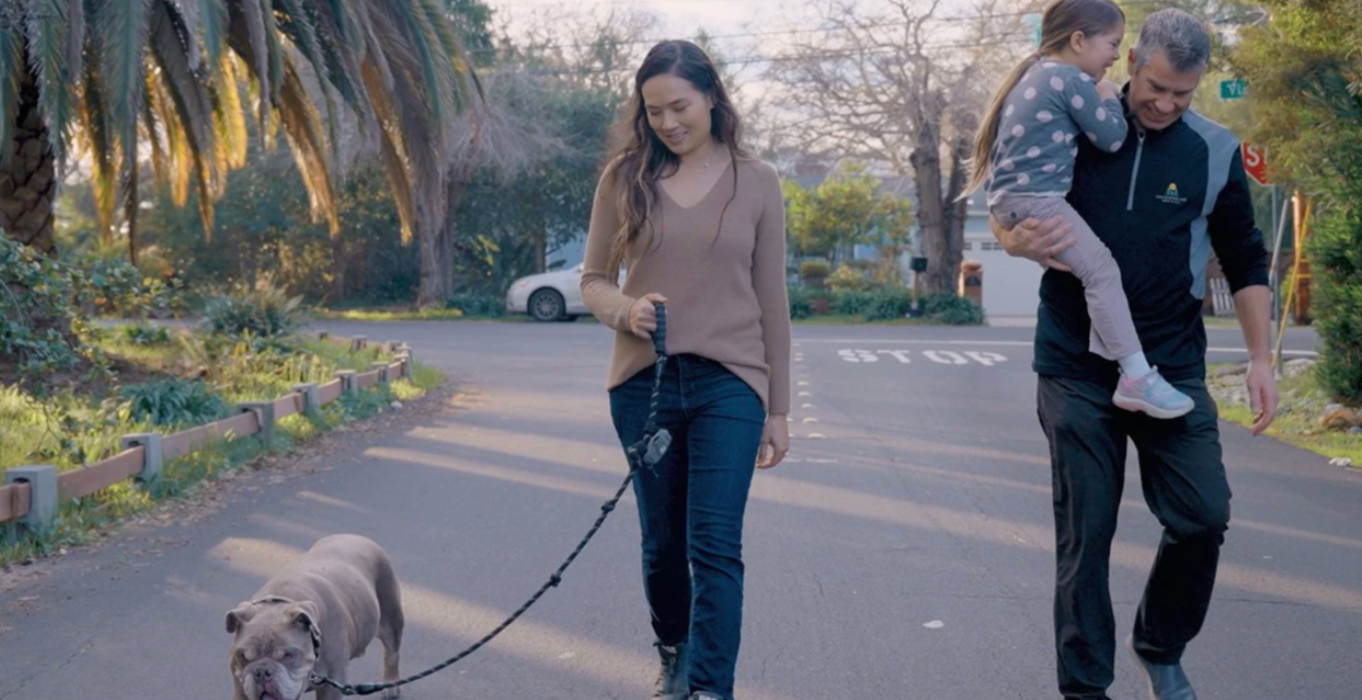
Photo credit: Jon Henderson’s campaign website // Henderson with his wife, daughter, and dog.
To add to or correct any information in this report, please email me at yashi.s@lead4earth.org or leave a comment below.
0
0

Comments