(PENSACOLA, Fla.) – The Pensacola Community Redevelopment Agency faces a $6.3 million challenge to preserve the historic Gibson School, a landmark in the local Black educational system.
With CRA officials projecting roughly a $1.75 million drop in agency revenue over the next two years due to Florida's Amendment 3 property tax adjustments, city leaders have yet to secure a dedicated funding source for the restoration.
During the meeting, Economic Development Director Steven Baham noted that of the $500,000 originally allocated to the project from the Westside district, more than half had already gone toward acquiring the property and paying the consulting fees.
“Things are tight in that area because the vast majority of all the funds there are committed to programs and to specific projects at this point,” he said, mentioning that annual revenue losses could climb to just under $2 million once the full exemption takes effect.
The 100-year-old facility had faced severe physical and environmental damage that required $2.8 million up front for critical repairs to prevent irreversible decay– a cost included in the $6.3 million total.
Due to constraints caused by the state tax changes, CRA projected the agency’s inability to finance the project internally.
At its Nov. 9 meeting, the CRA reviewed the deteriorating condition of the former school, which opened in 1921 to serve Black students during segregation. The building has suffered extensive water damage, termite damage, and structural deterioration.
While the board declined to commit internal capital funds, they directed staff to look into emergency measures and external partnerships.
Community Members Urge Preservation
Community members and civic advocates spoke out during the public comment, pressuring the officials to treat the building as an irreplaceable historic asset rather than a liability.
“Some of the potential future uses that the code allows would be, you know, with minor changes, an art gallery, a small place of worship, outpatient clinics, professional service offices, architects, lawyers, engineers, training and skill development, so you know, adult classes, and a daycare,” said Yuri Ramos.
Sylvia Marrero questioned whether the municipal leaders viewed the acquisition as a genuine effort for preservation or simply a chance to cash in on a rising real estate market.
Meanwhile, Leslie Andel urged board members to embrace public-private relationships, referencing previous historic property losses such as the John Sunday House and emphasizing that external capital models have succeeded in other Florida municipalities.
Resident Robin Resor fervently urged the agency to cover the deficit of neglected Black history, highlighting that John A. Gibson served as both a prominent 19th-century educator and one of Pensacola’s early Black aldermen.
Resor noted that the structure had only lost a single window during recent hurricanes, demonstrating the century-old building’s resilience and cultural worthiness of public investment.
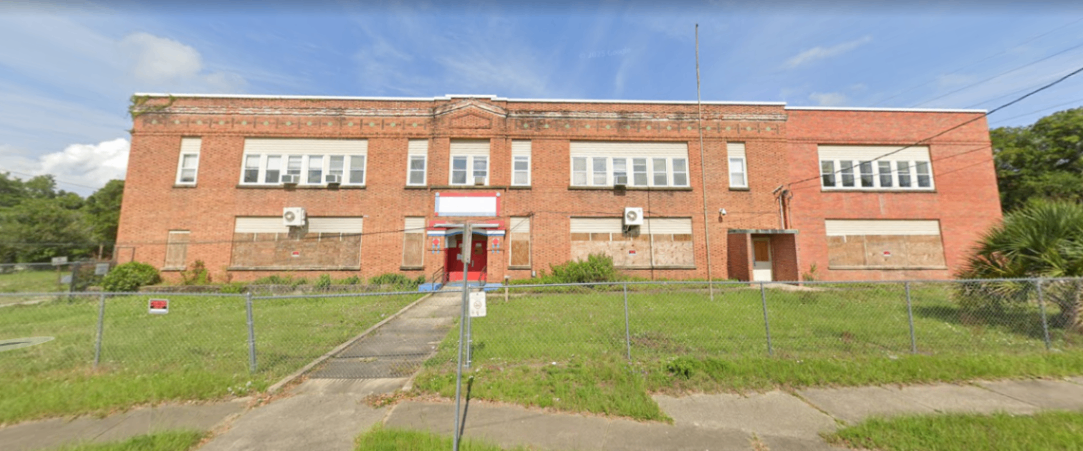
Photo Credit: Google Maps / Street View of the historic John A. Gibson School.
Other CRA Issues Discussed
Beyond historic preservation, the meeting exposed administrative and governance oversights regarding municipal land disposal.
Agency members identified a procedural error involving seven city-owned parcels slated for donation to a Community Land Trust.
Although the CRA had consistently funded maintenance and upkeep for the properties, legal staff confirmed the agency lacked disposal authority over them; it would require formal City Council approval before any property transfer could proceed.
The board also reviewed post-storm relief efforts under the CRA’s Emergency Resiliency Program and showed surprisingly limited community impact.
Out of 13 local property owners who applied for emergency structural recovery funding, only three qualified for the criteria.
Officials attributed the high disqualification rate to strict geographic boundary restrictions that excluded storm-damaged properties situated outside the CRA district lines.
Board Looks at Temporary Repairs and Outside Funding
Pensacola’s preservation funding dilemma reflected a widespread national pattern where municipalities struggle to fund the upkeep of legacy Black educational institutions.
Rather than committing major capital funds, the CRA board directed staff to explore immediate temporary stabilization options--such as blue tarp protective measures funded through existing contingency accounts while they investigate potential FEMA reimbursement for storm-related damage.
During this discussion, Board Member Patton cautioned that federal disaster funding would not provide an immediate fix for the deteriorating structure.
"This seems like too big of a chunk of the city to bite off at the moment, particularly given the circumstances, but I would love to see it preserved," Patton said, asking staff what short-term steps could stop further damage while the city weighs its next move.
Officials also noted that prior owners failed to utilize available FEMA funds following Hurricane Sally while deferring maintenance on the building.
Instead of taking a formal vote, the board directed staff to gauge interest from nonprofits, philanthropists, and private developers to help fund the $6.3 million restoration.
Through a public-private partnership, outside groups would cover part of the renovation costs in exchange for long-term lease agreements or shared community use of the building.
Watch the meeting: on https://opgov.news/platform/meeting/Pensacola-FL-US-2026-11-09-Special-Meetings.
For questions, news tips, or editorial follow-ups regarding this report, contact me at woody.f@lead4earth.org.
0
0

Comments