Editors Note: Last week, we followed Robert Storer’s campaign money. This week, follow something even more interesting: the vote that changed who votes.
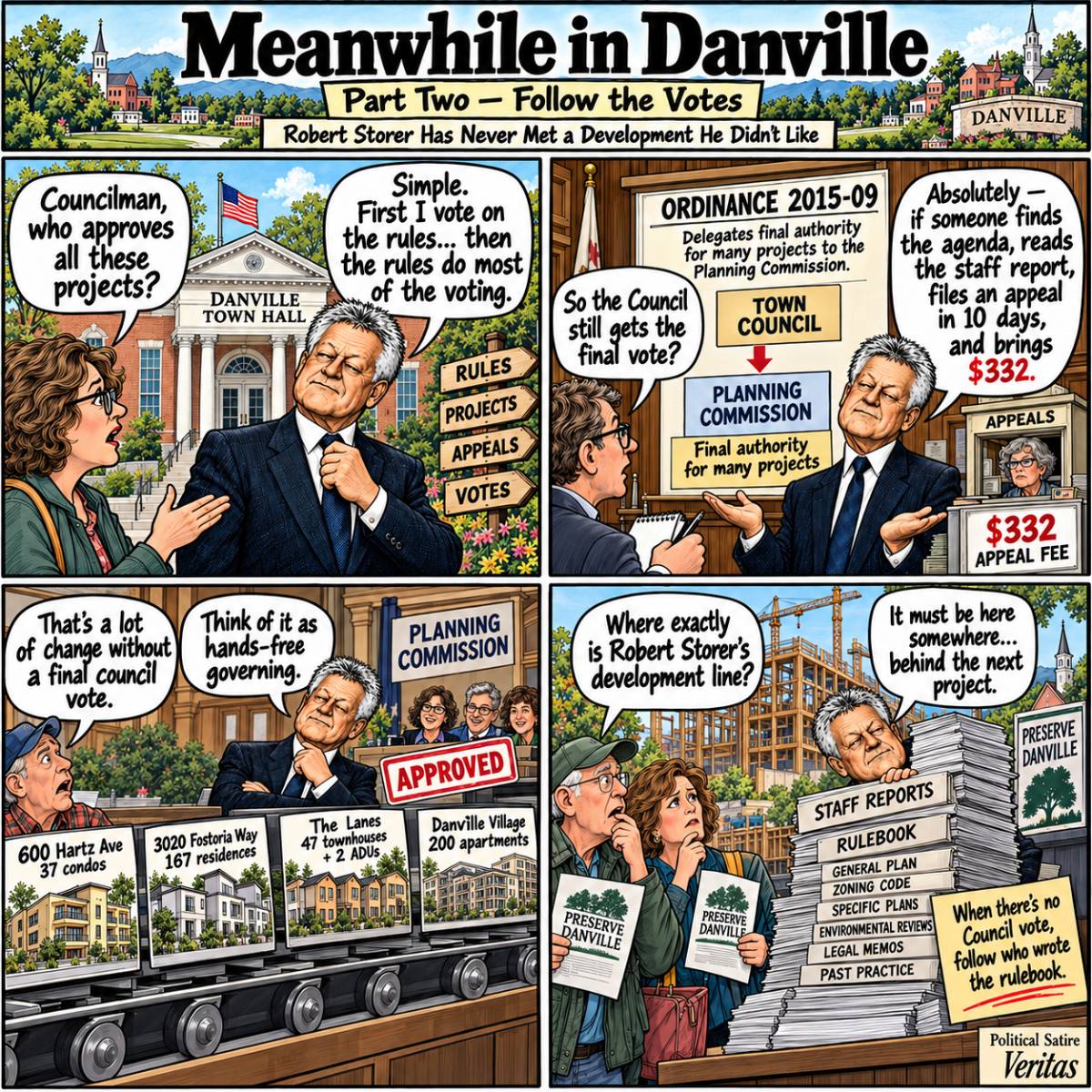
Credit: Veritas
“Robert Storer Has Never Met a Development He Didn’t Like” is satire, of course. But after eight years on Danville’s Planning Commission and 17 years on the Town Council, Storer has accumulated something more revealing than campaign slogans: a quarter-century of decisions helping shape the town.
At some point, you stop being a witness to change and become one of its authors.
Storer’s professional background makes that record particularly interesting. His work has included property development, construction, entitlements and rezoning. There is nothing wrong with that expertise. A developer may understand land use better than most people.
But putting a developer in the middle of decades of development decisions is like putting a candy-company president on a committee deciding whether children need more dessert. He may know everything about chocolate. The public still gets to ask whether anyone needs another slice of cake.
THE VOTE THAT CHANGED WHO VOTES
On November 17, 2015, Storer voted yes on Ordinance No. 2015-09, part of Danville’s development-approval framework. Under that framework, the Planning Commission has final authority over many applications, with Town Council review generally occurring only when someone appeals.
Since 2022, a review of development records identifies four major projects apparently approved without a final Council vote on the development itself: 37 condominiums at 600 Hartz Avenue, 167 residences at 3020 Fostoria Way, 47 townhouses at The Lanes, formerly Danville Bowl and 200 apartments at Danville Village.
Four projects. Roughly 450 residences. No final Robert Storer vote on their merits.
Apparently, there is more than one way to shape development. You can vote for the project, or vote for the rules that let somebody else make the final decision.
GOODBYE, DANVILLE BOWL
Consider Danville Bowl. After more than 60 years, the familiar bowling alley gave way to plans for 47 townhouses and two accessory dwelling units. On November 25, 2025, the Planning Commission approved the project, including removal of nine Town-protected trees, by a 6–1 vote.
The Town Council did not cast the final land-use approval vote.
Nobody walked into Town Hall announcing, “Good evening. Tonight, we'd like permission to permanently change the character of Danville.”
Change arrives more politely, wrapped in staff reports, density calculations and architectural renderings where the streets are empty, everybody owns a golden retriever, and nobody has trouble finding parking.
Traffic rarely makes the rendering. Neither do the neighbors.
DEMOCRACY WITH A COVER CHARGE
There is a legitimate argument for letting planning commissioners make technical decisions efficiently. State housing laws also limit local authority over many housing projects. Those realities deserve acknowledgment.
But Sacramento hasn't abolished the Danville Town Council. Local questions about design, traffic, safety, circulation and neighborhood compatibility still matter, subject to state law.
And residents who want the Council to reconsider a Planning Commission decision may have to navigate hundreds of pages of documents, meet a 10-day appeal deadline and pay a $332 fee.
The councilmember doesn't necessarily have to vote. The resident has to pay to ask for one.
Government by delegation, apparently, comes with a cover charge.
WHERE DOES STORER DRAW THE LINE?
After nearly 25 years in Danville government, Storer's experience should invite some straightforward questions.
What project is too large? What density is too much? How many parking spaces can disappear before somebody notices?
When does neighborhood character stop being a campaign promise and start becoming a planning condition?
Where, exactly, does Robert Storer draw the line?
There must be one somewhere. Perhaps it's hiding behind the next staff report.
To be fair, Storer has spoken about protecting open space, ridgelines and natural resources. Not every development is wrong, and some projects preserve open land while concentrating housing elsewhere.
But protecting open space and preserving a town's character are not automatically the same thing.
Danville doesn't change in one dramatic evening. It changes one approval, one density increase, one parking reduction and one familiar landmark at a time.
Eventually, residents look around and ask, “What happened to Danville?”
There were meetings. There were reports. There were rules. And there were votes — including votes deciding who would cast the final vote.
Robert Storer was there for nearly a quarter-century.
THE RECORD IS THE RECORD
This isn't an allegation of corruption, nor is it a claim that every project was a mistake. It's a question of judgment and accountability.
Storer has spent nearly 25 years helping shape Danville. That's a long time to promise to preserve small-town charm while helping write the rules governing what replaces it.
The question isn't simply what Storer says he wants Danville to become. It's what Danville has become while he helped make the decisions.
Next week: Part Three — THE RECORD MEETS THE BALLOT.
The election is November 3. The record is already written.
Read the record. Ask the questions. Then vote.
0
0

Comments