PART THREE — ROBERT STORER: THE RECORD MEETS THE BALLOT
Twenty-five years later, Danville voters get to decide what the record means.
By Melissa Martinez
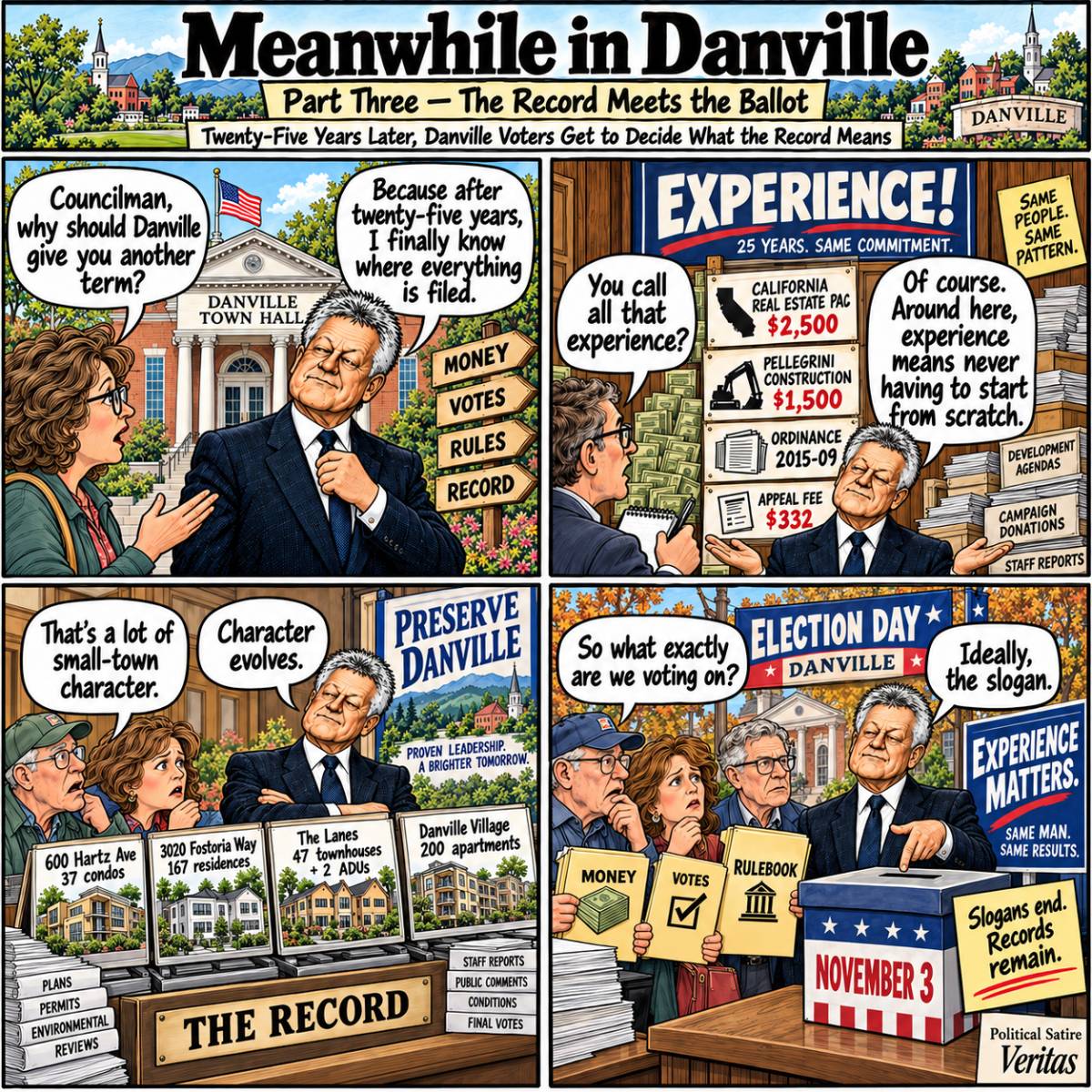
So, before November 3, the questions should be straightforward. Has Danville’s small-town character been protected as aggressively as Storer has promised?
For two weeks, this series has followed Robert Storer’s campaign money and his development record. Now the record meets the ballot. On Tuesday, November 3, Storer is asking Danville voters for another four years on the Town Council. At this point, “give him a chance” would be a difficult slogan to sell. He has already had one — in fact, he has had roughly twenty-five years inside Danville government.
Storer spent eight years on the Planning Commission and has served on the Town Council since 2009. During that quarter-century, he has reviewed development, voted on development, helped shape development rules and participated in decisions that helped determine what Danville looks like today. Twenty-five years is not a trial period. It is a record.
Part One followed the money. Through October 2, the campaign records reviewed for this series showed approximately $7,164 in 2026 contributions: $2,500 from the California Real Estate PAC, $2,000 from Jeffrey Woods, $1,500 from Pellegrini Construction and $1,000 from Robert Tiernan. Three sources supplied $6,000 of the reported total — about 84 percent. Part One also examined roughly $10,000 or more that the committee appears to have carried into 2026 from the previous campaign cycle. Those figures do not prove that any contribution bought a vote. They do tell voters who is helping finance the campaign and why the money is worth examining.
Part Three asks what voters should do with all of that information.
Part Two followed the votes — and, in some cases, the absence of one. It examined Storer’s November 17, 2015 vote for Ordinance No. 2015-09 and the development-review framework under which the Planning Commission can make final decisions on many applications unless an appeal brings the matter to the Council. The series identified four major projects since 2022 — 37 condominiums at 600 Hartz Avenue, 167 residences at 3020 Fostoria Way, 47 townhouses at The Lanes on the former Danville Bowl property, and 200 Danville Village apartments — roughly 450 residences in all, where the principal land-use approval appears to have occurred without a later Town Council vote on the merits.
The answer is not complicated: follow the money, follow the votes, follow the rulebook, compare the promises with the outcomes, and then make your own judgment.
Storer has long emphasized experience, and after 17 years on the Council nobody can reasonably argue that he lacks it. But experience is an interesting campaign credential. Early in a political career, it means, “Trust me, I know how government works.” After seventeen years, it means something more useful: “Here is what government did while I was there.”
That is the advantage voters have in 2026. They do not have to imagine what Robert Storer might do with another term. They can look at what happened during the terms he already had.
They can examine the campaign money and ask why so much of the reported 2026 total came from the Real Estate PAC, Pellegrini Construction and another large donor highlighted in Part One. They can examine the development votes and ask why Storer supported the 2015 framework that determines when the elected Council does — and does not — cast the final vote. They can examine The Lanes, where the Planning Commission approved 47 townhouses and two accessory dwelling units on the former Danville Bowl property without a final Council vote on the land-use merits. And they can ask whether residents should have to navigate a 10-calendar-day appeal period and pay $332 simply to place a major Planning Commission decision before their elected Council.
Then they can compare that record with one of the most familiar promises in Danville politics: protecting the town’s “small-town character and charm.”
It is a wonderful phrase. It fits nicely on a campaign mailer and looks even better next to a tree, a white picket fence or somebody drinking coffee on Hartz Avenue. But after nearly twenty-five years, campaign slogans have competition.
It is called the public record.
Storer can fairly point to years of public service, knowledge of land-use law, open-space preservation and experience navigating increasingly restrictive state housing mandates. Those are legitimate parts of his record. Critics can point to increasing density, major housing projects, traffic and parking concerns, development decisions that did not receive final Council votes and the overlap between Storer’s professional development background and his role in Town government.
That is what a long record looks like. It contains accomplishments, controversies, compromises and questions that cannot be answered by a campaign postcard.
Call it the “Developers Club” if you like. That is satire, not the name of an actual organization. But the overlap is worth examining: a professional developer, a former Planning Commissioner, a longtime councilmember, a participant in development rules, a candidate receiving substantial campaign support from the real-estate and construction world, and a public record spanning nearly a quarter-century. Follow the money long enough and it reaches the development world. Follow the votes long enough and they reach the rulebook.
None of that proves corruption. It does not prove every development was wrong, and it certainly does not mean Danville should never build housing. It means voters have something better than campaign advertising.
They have history. And history is considerably harder to fit on a lawn sign.
So, before November 3, the questions should be straightforward. Has Danville’s small-town character been protected as aggressively as Storer has promised?
Has the balance between development and preservation been right? Should projects representing hundreds of new residences be able to become final without a named vote by elected councilmembers? Should residents have to meet a 10-day deadline and pay $332 simply to obtain Council review? And after nearly twenty-five years helping shape Danville, what does Storer’s record say about the direction another four-year term would represent?
Those are not trick questions. They are what elections are for.
The 2022 Council race did not give Danville voters that kind of choice. Two candidates qualified for two seats, and the election was canceled. This time voters actually get to decide among candidates for the open Council seats. That makes November 3 more than another campaign season. It is an opportunity to examine a quarter-century record.
Not a résumé. Not a slogan. Not a glossy mailer.
A record.
Some voters may look at that record and conclude that Storer’s experience has served Danville well. Others may look at the same record and conclude that the Town would benefit from a different approach. That judgment belongs to the voters.
But it should be an informed judgment.
Part One followed the money. Part Two followed the votes and the rulebook. Part Three brings both to the ballot. The numbers, the projects, the procedures and the promises are no longer separate stories. Together they form the record voters can examine before deciding what twenty-five years of experience — and twenty-five years of outcomes — mean for Danville’s next four years.
Read the record. Ask the questions. Follow the money. Follow the projects. Follow the rules. Follow the votes — and when there is no Council vote, ask who wrote the rulebook. Then look around Danville and make your own judgment.
On November 3, the campaign slogans will stop mattering. The record will not. After nearly twenty-five years in Danville government, Robert Storer is not asking voters to judge a promise. He is asking them to judge a history.
Read the record. Ask the questions. Then vote.
0
0

Comments