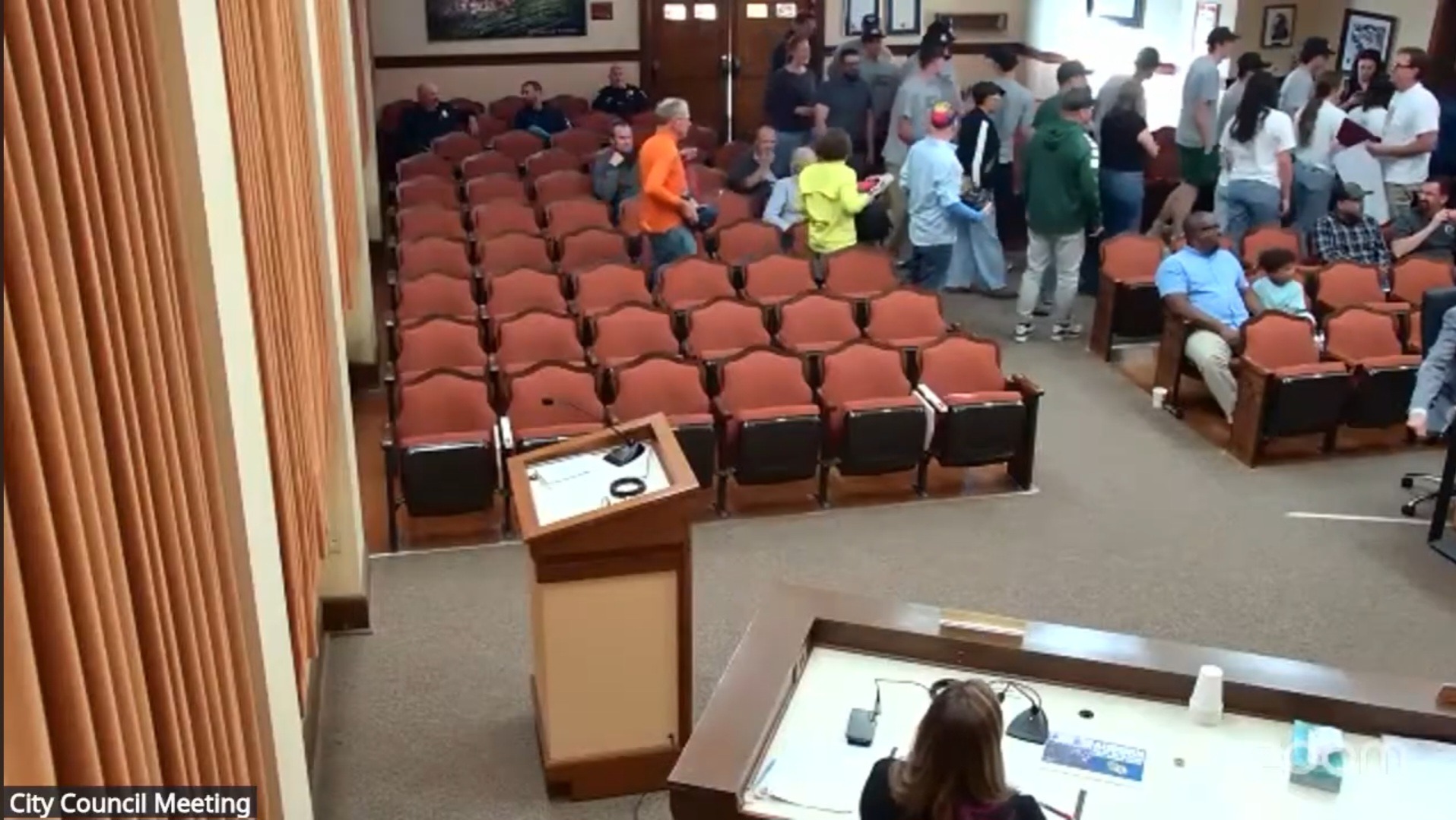
Image Source: Auburn City Council via YouTube
(Auburn, CA) — What began with loud applause—Auburn’s proclamation of May as “Bike Month”—ended in a nearly empty council chamber.
At the last meeting of the Auburn City Council, Mayor Kelley Davis opened by noting a “full house of many high schoolers.” Students from Placer High School had come to be recognized for a rare achievement: both the boys’ and girls’ Division III basketball teams had claimed championships, the first such titles since 1990 and 2018 respectively. After a brief statement from their coach and a round of photos with the council, the moment ended quickly.
Mayor Davis, smiling, offered what she called the “best news”: the students did “not have to stay.” They didn’t. The athletes filed out, followed by their families.
Councilmember Amara gently pushed back gently, suggesting the students remain, calling it “government in action.” Vice Mayor Rachel Radell-Harris, lightening the mood, joked about calling an “intermission while most of the people leave the room.” Laughter followed. Chairs scraped. The crowd thinned.
The filing out of a large audience leaves the chambers virtually emptied.
Video Source: Auburn City Council via YouTube
After the room emptied, work moved on to routine approvals and public comments. Auburn resident Charlie Engan approached the podium with a modest but specific concern: five additional “No Dumping” signs along Brewery Lane. Drawing on informal conversations with roughly 30 nearby residents, Engan argued the signage was “an overcorrection relative to the actual conditions,” creating a “negative visual impact” without addressing a significant problem. City staff were directed to follow up.
Another joke about the emptying of the chambers was said before Auburn Police Chief Bryan Morrison outlined the department's 2025 Annual Report to the council. The Chief described the year as one “of transition,” shaped by fiscal hardships that the department navigated without layoffs. He noted the addition of three volunteers and highlighted the promotion of Community Services Officer Kimberly Aronda following her graduation from the Sacramento Police Academy.
The annual report showed steady improvement. Arrests fell by 23 percent overall, with declines across crimes against persons, property, and society. Only one category held steady: arson, with a single arrest in both years. Additionally, the department responded to more than 17,000 calls for service, meeting what Chief Morrison described as California “best practice suggestions” for response times.
Then, briefly, the orderly flow of the meeting broke.
From the audience, a woman interrupted—her voice insistent. “They didn’t respond to me.” Parts of her remarks were difficult to hear, but the urgency was clear. Mayor Davis called for order, striking her gavel. “No—I want answers!” the woman shouted, “why, what have I done?”
Chief Morrison stepped away from the podium and the woman was instructed to wait until the public comment period. The council hesitated, then continued. The door closed and the chief returned to the podium to resume his presentation.
A woman interrupts Chief Bryan Morrison. Video Source: Auburn City Council via YouTube
The report moved on to longer-term issues: seven active cold cases, homeless outreach showing measurable progress, with chronic homelessness reduced from 14 individuals to six; four people had been placed into permanent housing through continued engagement rather than enforcement. Traffic collisions declined by roughly 26 percent and dispatchers exceeded state benchmarks, answering 93 percent of 911 calls within 15 seconds.
The Chief also discussed the establishment of a “Youth Advisory Council” and engagement in “youth outreach”—an idea that stood in contrast to the high-achieving students who had already left the room.
While by the numbers the system appears to be improving, questions of public trust surfaced. Vice Mayor Radell-Harris raised “concerns” from the community about license plate reader cameras. Chief Morrison acknowledged that some devices had been removed and thrown into a “nearby canal” and emphasized that the Flock system used collected data feeds into state-level systems, not federal databases.
Later in the meeting, the council voted 4–1 to approve a city-funded fireworks display marking the 250th anniversary of the Declaration of Independence. Councilmember Amara cast the lone dissent, citing cost and priorities and warning that such a “high-risk” event could divert resources from essential city services.
The meeting began and ended with a brief recognition of longtime local record store owner Al Lauer—known to many as “Mr. Cherry Records”—who passed away on April 19.
But by then, the applause was gone—and so was the crowd.
To add to or correct any information in this report, please contact me at robert.m@lead4earth.org or leave a comment below with your thoughts
2
0

Comments