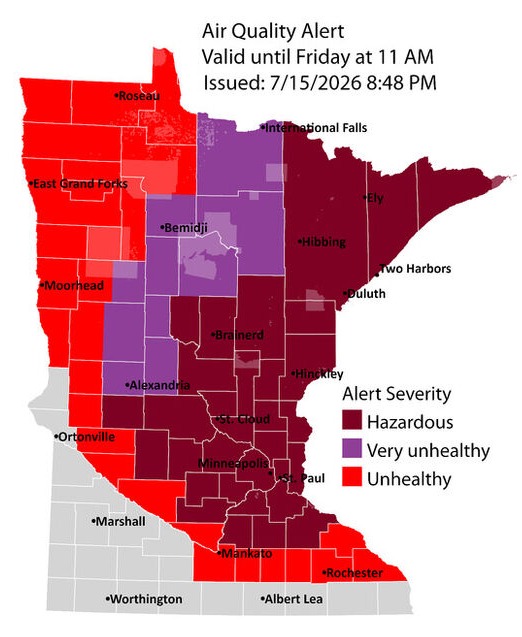
Photo Credit: Minnesota Pollution Control Agency / July 15
(MINNESOTA) – Around 20 wildfires are currently burning across northern Minnesota. Governor Tim Walz activated the Minnesota National Guard to support firefighting efforts in the northern part of the state, declaring the fires a peacetime emergency. Initial findings support the idea that the fires were started by lightning from July 6-7 storms, and the spread was intensified due to extreme heat and dry conditions.
Five fires are burning in the Boundary Waters Canoe Area Wilderness (BWCAW) alone. A large portion of the BWCAW spanning Crane Lake, northern Ely, and the up to the Canadian border has been closed. Visitors have been evacuated from the area, and US and Canadian firefighting and forestry teams have been conducting water drops in difficult to reach areas containing smaller remote fires, as ground teams continue to fight the larger more accessible fires.
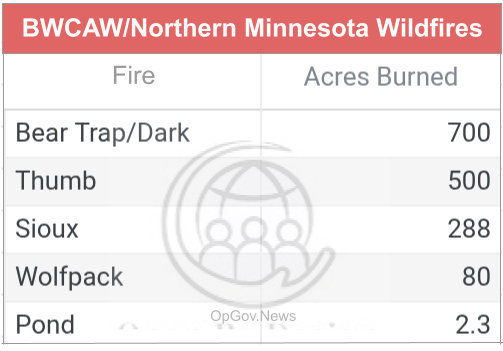
The largest are the Bear Trap/Dark, Thumb, Sioux, Wolfpack, and Pod fires, which have burned more than 1,300 acres combined. Low humidity mixed with strong winds and dry vegetation have created perfect conditions for the fire to spread. The Bear Trap/Dark fire is currently burning toward Crooked Lake, and the Sioux fire continues to spread toward the BWCAW.
On July 12, the U.S. Forest Service released a statement saying, “Some wildfires experienced increased growth this afternoon due to higher winds, low vegetation moisture, and low relative humidity. Smoke columns are visible from nearby communities.” Newer, small fires have been detected daily since the first initial fire broke out.
Video Source: YouTube / MPR
A statewide air quality alert was issued by the Minnesota Pollution Control Agency for July 15-17, as the fires from Northern Minnesota and Southern Canada have created hazardous levels of smoke.
Residents in most of Minnesota are urged to stay indoors and avoid outdoor activity as much as possible, especially those with medical conditions that may be exacerbated by the smoke. This includes anyone with heart or lung disease, asthma, severe allergies, COPD diabetes, pregnant women, children, and the elderly. Those who work outdoors will be most at risk during this time.
To add to or correct any information in this report, please contact me at kristin.h@lead4earth.org.
0
0

Comments