(ASBURY PARK, N.J.) — A 2004 redevelopment report obtained by OpGov.news provides the most detailed look yet at what developers envisioned for the restoration of Asbury Park's historic Casino complex, outlining millions of dollars in proposed rehabilitation work, structural repairs, environmental remediation and the partial reconstruction of one of the city's most recognizable landmarks.

(Image of the Clarke Caton Hintz report.)
The Casino, a century‑old structure anchoring the southern end of the Asbury Park Boardwalk, is one of the city’s most recognizable historic landmarks and a central feature of the waterfront redevelopment zone.
The report, prepared by the architectural and planning firm Clarke Caton Hintz pursuant to Section 3.5 of the City's 2002 Redeveloper Agreement with Asbury Partners, was intended to evaluate the condition of the Casino and Power Plant and recommend a path forward for redevelopment.
According to the report, the redevelopment agreement required the developer to provide "a report by an appropriate professional firm(s) reviewing the condition of each property and recommendations for the rehabilitation or demolition (limited to the rear of the Casino building) if necessary and the costs of renovation along with a detailed schedule."
A $33.6 million redevelopment proposal
Supporting construction estimates prepared by Becker & Frondorf on Nov. 22, 2004 projected approximately $33.6 million in redevelopment costs for the Casino complex, including the Carousel, Arcade, Arena and Power Plant components. The estimates break down anticipated costs for demolition, structural work, restoration, mechanical systems, electrical upgrades, roofing, masonry repairs and interior construction.
The estimates envisioned significant investment throughout the complex, including restoration of historic architectural features, rehabilitation of the Arcade and Carousel, extensive work to the Power Plant, and construction of a new Arena structure.
Engineers found extensive structural deterioration
The report describes a building that had suffered decades of deterioration before redevelopment planning began.
According to Clarke Caton Hintz, portions of the Casino had reached "an advanced state of deterioration." The report states that the original metal roof over the arena section had been replaced with a tar-paper roof that ultimately failed, leaving the arena exposed to the elements and causing extensive structural damage.
The report incorporates findings from consulting structural engineer John N. Harrison, who concluded that most of the arena's structural framework should be removed and replaced rather than restored because of its deteriorated condition.
Harrison wrote that the structure had "been neglected and exposed to the elements for too long of a period" and concluded it likely could not meet modern building code requirements without major reconstruction.
Based on that assessment, the redevelopment proposal called for rehabilitating the Carousel and Arcade while demolishing and replacing the approximately 40,000-square-foot arena section with a new structure occupying the same footprint and designed for retail and entertainment uses.
Historic preservation remained central
Although portions of the Arena were proposed for replacement, the report emphasizes preserving the Casino's historic character.
(OpGov.news graphic.)
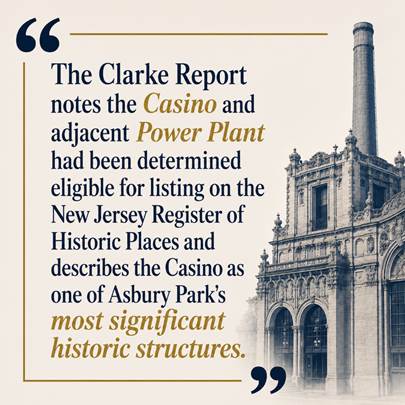
The Clarke report notes both the Casino and adjacent Power Plant had been determined eligible for listing on the New Jersey Register of Historic Places and describes the Casino as one of Asbury Park's most significant historic structures.
The report also references permit conditions requiring rehabilitation work to comply with the U.S. Secretary of the Interior's Standards for Rehabilitation and requiring review by the New Jersey Historic Preservation Office before construction could begin.
Environmental concerns documented
The report also summarizes environmental investigations performed at the property.
Among the issues identified were underground storage tanks, petroleum-contaminated soils, groundwater contamination associated with earlier fuel storage systems and additional environmental conditions requiring review before redevelopment. The report summarizes recommendations from environmental consultants regarding further investigation and remediation before construction.
Questions remain
The report provides a detailed snapshot of the redevelopment vision that existed in 2004, but it does not answer the legal question now dividing City officials and critics: whether the recommendations and construction program ultimately became enforceable redevelopment obligations under the City's agreement with Asbury Partners.
That issue remains at the center of an ongoing legal dispute following retired Superior Court Judge David Solomon's recent opinions interpreting the City's redevelopment agreements.
OpGov.news has requested additional records from the City of Asbury Park concerning the acceptance and implementation of the Clarke Caton Hintz report and will continue reporting as additional documents become available.
Note to readers: Redevelopment Attorney Joseph Maraziti has contacted OpGov.news and indicated he is willing to discuss the ongoing legal dispute surrounding the Casino redevelopment. OpGov.news intends to interview Maraziti as part of its continuing coverage and will update this story with any additional information or clarification he provides.
If you’d like to add or correct anything in this report, feel free to reach out to me or leave a comment below. If you have any Asbury Park story tips or ideas, please reach out to Sarah Denos at sarahkdenos@gmail.com.
10.Clarke.Caton.Report
10.Clarke.Caton.Report.pdf
0
0

Comments