(ATLANTA, Ga) -- A couple of laws will impact Georgia public schools when the 2026 school year begins.
Law HB340, also known as the Distraction-Free Education Act, bans personal internet-connected devices like phones and smartwatches in schools during instructional time and school activities.
School districts must have the policy in place by July 1, 2026.
“The purpose of the law is to promote a positive learning environment free from electronic distractions,” according to the Georgia Department of Education website.

Georgia Department of Education Website
The website notes that studies have shown that the presence of a cellphone reduces available cognitive capacity and that smartphone bans result in a 43-46% reduction in bullying.
Law HB 268, also known as Ricky and Alyssa’s Law, requires districts to provide suicide awareness training for grades 6-12 and implement an anonymous reporting system for threats and mental health issues.
OpGov.ai reached out to the Cobb County School District and Fulton County School District for comment.
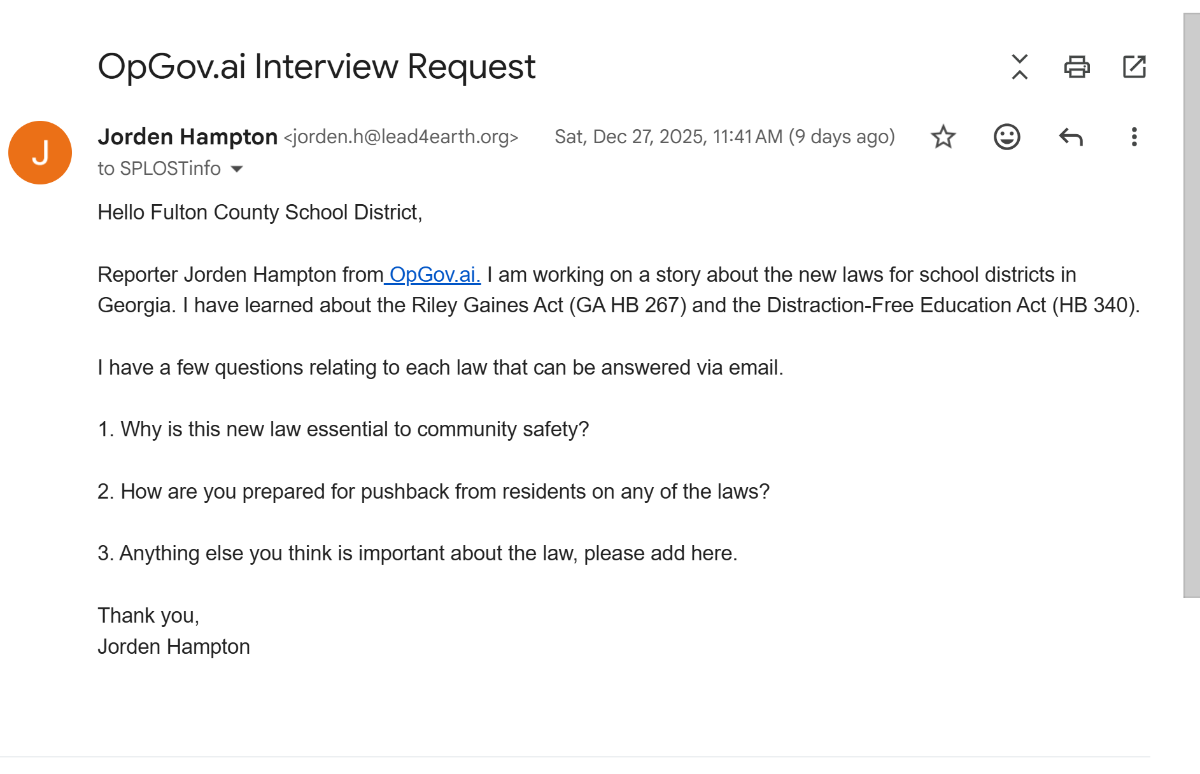
Photo Credit: Jorden Hampton
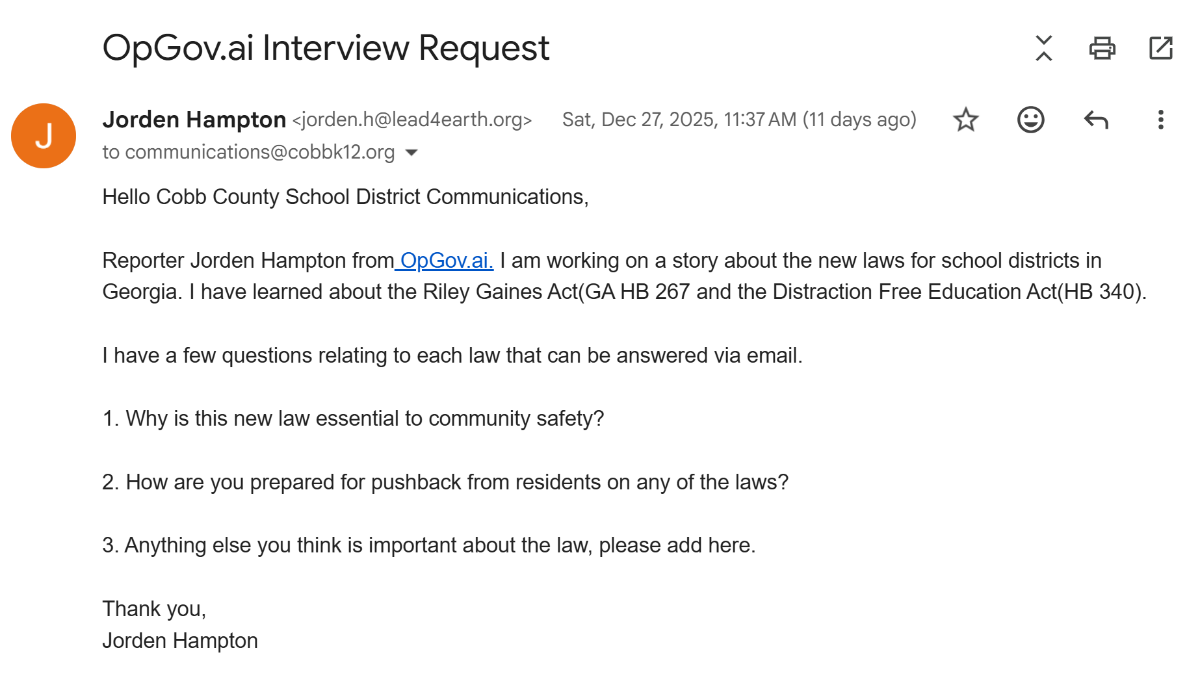
Photo Credit: Jorden Hampton
This real-time reporter reached out to residents via NextDoor and received mixed responses.

Reporter Jorden Hampton reaches out to community (Photo Credit: Jorden Hampton / NextDoor account)

Reporter Jorden Hampton reaches out to community (Photo Credit: Jorden Hampton / NextDoor account)
“I applaud both of these,” NextDoor user Janet Ellis said.
Some residents shared concerns about kids learning about suicide in school.
“Any subject taught or mentioned interjects into the hearer's awareness a topic that may never have been a thought,” NextDoor user Dianne Hadaway said. “I would not want my 6-12th grader in a group setting where suicide was the topic.”
“I don’t like the idea of teaching s- prevention to students,” NextDoor user Betsy Markman said. “I think it gives kids ideas they otherwise wouldn’t have. Look into how “successful” D.A.R.E. education was in the 80s & 90s. S- prevention education should be for the school staff.”
Suicide is a sensitive topic that can be scary to discuss in an academic setting.
It's nice to see that people care about the laws and have strong opinions. Some of the residents may have children, so speaking up makes sense.
The post received over 1,000 views.

Views for post (Photo Credit: Jorden Hampton NextDoor account)
Georgia isn't the only state that is banning cell phone usage in class.
According to AmericanConsumer.org, around 38 states already have active phone-related laws or policies.
The website adds that the National Center for Academic Statistics also reports that public school leaders see a negative impact from cell phone use in classrooms.
OpGov.ai also reached out to Congresswoman Nikema Williams, who serves Georgia's Fifth Congressional District.
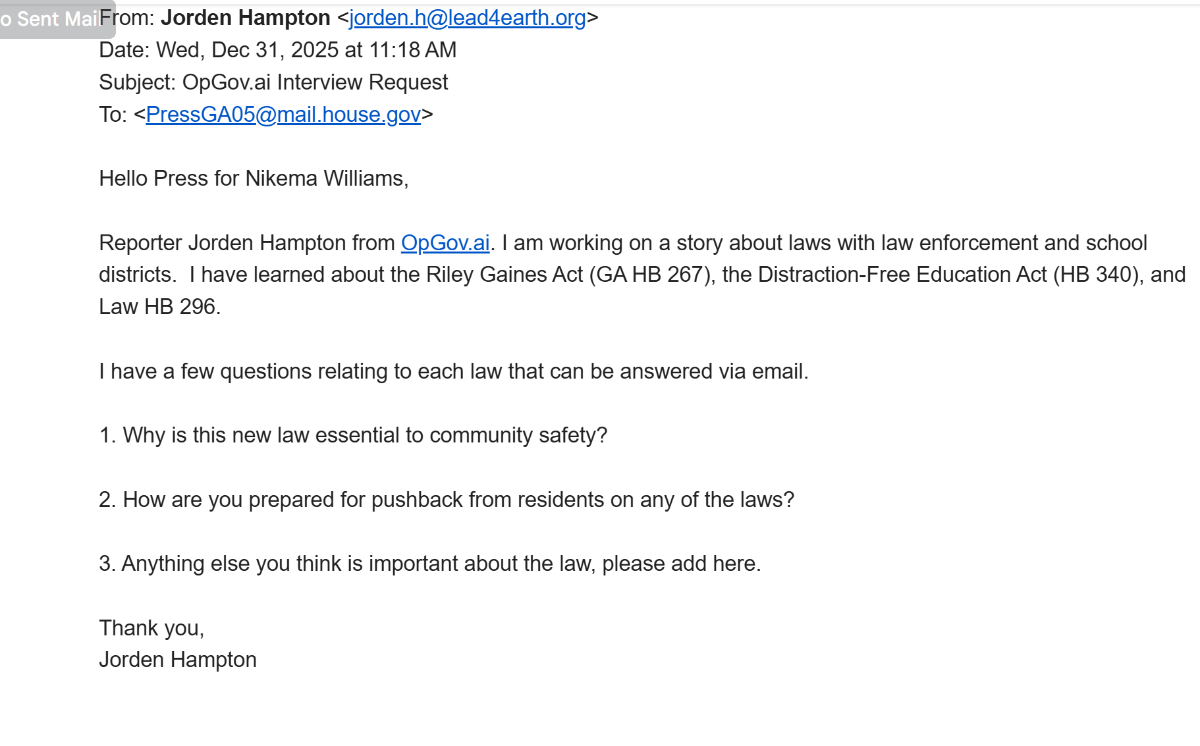
Initial email sent to Nikema Williams (Photo Credit: Jorden Hampton
The platform didn't receive a response from Williams. Not responding is damaging because the laws are significant, and Congress officials like Williams should be willing to share their thoughts.
If you have any additional comments, questions, or concerns, please contact jorden.h@lead4earth.org.

Comments