(CHARLOTTE) — The Metropolitan Public Transportation Authority held its inaugural meeting Dec. 18, at the Valerie C. Woodard Center, formally launching a new regional body tasked with overseeing public transit planning and governance in Mecklenburg County following voter approval of the Public Access to Valuable Equity Act (P.A.V.E.) referendum.
The meeting opened with welcome remarks, the presentation of colors, and the administration of oaths of office to newly appointed trustees representing Charlotte, Mecklenburg County, and surrounding towns. Mayor Vi Lyles administered the oaths, marking the official start of the authority’s work.

Members of the Metropolitan Public Transportation Authority Board of Trustees at the Valerie C. Woodard Center in Charlotte. (PHOTO: CITY OF CHARLOTTE)
“Today is an important moment for Mecklenburg County because a commitment is being forged,” said Mark Jerrell, chair of the Mecklenburg Board of County Commissioners. “As we embark on this journey together, let us remember this moment, let it serve as a reminder that when we lead with respect, when we center on people, and when we stay anchored in our why, we can build something that truly moves Mecklenburg County forward.”
Trustees also elected officers and selected term lengths before turning to the primary action item of the evening: adoption of the P.A.V.E. Act Studies Report. The report, required by state law, examines the feasibility of transferring public transit operations, assets, and oversight from the City of Charlotte and the Charlotte Area Transit System to the newly created authority.
Recent research from the Mineta Transportation Institute shows that robust benefit-cost analysis of public transit investments can help regional authorities, such as the newly formed Metropolitan Public Transportation Authority, prioritize projects that deliver the greatest economic and social returns for riders and taxpayers.
A statewide benefits-of-transit analysis from the North Carolina Department of Transportation similarly highlights that effective public transportation systems increase access to jobs, reduce household transportation costs, and improve overall quality of life.
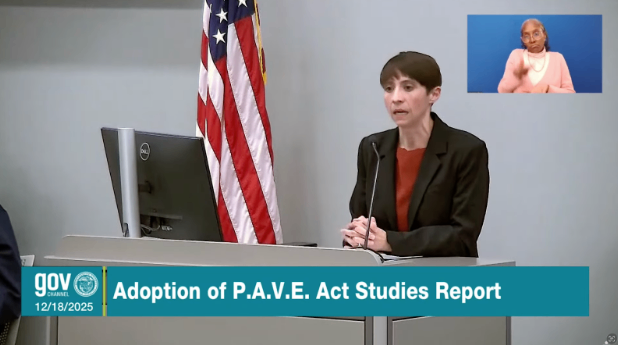
Katherine Claudefelter, an attorney with Parker, Poe, Adams and Bernstein, presents findings from the P.A.V.E. Act Studies Report. (PHOTO: CITY OF CHARLOTTE)
Katherine Claudefelter, an attorney with Parker, Poe, Adams and Bernstein, outlined the legal framework guiding the transition and emphasized that the process is expected to occur in phases.
“It is under the interlocal cooperation statute,” Claudefelter said. “That will allow the Authority and the city to undertake a time of use and operation of the public transit system that exists while some assets remain with the city with the debt while some assets are able to transfer and operations are able to transfer.”
The report identifies several constraints affecting the pace of the transition, including long-term debt obligations, federal grant requirements, and employee benefit structures. Some transit assets are tied to certificates of participation and federal funding agreements that prevent immediate transfer of ownership, requiring interim operating agreements between the city and the authority.
The authority’s creation comes amid broader growth-related planning pressures in Charlotte and Mecklenburg County. The meeting coincides with ongoing land-use and zoning decisions by Charlotte City Council, where officials have recently approved dozens of rezoning petitions tied to density increases and transit-oriented development as the city continues to expand.
Trustees noted that the additional one-cent sales tax approved by voters will provide a dedicated funding stream for transit investments, including expansion, maintenance and long-term system planning. Studies on transit funding and governance models show that voter-approved local sales taxes have become one of the most common mechanisms for stabilizing public transportation systems amid rising costs and post-pandemic ridership shifts.
Beyond infrastructure and funding, several speakers emphasized the role transit plays in residents' daily lives across the region. Transit access has increasingly been framed as an equity issue, particularly during winter months, as highlighted in recent reporting on warming centers and temporary shelter services for unsheltered residents who rely heavily on public transportation.

Members of the Metropolitan Public Transportation Authority trustees were sworn in and voted to adopt the P.A.V.E. Act Studies Report. (PHOTO: MECKLENBURG COUNTY)
With the adoption of the P.A.V.E. Act Studies Report, the authority will now move forward with developing formal agreements, operational plans, and timelines for assuming greater control of the transit system. Copies of the report will be submitted to state legislative leaders, local governments, and public agencies as required by law.
The board adjourned following closing comments, with future meetings expected to focus on governance policies, budgeting, and long-term transit priorities for the Charlotte region.
If you would like to add to this report, please contact me at Victoria Osborne at victoria.o@lead4earth.org.

Comments