Photo Credit: Google Gemini / Website
(UNITED STATES) – Google has placed a cap on Meta’s Gemini AI computing capacity. The cap wasn’t personal; Google capped several clients, but it did come at a bad time for Meta. Google told Meta in March that it simply couldn’t meet the demand considering other clients. Despite receiving the information, Meta moved forward with plans to announce major updates to its AI model Muse Spark (codename ‘Avocado’).
Chief AI Officer Alexandr Wang announced the update to Muse Spark, ‘Watermelon’ would contain improved coding and require less human interaction to achieve goals.
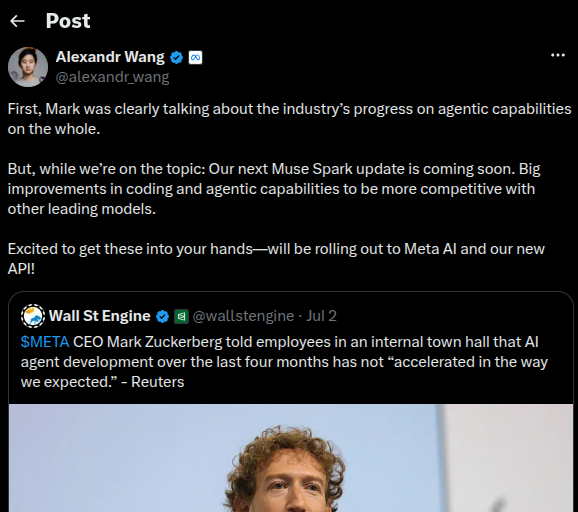
Photo Credit: X / Alexandr Wang
So why did Meta rent Gemini when it has its own open-sourced AI model named Llama? Well, Llama doesn’t perform as well as Gemini in regards to coding and autonomous action. Instead of upgrading the model, renting Gemini’s computing capacity seemed like a better option – until it wasn’t. The company also uses Anthropic’s Claude AI to perform some of the heavy lifting, but Gemini is currently the key to the success of ‘Watermelon’.
The cap isn’t Meta’s only issue surrounding AI.
The company initially encouraged employees to consume mass quantities of AI tokens. Estimates put AI token spending at $50k per Meta employee annually, and further estimates allege that employees used 60 trillion AI tokens in a single month at the beginning of this year. In a sharp turnaround, Meta is now encouraging its employees to rely more on its internal coding assistant versus third-party alternatives.
For context, most AI providers charge clients by how many AI tokens they use. Cost is divided between prompts and documents sent (input tokens), and AI-generated responses (output tokens). AI output tokens are marginally more expensive because they include the generated response of the AI tool used.

Photo Credit: Pixabay / Tung Nguyen
This leaves Meta scrambling to prioritize upgrades to Muse Spark, the first AI model from Meta Super Intelligence Labs, to reduce reliance on external AI providers for future models. The question is whether upgrades will arrive in time to make the Gemini cap irrelevant or if Meta will need to temporarily slow its role in AI and the release of Watermelon.
While the two have been confused, Wang says the upcoming Watermelon AI model is not Muse Spark (though it is an upgrade to the model). Regardless of the cap, he told employees Meta Watermelon has already met and matched all the same internal AI criterion as GPT-5.5.
The AI model is still being trained, but it already uses ten times more computing power than Muse Spark. It sounds like Meta is in the running to become a major contender in AI, but there’s a problem – so far, the claims are unfounded.
The test results showing Watermelon meets GPT-5.5 criterion aren’t available, and tests were performed internally, not by an independent third-party. No specific benchmarks were named, and no independent tests have been performed on Watermelon (to date) that can back the results alleged by Wang. If Meta doesn’t release the criteria it used to determine the AI model's equivalency to GPT-5.5’s benchmarks, it’s impossible to tell if it really has the capabilities Meta claims.
Additionally, AI is evolving every day; criteria used to determine if an AI model is improving will also evolve regularly. Case in point, OpenAI has already introduced a limited version of GPT-5.6, effectively making Watermelon comparable to a newly outdated version of the tool.

Photo Credit: Aterio / Meta Prometheus, Ohio
What is known is that Watermelon has a massive training scale and is far improved over Meta’s prior AI models. The model is being trained on Prometheus, Meta’s Ohio AI supercluster. The buzz is that Watermelon may be capable of ranking among some stronger AI models, but it still isn’t comparable to models from the big three in AI: OpenAI, Anthropic, and Google.
Meta is primarily training Watermelon using proprietary data from Facebook, Instagram, WhatsApp, and Threads, relying more on private datasets versus the public data most of its competitors use. Depending on what one considers relevant data, this could be an advantage or a shortfall. Either way, only independent testing will determine if Watermelon lives up to Meta’s current claims, and only time will tell if the cap on Gemini creates further delays in its release.
To add to or correct any information in this report, please contact me at kristin.h@lead4earth.org.
0
0

Comments