(CHARLOTTE) — As North Carolina’s newly enacted Iryna’s Law takes effect, Mecklenburg County officials are beginning to outline how the legislation could reshape public safety and detention operations, even as key questions remain unanswered by other parts of the local criminal justice system.
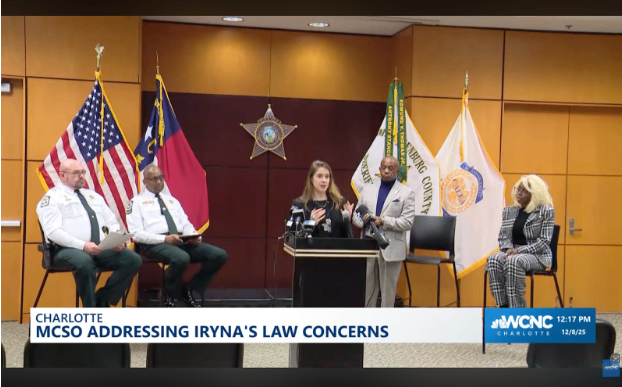
Sheriff Gary McFadden acknowledged the tragedy that prompted the legislation, while emphasizing that the issue reflects a broader national pattern. (PHOTO: WCNC)
During a recent press conference, officials with the Mecklenburg County Sheriff’s Office (MCSO) addressed public concerns surrounding the law, which limits pretrial release for certain violent offenders following a high-profile killing on a Charlotte light rail platform. The law is intended to keep individuals accused of serious violent crimes in custody while their cases move through the court system.
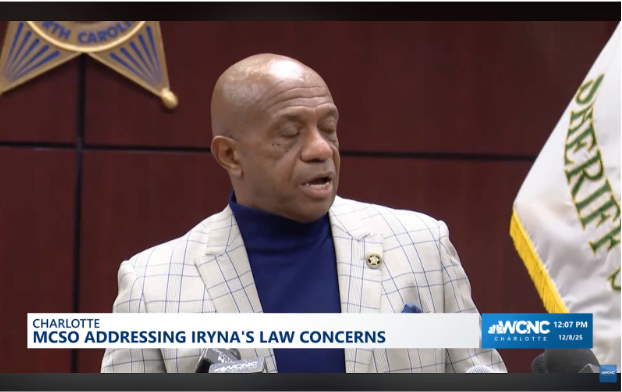
Sheriff Gary McFadden addresses the media on Iryna’s Law, noting its intent to improve public safety. (PHOTO: WCNC)
“This is a tragedy in our city, but it is one of the tragedies that has been highlighted all over the U.S.,” McFadden said.
MCSO leadership emphasized that while the law is designed to improve public safety, its local implementation presents significant logistical challenges, particularly related to jail capacity, staffing, and long-term resource needs. Officials warned that the county jail system was not designed to absorb a sustained increase in pretrial detainees.
“This law will cause our detention centers to rise,” McFadden said. “We will have more people staying inside of a detention center for a longer stay than normally because it attacks the new bond referendum.”
Detention Center administrators said those impacts are already beginning to materialize. Major A. Draw, who oversees detention operations, noted a sharp year-over-year increase in the jail population.
“Right now, it’s about an 18% increase from the same time last year,” Draw said. “The detention center reflects the community it serves.”

Major A. Draw speaks during a Mecklenburg County Sheriff’s Office press conference. (PHOTO: WCNC)
Officials cautioned that longer detention periods could place additional strain on correctional officers, medical services, and infrastructure, requiring close coordination with county leadership and the courts. At the same time, MCSO leaders stressed their obligation to carry out the law as written.
“Our mission is to not only detain but also rehabilitate and prepare individuals to reenter society,” Draw said.
While the Sheriff’s Office has publicly addressed these concerns, every other agency contacted for this story did not respond, despite multiple requests for comment.
As of publication, the Mecklenburg County District Attorney’s Office has not responded to repeated inquiries regarding how Iryna’s Law is affecting prosecutorial decisions, pretrial detention requests, or court capacity. The Charlotte-Mecklenburg Police Department (CMPD) also did not respond to multiple requests for comment about whether officers have observed changes in arrest procedures, repeat offenses, or workload since the law took effect.
The lack of response leaves unanswered questions about how Iryna’s Law is functioning across the broader criminal justice system, from arrest to prosecution to detention, and whether additional funding, staffing, or policy adjustments will be required at the county level.
Supporters of Iryna’s Law argue the measure closes gaps that previously allowed individuals accused of violent crimes to return to the community too quickly. Critics, including legal advocates and county officials across North Carolina, have warned that without additional resources, the law risks exacerbating overcrowding in already-strained jail systems.
For Mecklenburg County, those tensions are now shifting from theory to practice.
OpGov.ai will continue seeking responses from law enforcement and court officials as implementation continues and more data becomes available.
You can reach Victoria at victoria.o@lead4earth.org.
0
0

Comments