California's statewide median home price is forecast to climb 3.6% to a record $905,000 this year. But in Lathrop, a fast-growing city of nearly 40,000 along the I-5 corridor, the market is moving in the opposite direction. Home values here have dropped 8% or more over the past year, depending on the neighborhood.
Zillow pegs the average Lathrop home value at roughly $629,000, down 8.4% year-over-year. Movoto's March 2026 data shows listing prices per square foot fell 8% from last year. In River Islands, the massive master-planned community at the center of Lathrop's growth engine, it's worse. Redfin reports average prices there fell 21% year-over-year, with a median sale price around $700,000.
The culprit is oversupply. River Islands has over 4,300 homes built and 17 new neighborhoods under construction, with an eventual buildout target of 15,001 homes. Kiper Homes, Lennar, Pulte, Taylor Morrison and Del Webb are all selling aggressively within the development, and they've been slashing prices to do it. Kiper ran a "Year-End Clearance Extravaganza" at the close of 2025, offering thousands in upgrades and reduced pricing on move-in-ready inventory. Lennar and others have pushed similar deals.
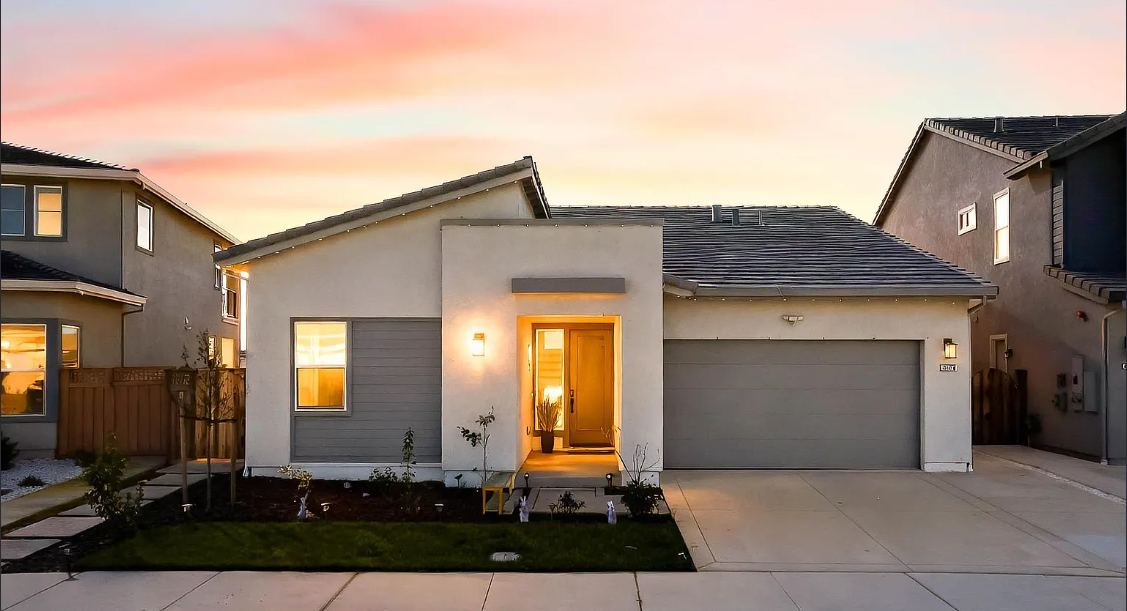
That puts existing homeowners in a tough spot. They're not just competing with each other anymore. They're up against brand-new construction with builder incentives they can't match.
The slowdown shows up clearly in days on market. Homes in Lathrop now sit for a median of over 100 days before selling. A year ago, that number was 28. Properties are closing at roughly 2-4% below list, and even the "hot" homes in River Islands that used to go pending in 11 days are now taking 41 - 60 days.
What buyers are looking at:
Lathrop's correction has created a buying window that hasn't existed in years. Take a single-story home in River Islands: 3 bedrooms, 2.5 baths, a Kiper Homes build with $70,000 in upgrades, smart home tech, pre-paid solar, gourmet kitchen. A year ago, that home lists above $850,000. Today, comparable properties sit around $725000 with room to negotiate.
The rate environment helps too. The California Association of Realtors projects the average 30-year fixed mortgage will drop to about 6.0% this year, down from 6.6% in 2025. On a $789,000 home with 20% down, that's roughly $3,786 per month in principal and interest, compared to north of $4,000 at last year's rates on a higher sticker price.
Some sellers have started going the For Sale By Owner route, cutting out agent commissions entirely and passing $20,000 to $30,000 in savings to the buyer. For people who've been priced out of the Bay Area and are eyeing the Central Valley, the math is starting to work.
Lathrop isn't alone...
The Central Valley as a region posted a 1.4% year-over-year price decline to close 2025, according to C.A.R. It was the only major region in the state to go negative. The Far North gained 2.8%, Southern California edged up 0.6%, and the Bay Area held flat.
Heavy new construction in communities like Lathrop and Manteca, higher inventory levels relative to coastal markets, and a buyer base more sensitive to rate swings are all contributing. But Lathrop stands out because of River Islands' sheer scale. With plans to add over 10,000 more homes in the coming years, new inventory will keep flowing in regardless of demand. The community is adding amenities like a new high school, waterfront restaurants, parks, and a planned 350-acre business park, but that doesn't change the near-term math for sellers.
The reality for current homeowners:
People who bought in Lathrop during the 2021-2022 peak may be sitting on significantly less equity than they expected. Some could be underwater. Selling in this market means pricing realistically and being patient.
Well-maintained homes that are priced right are still moving. But multiple offers within a week? That era is done here, at least for now.
Lathrop's story is worth watching because it challenges a basic assumption about California real estate: that there's always a shortage. In a state where housing supply is famously constrained, a master-planned community 80 miles east of San Francisco is proving that aggressive construction can outrun demand. The rest of the Central Valley should be paying attention.
OpGov.news covers local government, policy, and community developments across the Bay Area and Central Valley.
0
0

Comments