(LOS ANGELES, CA.) — The Los Angeles mayoral primary has become the center of a growing debate over California’s vote-counting process after late-arriving and provisional ballots reshaped the standings in the race for a spot in the November runoff.
Incumbent Mayor Karen Bass secured the top position in the race with 34.3% of the vote, while City Councilmember Nithya Raman finished second with 28.6%, edging out former reality television personality Spencer Pratt, who received 25.8%.
Because no candidate received a majority, Bass and Raman will advance to the November runoff election scheduled for November 3.
Los Angeles County election officials have continued processing thousands of outstanding vote-by-mail, provisional, and cured ballots in the days following Election Day, with totals shifting as updates are released.
Election officials have defended the pace of counting, noting that California law allows ballots postmarked by Election Day to be counted if they arrive within the statutory deadline. Officials also verify signatures, process provisional ballots, and provide voters opportunities to correct certain issues before final certification.
Election experts say fluctuations in vote margins are common in California, where a significant share of voters cast ballots by mail. Because different categories of ballots are processed at different times, candidates leading on election night do not always maintain their position as additional ballots are counted.
OpGov.news reports early returns on Election Night showed Spencer Pratt briefly ahead of Raman for second place, while Bass held a clear lead. However, as vote-by-mail and provisional ballots were processed over the following days, Raman steadily gained ground and ultimately overtook Pratt in the unofficial tally.
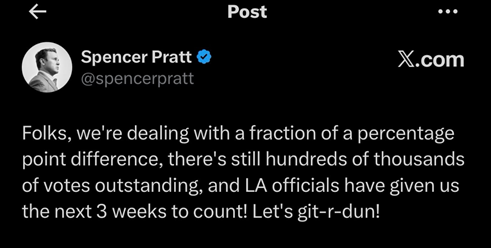
(By midday Tuesday, a Facebook post from Spencer Pratt sharing a screenshot of his X account had generated more than 33,000 reactions, 4,000 comments, and hundreds of shares.)
The shift in standings prompted criticism from some voters and political commentators who questioned why vote totals continued to change after Election Day. Social media users responded with a mix of skepticism, frustration, and sarcasm, with memes and conspiracy theories circulating widely across platforms.
Among the more widely shared comments:
“Anyone wanna make a quick trip to LA? Apparently anyone's votes will count soooooooo.” — Jeremy Long
“I’m from North Carolina but I have a student ID from when I was 12. I think I’ll go ahead and register to vote in California and mail-in vote for Spencer!” — Dylan Shaw
“Best of luck Mr Pratt. However, you’re not running against a candidate, but a machine.” — Steve Pederson
“Fight, Spencer! Don’t let them do you like this! … I’ve got a husband and two cats and you have our vote!” — Felicia Campbell
“The entire country should mail in ballots for Spencer at this point! Where can I get one??” — Kate Petty
“Dead people still voting, they move slower.” — Beth Hibbs
The comments reflected a familiar phenomenon in modern elections: when ballot counting takes longer than expected, social media often fills the gap with memes, speculation, and informal theories about election integrity.
No evidence of widespread fraud or manipulation has been presented by election officials, and no findings have emerged indicating that the vote count was improperly conducted. Officials continue to emphasize that the counting process is designed to ensure all eligible ballots are included rather than to produce rapid results.
Nevertheless, the race has renewed debate over whether California should adopt faster reporting methods or modify its ballot-processing procedures to provide election results more quickly.

(Image credit: Karen Bass Facebook post on June 8.)
The final outcome sets up a November runoff between Bass and Raman in one of California’s most closely watched municipal contests, reflecting sharp divisions over homelessness, housing affordability, and public safety in Los Angeles.
OpGov.news reports county officials are expected to continue updating results until all eligible ballots have been processed and the election is certified.
Even as election officials continue their work, many online commenters remain unconvinced:
“Proving it’s not who votes, it’s who counts the votes.” — Simon Lumley
“All those last minute votes to just pull ahead for the victory and how many of those last minute votes were for Pratt not a single one.” — Edward Cline
The controversy highlights a recurring challenge in California elections: balancing the goal of counting every eligible vote with the public’s expectation of immediate results. In an era of real-time social media commentary, the state’s methodical ballot-counting process can feel slow—even when it is operating as designed.
The runoff election in November will determine whether Bass secures a second term or Raman pulls off a progressive upset in Los Angeles’ mayoral race.
If you’d like to add or correct anything in this report, feel free to reach out to me or leave a comment below. Submit tips and story ideas to Sarah Denos at sarahkdenos@gmail.com.
0
0

Comments