(SACRAMENTO, CA.) — A Del Paso Manor resident says a man is recovering after an alleged violent April 30 attack at Watt Avenue and Whitney Avenue, in Sacramento, where a homeless man armed with a metal pipe confronted him, smashed his car, and struck him in the head before a passerby intervened.
“He’s stubborn, and very protective of his family. He needed 16 staples, but he’s recovering,” said Steve L, describing the alleged victim in a NextDoor post, which soon after had sparked much attention and a discussion about public safety, Proposition 1 (Prop 1) and California Senate Bill 43 (SB 43), receiving 214 likes and over 96 comments at the time this article was drafted.
Another resident, DW M. of Del Paso Manor, added, “I think that culprit has been a regular around the Watt and El Camino area. Hope your friend has a speedy recovery.”
Kathy L of Del Paso Manor said, “This person was known in our community to be dangerous… he appeared to be experiencing a meth rage.”
KEY TAKEAWAYS
• Violent April 30 attack at Watt & Whitney reignited neighborhood concerns about safety.
• Residents report the suspect had shown dangerous behavior in the area previously.
• Prop 1 reforms California’s behavioral‑health system, but full county implementation begins July 1, 2026.
• $6.4B Prop 1 bond funds new treatment beds, supportive housing, and veteran‑focused housing.
• SB 43 expands who qualifies for involuntary treatment, including severe SUD cases.
• Sacramento County implemented SB 43 on Jan 1, 2025, earlier than required.
• Counties must complete new BHSA Integrated Plans in 2026 with mandated public hearings.
• Officials remind residents to report dangerous behavior and avoid intervening in violent situations.
These reactions reflect a wider frustration: community members see obviously deteriorating behavior, yet counties often lack the legally authorized treatment slots, secure beds, and staff to intervene quickly.
California’s recent legal and funding changes—Proposition 1 and SB 43—aim to fix that. But the reforms have precise timelines, complex requirements, and implementation gaps that matter on the street.
What Proposition 1 Actually Does—and When
According to the California Department of Health Care Services (DHCS), Proposition 1, approved by voters on March 5, 2024, is a two‑part package: (1) the Behavioral Health Services Act (BHSA), which replaces and rewrites the 2004 Mental Health Services Act, and (2) a $6.4 billion bond to build treatment facilities and supportive housing, including dedicated funding for veterans.
DHCS describes the Prop 1 program as a comprehensive “Behavioral Health Transformation” designed to modernize delivery, strengthen accountability, and expand capacity statewide.
According to Sacramento County government, under BHSA, counties must operate under the new framework starting July 2026.
In the run‑up to that date, county behavioral‑health departments are required to develop three‑year Integrated Plans (FY 2026–2029) through a formal public “Community Planning Process,” with 30‑day comment windows and board approvals before submission to DHCS.
DHCS confirms on its website that the bond finances new beds, supportive housing, and community‑based treatment sites, while BHSA reforms how dollars are spent, adds substance‑use disorder (SUD) treatment to the scope, and tightens reporting and oversight.
Two elements are especially important for residents who want to see visible change:
Spending rules: County allocations must be rebalanced to emphasize housing interventions and Full‑Service Partnerships (FSPs) for those with the highest needs. San Mateo County’s public implementation brief—which mirrors DHCS guidance—summarizes the required 30%/35%/35% split (housing interventions / FSPs / behavioral‑health services & supports).
Infrastructure build‑out: The $6.4 billion bond channels funds through DHCS grants for treatment facilities and through Homekey+ (administered by the California Department of Housing and Community Development, with CalVet) for supportive housing, including about $1.065 billion earmarked for veterans.
Residents sometimes ask, “If Prop 1 passed in 2024, why aren’t results on the street right now?” The answer lies in the state’s explicit implementation timeline. Prop 1’s structural changes (including county plans and contract terms) take effect July 1, 2026; counties are drafting Integrated Plans in spring 2026 and moving through approvals ahead of that date.
DHCS notes that bond funding is already flowing to expand capacity, but building licensed facilities, contracting providers, and hiring staff takes months to years.
How Homekey+ Fits the Picture (Veterans and Supportive Housing)
For housing specifically, Homekey+—the permanent supportive housing component of the Prop 1 bond—went live with a Notice of Funding Availability on November 26, 2024; applications opened in January 2025 with award announcements beginning in summer 2025.
HCD’s program page explains that $2.2 billion in bond funds support Homekey+, with a major tranche dedicated to veterans experiencing or at risk of homelessness with behavioral‑health needs.
CalVet’s program brief confirms the veteran’s allocation (~$1.065 billion) and describes how funds will be distributed and paired with supportive services.
According to the California Department of Health Care Services, these details matter locally: street‑level safety problems often involve people with untreated substance use disorder (SUD) or co‑occurring disorders living in unstable conditions. Prop 1’s design explicitly connects clinical capacity (beds and programs) and housing interventions under one financing umbrella.
SB 43: The New “Gravely Disabled” Standard—and County Deadlines
While Prop 1 reorganizes funding and builds capacity, SB 43 (2023) updates who qualifies for involuntary treatment. The bill text (Welfare & Institutions Code § 5008) expands “gravely disabled” to include people who—due to a mental disorder, severe SUD, or co‑occurring conditions—cannot provide for personal safety or necessary medical care, in addition to food, clothing, or shelter.
DHCS’ official Behavioral Health Information Notice (BHIN 24‑011, March 25, 2024) reiterates the new definition and clarifies how it applies across 5150 crisis holds, 14‑day intensive treatment, extensions, and LPS conservatorships.
Crucially, SB 43 authorizes counties to defer implementation until January 1, 2026, acknowledging that facilities and staffing must be in place to support expanded involuntary treatment.
DHCS’ SB 43 FAQs outline practical intake questions (which facilities can accept 5150 holds for severe SUD only, data reporting expectations, etc.).
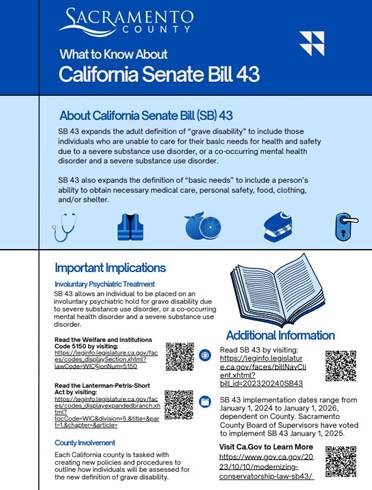
(Image credit of SB43 fact sheet/Sacramento County.)
Sacramento County initially signaled a delay as it worked through system readiness (“implementation is complex and involves multiple systems”), but subsequently implemented SB 43 on January 1, 2025, according to the county Behavioral Health Services website and fact sheet.
That sequence—early planning materials, followed by an earlier‑than‑required go‑live—illustrates the dynamic nature of county timelines under SB 43.
What Changes Residents Should Expect (and When)
Putting Prop 1 and SB 43 together:
* Policy authority to intervene: SB 43 now allows clinical teams and courts to act when someone’s personal safety or medical care is compromised due to serious mental illness or severe SUD—even if the person can technically find food or temporary shelter.
* Capacity to intervene: Prop 1/BHSA intends to fund and staff the beds, programs, and housing necessary to make those interventions real, but county systems fully pivot July 1, 2026, with bond‑funded projects rolling out on varied construction schedules.
* Local planning and public input: Counties must run transparent planning processes, post draft Integrated Plans, host 30‑day comment periods, and adopt plans before submitting them to DHCS—steps underway now across California.
In other words, legal criteria expanded in 2024–2025 (SB 43), but system capacity and funding structure are still being aligned and built (Prop 1/BHSA) on a 2026 schedule.
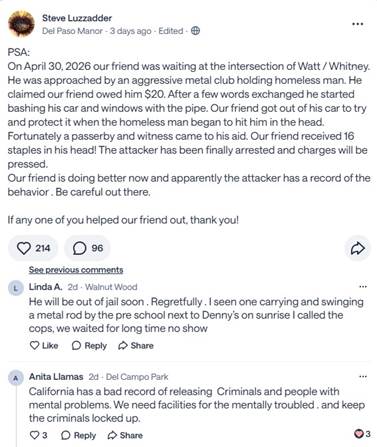
(Screenshot of a Nextdoor post shared by Del Paso Manor resident Steve L, describing the April 30 incident at Watt and Whitney.)
Back to Watt & Whitney: Why This Matters…
Following the attack, neighbors debated how quickly the system should act—and whether county teams had the tools.
“Massive changes to a system take time,” wrote Kristi G. “Counties must reorganize their mental‑health and justice systems, acquire funding, build facilities, create new rules, hire staff, and more.”
Holly B. pressed for enforcement and cleanup at Watt & El Camino, noting, “Please people, show up for things. It’s a must.”
That tension is exactly what Prop 1 and SB 43 were designed to address: SB 43 authorizes intervention for severe SUD and for threats to personal safety or medical care (not just food, clothing, shelter), and Prop 1 pays for the care settings and housing to follow through.
As DHCS and CalHHS emphasize, the transformation links treatment, housing, workforce, and accountability so counties can concentrate resources on those with the highest needs.
This attack has led to renewed calls for coordinated enforcement and behavioral‑health intervention. One neighbor commented, “We need a meaningful response. People have been reporting dangerous behavior in this area for years.”
Another added, “This situation highlights exactly why the new mental‑health laws matter—but also why the timeline feels too slow for people living with the consequences today.”
The victim’s family expressed gratitude for the passerby who intervened and said they are focused on recovery, while cooperating with investigators.
Authorities encourage residents to report aggressive or threatening behavior immediately and remind the public not to place themselves at risk during violent encounters.
Note: Quoted statements come from local residents’ public posts shared with the post writer Steve L and others. Names are presented as they appeared. The remainder of the article relies exclusively on government sources listed above and in the story links.
If you’d like to add or correct anything in this report, feel free to reach out to me or leave a comment below. Have tips or story ideas from around Sacramento County? Send them to Sarah Denos at sarahkdenos@gmail.com.
Story image of homeless individual credit Mart Production, pexels.com.
0
0

Comments