Expert Analysis • Verified against sources available through 16 September 2026
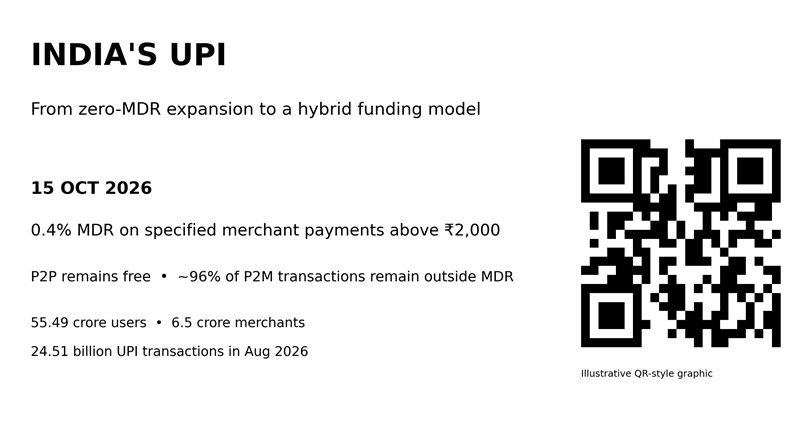
Graphic: original illustration for this report. Data/policy inputs: Ministry of Finance (PIB) and NPCI. Not an official UPI/NPCI graphic.
THE SHORT VERSION
UPI is not becoming a paid service for ordinary users. Person-to-person transfers remain free. From 15 October 2026, a merchant-side MDR applies to specified person-to-merchant payments above ₹2,000, with exemptions and concessional rates for small merchants and selected sectors. The policy marks a shift from blanket zero-MDR toward a hybrid model intended to finance infrastructure, cybersecurity, resilience and competition.
Executive summary
· From 15 October 2026, specified UPI person-to-merchant (P2M) transactions above ₹2,000 will attract a 0.4% Merchant Discount Rate (MDR), generally capped at ₹300. Person-to-person (P2P) transfers remain completely free, irrespective of amount. [1]
· Payments to merchants up to ₹2,000 remain zero-MDR. Small merchants, including street vendors receiving up to ₹1 lakh per month through UPI QR under the protected P2PM category, remain zero-MDR. The Government says roughly 96% of P2M transactions by count will remain unaffected. [1]
· Selected sectors receive concessional pricing: railways, telecom, insurance, fuel and certain other specified categories have a flat ₹5 MDR above the threshold; capital-market payments involving mutual funds, securities, stockbrokers and dealers attract 0.02%, capped at ₹300. [1][6]
· The policy follows a 2026 amendment to Section 10A of the Payment and Settlement Systems Act, which shifted the law from a fixed statutory zero-charge formulation to a framework in which the Central Government can specify electronic payment modes that must remain free. [2][10]
· The scale is enormous: 55.49 crore individuals and 6.5 crore merchants were connected to UPI in 2026; UPI processed 24,161.69 crore transactions worth ₹314.23 lakh crore in FY2025-26. In August 2026 alone, NPCI recorded 24.51 billion transactions worth ₹29.82 lakh crore. [3][4][5]
· The central policy question is no longer how to induce UPI adoption, but how to finance a mature, systemically important payment network without undermining financial inclusion, merchant acceptance or the low-friction user experience that produced its scale.
1. What changes on 15 October 2026
The most important distinction is between the person making a payment and the merchant/payment ecosystem receiving it. MDR is a merchant-side payment-processing charge. The Ministry of Finance explicitly states that it is neither a tax nor a charge collected by the Government or NPCI, and that ordinary users must not face transaction, platform or hidden charges for P2P payments. [1]
Transaction / merchant category
Treatment
Practical meaning
P2P transfer
Zero MDR
Sending money to another person remains free, irrespective of amount.
P2M payment up to ₹2,000
Zero MDR
Everyday merchant payments under the threshold remain outside MDR.
Protected small merchant / P2PM
Zero MDR
Small merchants receiving up to ₹1 lakh per month through UPI QR remain protected.
Standard P2M above ₹2,000
0.4%
Merchant-side MDR applies; standard fee reaches ₹300 at ₹75,000.
High-value standard transaction
Cap ₹300
The standard 0.4% fee stops rising once the cap is reached.
Railways / telecom / insurance / fuel / specified essential categories
Flat ₹5
Concessional pricing for high-volume or thin-margin categories.
Capital markets
0.02%, cap ₹300
Lower rate for mutual funds, securities, stockbrokers and dealers.
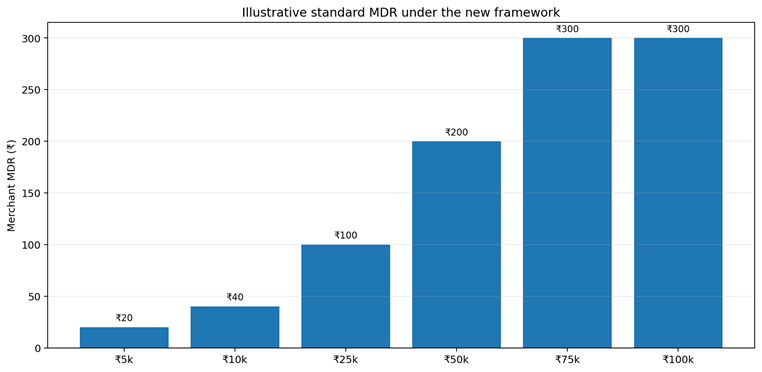
Figure 1. Illustrative standard MDR examples (0.4%, capped at ₹300). Graphic by author; rule parameters from Ministry of Finance/NPCI reporting. [1][6]
2. Why this is a major policy shift
UPI is no longer an emerging payment product. It is core national infrastructure. In June 2026, the Government reported 55.49 crore users on the platform. Separate official releases place the merchant base at 6.5 crore. UPI accounted for about 85% of India’s digital payments and close to half of global real-time payment volume. [3][5]
In FY2025-26, UPI processed 24,161.69 crore transactions worth ₹314.23 lakh crore, up from 4,595.61 crore transactions worth ₹84.16 lakh crore in FY2021-22. That is not merely product growth; it is the expansion of a payment rail into a nationwide utility. [3]
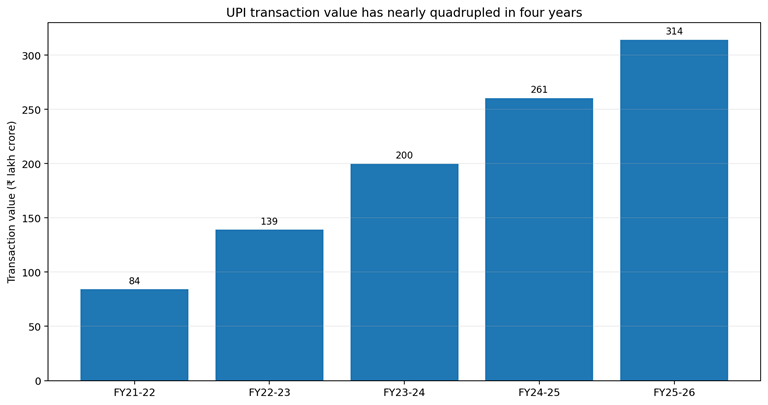
Figure 2. UPI annual transaction value, FY2021-22 to FY2025-26. Chart by author; source: Ministry of Finance / PIB, 20 July 2026. [3]
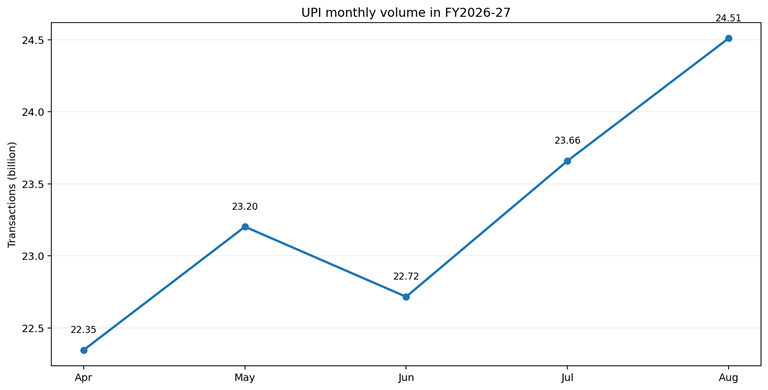
Figure 3. UPI monthly transaction volume, April-August 2026. Chart by author; source: NPCI Product Statistics. [4]
3. Why UPI was effectively free in the first place
India’s zero-MDR policy was an adoption strategy. Removing visible merchant acceptance costs made QR-based payments attractive even for very small businesses. The Government then supported parts of the ecosystem through incentive schemes rather than allowing ordinary UPI merchant pricing to develop organically.
For FY2024-25, for example, the Union Cabinet approved a ₹1,500 crore incentive scheme for low-value BHIM-UPI P2M transactions. The scheme covered transactions up to ₹2,000 for small merchants and paid acquiring banks an incentive of 0.15% of transaction value, while maintaining zero MDR for merchants. [7]
This architecture helped accelerate network effects: more merchants accepted UPI because acceptance was cheap, more consumers used it because acceptance became ubiquitous, and banks and apps competed on convenience rather than transaction pricing. The economic cost of the system, however, did not disappear. It was borne through bank budgets, cross-subsidisation, public incentives and private investment.
4. The legal architecture changed before the pricing did
The 2026 MDR decision was preceded by a legal change. The Taxation and Other Laws (Amendment) Act, 2026 amended Section 10A of the Payment and Settlement Systems Act, 2007. The previous language referred to electronic payment modes prescribed under tax law. The amended provision allows the Central Government, by notification, to specify one or more electronic modes of payment for which charges cannot be imposed. [10]
The Ministry of Finance described this as an enabling provision, arguing in August 2026 that UPI’s transaction scale requires continuous investment in cybersecurity, fraud prevention, technology, market expansion and resilience. The Government also stated that consumers would remain free of transaction charges and that any merchant pricing would be limited and threshold-based. [2]
On 14 September 2026, the Government notified RuPay debit cards and UPI transactions up to ₹2,000 as protected electronic payment modes under Section 10A. NPCI’s subsequent framework then set out differentiated MDR for larger merchant transactions. [11][1]
5. The economics: India is changing who finances the payment rail
The deeper significance of the rule is not the 0.4% number. It is the financing transition. The first phase of UPI treated universal, frictionless adoption as the overriding objective. The new model preserves a free public-infrastructure layer for P2P, low-value merchant payments and protected small merchants, while asking higher-value commercial use to contribute directly to ecosystem costs.
That is why the policy can simultaneously be described as a monetisation move and a financial-inclusion policy. It monetises a narrow slice of commercial activity while keeping the majority of merchant transactions by count outside MDR. The Government’s stated objective is to create a self-sustaining revenue model that can support infrastructure, fraud controls, technology and competition. [1][2]
A useful way to read the policy
UPI is being divided economically into two layers: (1) a protected public-utility layer for people, low-value commerce and small merchants; and (2) a priced commercial layer for larger merchant payments. The policy test is whether that boundary is calibrated well enough to fund resilience without pushing merchants back toward cash.
6. What changes for ordinary users
For the ordinary user, the formal answer is simple: P2P remains free and the consumer is not supposed to be charged MDR. A ₹25,000 transfer to a family member remains outside the merchant MDR framework. A ₹1,900 purchase remains zero-MDR. A ₹10,000 purchase from a standard larger merchant attracts a merchant-side MDR of ₹40. [1]
The more difficult question is economic incidence. A rule can assign a fee legally to the merchant, but businesses can respond by absorbing it, altering prices, reducing discounts, steering customers toward cash or other payment instruments, or changing checkout behaviour. The Government has advised banks to prevent explicit pass-through to customers, and UPI app providers cannot add platform or hidden charges. But indirect price effects are much harder to regulate.
7. Small merchants are protected, but the threshold will matter
A critical design feature is the protection for small merchants receiving up to ₹1 lakh per month through UPI QR under the P2PM classification. This is intended to protect street vendors, neighbourhood shops and micro-enterprises from the new merchant cost. [1]
The challenge is calibration. Monthly UPI receipts are not the same thing as profit, turnover across all payment modes or business size. A shop can cross ₹1 lakh in monthly digital receipts while remaining a very small, low-margin enterprise. Implementation will therefore depend on merchant classification, onboarding data and how cleanly banks distinguish protected merchants from ordinary commercial P2M accounts.
8. Banks, apps and payment firms finally get transaction economics
For banks and payment firms, UPI’s success created a paradox: enormous transaction volume but very limited direct revenue from ordinary bank-account-linked UPI payments. The new MDR creates a recurring revenue pool. Reuters reported analyst estimates of roughly ₹16,000-17,000 crore in potential annual ecosystem revenue, though actual revenue will depend on exemptions, transaction mix and the final distribution formula. [8]
This could strengthen incentives to invest in uptime, fraud controls, merchant acquisition and customer service. It could also make the UPI market more commercially attractive to smaller applications. But the distribution mechanism matters: if most revenue accrues to already dominant apps and large acquiring institutions, pricing could reinforce concentration rather than diversify competition.
9. The central behavioural risk: selective movement back to cash
The strongest near-term policy risk is not that India suddenly abandons UPI. The network is too embedded for that. The more plausible risk is payment steering on larger purchases: UPI for small tickets, cash or another rail for transactions where a 0.4% merchant cost matters.
Retail groups have warned that the new cost may be significant in thin-margin categories and could encourage cash acceptance. Reuters reported pushback from retailer organisations and brokers following the announcement. A petition has also been filed in the Supreme Court challenging the fee framework, adding a legal dimension to implementation. [9][12]
Whether those concerns materialise is measurable. Policymakers should monitor the UPI share of transactions above ₹2,000, cash usage in affected retail segments, payment steering at checkout, merchant churn, and the transaction mix of protected versus non-protected merchants.
10. The political debate: separate mechanics from claims about motive
Because UPI is one of India’s most visible digital-public-infrastructure projects, even a narrow pricing change carries political significance. Opposition figures have criticised the fee and argued that merchant costs may ultimately reach consumers; some have also alleged foreign commercial pressure. The Government has rejected claims of external influence and says the policy is designed around domestic priorities of sustainability, cybersecurity, resilience and expansion. [2][6]
The evidence currently establishes the legal and policy sequence: Parliament amended the PSS Act; the Government specified the protected zero-charge modes; and the UPI governance framework introduced differentiated merchant pricing. Claims about political or foreign motives remain contested and should be treated as attributed political claims rather than established causal explanations.
11. The public-finance question
UPI’s earlier model effectively used public policy to subsidise or suppress transaction pricing in order to maximise adoption. That was rational during network formation because the benefits of interoperability, formalisation and digital inclusion extended beyond the individual transaction.
The 2026 framework begins shifting part of the recurring cost from public incentives and cross-subsidisation toward commercial users of the network. This is a classic infrastructure transition: public support helps build scale, while mature higher-value usage is gradually asked to contribute to operating economics.
The critical question is not whether every digital transaction should be free forever. It is which transactions should remain part of the protected public-infrastructure layer, and which can be priced without damaging inclusion or pushing activity back into cash.
12. What should be measured after 15 October
· Share of P2M transactions above ₹2,000 that remain on UPI.
· Cash substitution in retail categories with narrow margins.
· Merchant complaints and evidence of explicit or implicit consumer pass-through.
· Growth or decline in protected small-merchant UPI acceptance.
· System uptime, fraud rates, dispute resolution and customer-service performance.
· Whether MDR revenue supports broader app/bank competition or reinforces existing concentration.
· The fiscal trajectory of future UPI incentive schemes and public support.
· Rural and semi-urban merchant acquisition after the new model begins.
· Changes in high-value use cases such as education, utilities, fuel and investment payments.
Conclusion: UPI is entering its second economic phase
India has not ended free UPI. It has drawn a boundary around what remains free.
P2P payments remain free. Low-value merchant payments remain zero-MDR. Protected small merchants remain outside MDR. At the same time, larger commercial transactions will begin contributing directly to the economics of the payment network.
That makes 15 October 2026 an important institutional milestone. The first phase of UPI was about scale, interoperability and adoption. The second will test whether India can make the system financially sustainable without weakening the low-cost access, merchant ubiquity and public trust that made UPI successful.
The correct test of the reform is therefore not whether a new fee exists. It is whether the hybrid model produces measurable improvements in resilience, security and competition while preserving financial inclusion and avoiding a meaningful return to cash.
Source : https://share.google/QatCesy4rcMgcY4E4
References and source notes
Sources were checked on 16 September 2026. Official Government/NPCI sources are prioritised for rules and statistics; Reuters and other financial press are used for market, political and stakeholder reaction.
1. Ministry of Finance, Press Information Bureau, “UPI Continues to Remain Free for Peer to Peer Transactions and 96% of Merchant Transactions,” 15 Sep 2026. Source
2. Ministry of Finance, Press Information Bureau, “No Charges for UPI Users,” 8 Aug 2026. Source
3. Ministry of Finance, Press Information Bureau, “Nearly 55.49 Crore Users Onboarded on UPI as in June 2026,” 20 Jul 2026. Source
4. National Payments Corporation of India, UPI Product Statistics, 2026-27 monthly data. Source
5. Press Information Bureau, official 2026 digital infrastructure releases reporting more than 55.49 crore UPI individuals, 6.5 crore merchants and 731 banks. Source
6. Reuters, “India's UPI fee shake-up: What changes and why it matters,” 16 Sep 2026. Source
7. Press Information Bureau, “Cabinet approves Incentive scheme for promotion of low-value BHIM-UPI transactions (P2M),” 19 Mar 2025. Source
8. Reuters, “India's payment firms jump as UPI fee boosts revenue outlook,” 16 Sep 2026. Source
9. Reuters, “India's UPI fee faces retailer, broker pushback,” 16 Sep 2026. Source
10. The Taxation and Other Laws (Amendment) Act, 2026, Gazette of India, 17 Aug 2026; amendment to Section 10A of the Payment and Settlement Systems Act, 2007. Source
11. Ministry of Finance Notification S.O. 5067(E), Gazette of India, 14 Sep 2026, specifying RuPay debit cards and UPI transactions up to ₹2,000 under Section 10A. Source
12. Reuters, “Petition filed in India's top court to challenge UPI fee,” 16 Sep 2026. Source
Visual credits
Cover infographic: original graphic created for this report. Data/policy inputs: Ministry of Finance (PIB) and NPCI.
Figures 1–3: original charts created for this report from official Ministry of Finance / PIB and NPCI data. No third-party stock images used.
UPI, BHIM and NPCI names and marks belong to their respective rights holders. This report does not reproduce an official UPI logo or QR code.
Photographs
OPGOV TEAM
0
0

Comments