On November 25, 2025, the Danville Planning Commission voted 6-1 to approve The Lanes at 200 Boone Court: 47 townhouses, two accessory dwelling units and the removal of nine Town-protected trees.
Lou Palandrani, Archie Bowles, Robert Combs, Mark Graham, Ian Halker and Chris Trujillo voted yes. Paul Radich cast the sole dissenting vote.
The commissioners made an identifiable public decision.
The Danville Town Council did not.
Renee Morgan, Newell Arnerich, Karen Stepper, Robert Storer and Mark Belotz did not conduct the final land-use hearing. They did not question the developer in a Council proceeding, debate the project’s merits or cast public votes on its density, traffic, parking, building scale, protected-tree removal or the loss of the Danville Bowl.
The final decision was left to an appointed commission.
That may have been permissible under Danville’s municipal code.
That does not mean it is the best way to govern.
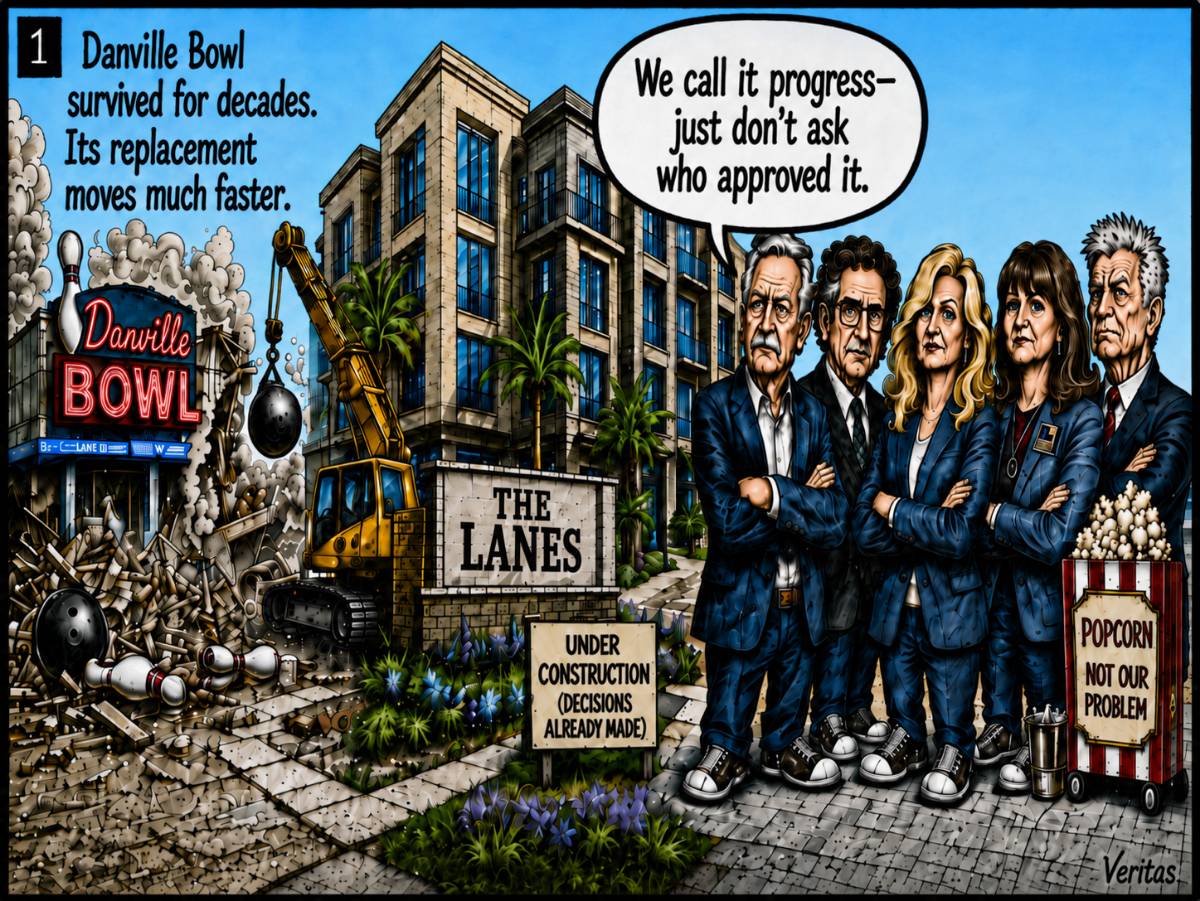
Photo Credit : Veritas
The Problem Is the System
The Planning Commission has an important role.
Commissioners study plans, hear technical evidence and determine whether applications comply with adopted standards. State housing law can also limit a town’s ability to deny qualifying housing projects.
There is therefore a reasonable argument for allowing the Planning Commission to perform the detailed technical review.
But administrative efficiency and democratic accountability are not mutually exclusive.
The Planning Commission can review the plans, evaluate the evidence and recommend conditions. The elected Town Council can still hold the final public hearing on developments significant enough to permanently reshape Danville.
When a project affects traffic, parking, density, building scale, protected trees or a longstanding community institution, efficiency should not displace elected responsibility.
The Council Maintains the Rulebook
The Council did not directly approve The Lanes.
But it cannot be treated as a spectator.
Danville’s current system allows many projects processed within existing zoning to receive final Planning Commission approval unless someone files an appeal.
That means Council accountability is not automatic.
Residents must trigger it.
And that is where the process becomes difficult to defend.
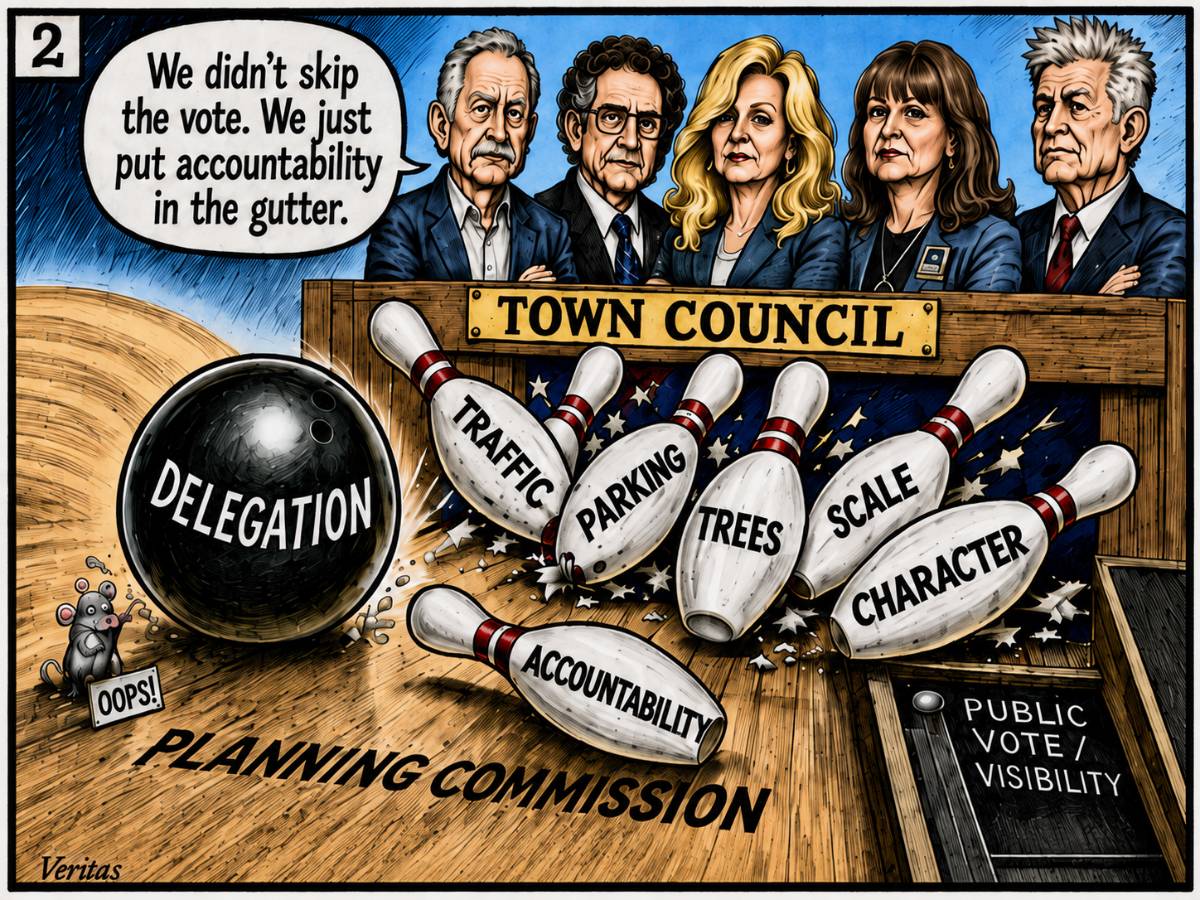
Photo Credit : Veritas
Residents must first discover that a project is pending. They must locate the agenda and supporting materials and may have only a short period to review hundreds of pages of plans, traffic studies, technical reports and staff analysis.
After the Planning Commission acts, residents must understand that an appeal is available, identify appropriate grounds, prepare the paperwork and pay a $332 fee — all within 10 calendar days.
Residents should not have to become unpaid planners, engineers and land-use lawyers merely to obtain a public position from their elected representatives.
Accountability should be built into the process.
It should not depend on whether a resident discovers a deadline and pays a fee.
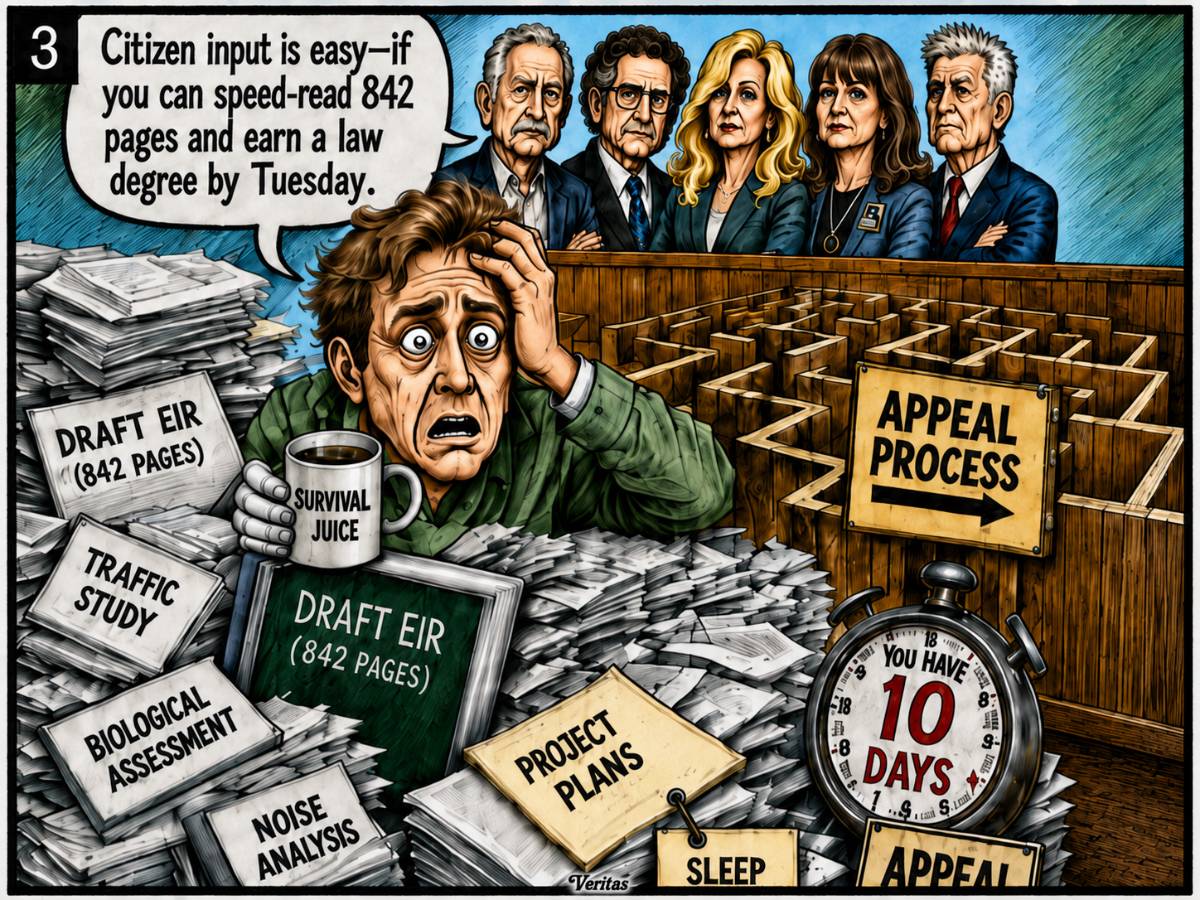
Photo Credit : Veritas
Being Informed Is Not the Same as Voting
The Lanes eventually appeared before the Town Council.
But not for a hearing on whether the project itself should be approved.
At the December 16, 2025 Council meeting, the project was included in the Town Manager’s report. By then, the Planning Commission had approved it, the appeal period had expired and no appeal had been filed.
The project appeared again in January 2026.
Then, nearly seven months after approval, the Council considered funding an independent review of the project’s Stormwater Control Plan. That review did not reopen the underlying questions about density, traffic, parking, building height, protected trees, neighborhood compatibility or the loss of the Danville Bowl.
There is a meaningful difference between being informed about a decision and being publicly accountable for making it.
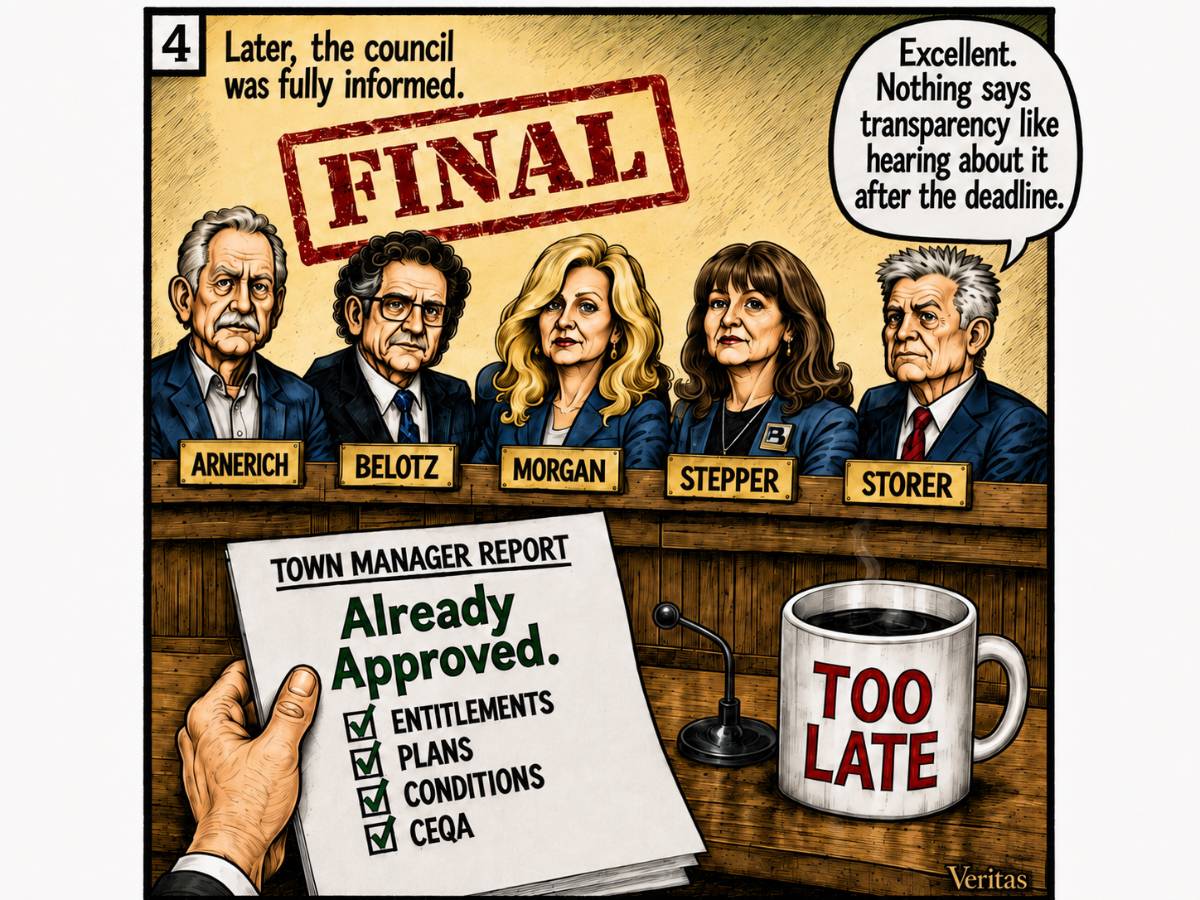
Photo Credit : Veritas
The Lanes Was Not an Exception
This is not simply an argument about one bowling alley.
A review of Danville housing-development records since 2022 identifies several major projects in which the Planning Commission appears to have granted the principal land-use approval without a later Council vote on the development itself:
the 37-condominium development at 600 Hartz Avenue;
the 167-unit Borel development at 3020 Fostoria Way;
The Lanes; and
the 200-unit Danville Village Apartments project.
Together, those projects represent approximately 450 residences.
The question is not whether the Planning Commission acted within its authority.
The question is whether projects of this magnitude should become final without the five elected officials responsible for Danville casting a public vote.
Major Developments Deserve Named Votes
Major development decisions permanently affect traffic, parking, infrastructure, neighborhood compatibility, public services and Danville’s physical character.
Projects of that magnitude deserve visible democratic ownership.
A named vote requires each elected official to hear the evidence, listen to residents and explain a final judgment.
Residents should have been entitled to know whether Morgan, Arnerich, Stepper, Storer and Belotz believed The Lanes was right for Danville.
That does not mean every project can lawfully be denied.
State housing law matters.
But where meaningful local discretion remains, the people elected to govern should exercise that discretion openly.

Credit : Veritas
Change the Rules Before the Next Major Project
The Town Council should amend the municipal code so that major housing developments meeting clearly defined thresholds receive final review by the Council.
Those thresholds should include project size and density, building height, major waivers or concessions, significant traffic or parking impacts, exceptional public interest and the loss of a longstanding community-serving business or institution.
The Planning Commission should continue doing the work it was created to do: review plans, examine technical evidence, conduct hearings and make recommendations.
But when a development will materially and permanently reshape Danville, the final decision should rest with the elected Town Council to the fullest extent permitted by state law.
The Council should also require meaningful advance notice.
For major housing developments, residents should receive at least two weeks’ notice - not 72 hours before the hearing. The complete agenda packet — including staff reports, project plans, traffic analyses, environmental documents and technical studies — should be published at the beginning of that period, not days before the vote.
A legitimate public process should help residents understand and influence major decisions.
It should not test whether they can discover an application, download hundreds of pages of documents and analyze them before the clock expires.
Nor should residents have to decipher an appeal system, formulate legal grounds, meet a 10-day deadline and pay a fee simply to obtain a Town Council hearing on a project capable of transforming their community.
The Issue Is Accountability
The issue is larger than The Lanes.
Danville Bowl is gone. The 47 townhouses have been approved. That decision cannot be undone.
But the process that produced it can be changed.
The five current Council members should state plainly whether major developments deserve a final public Council hearing and a recorded, named vote.
Council candidates Denton Carlson and Pratima Sonavne should answer the same question.
Do they support the current system?
Or would they change it?
Major development decisions should not reach the Town Council only because residents discover what happened, file an appeal and pay a fee.
When a project will significantly and permanently alter Danville, the elected Council should hear it in public, debate it in public and vote on it in public.
That is not an unreasonable burden.
It is the basic work of representative government.
Danville should end government by delegation and accountability by appeal.
The next major development will come.
Before it does, the Council should establish a simple principle:
Decisions that reshape Danville should carry the names — and the votes — of the people elected to make them.
1
3

Comments