(SACRAMENTO, Calif.) — The fatal shooting of a miniature donkey by a police officer during a search for a missing child in Georgia has raised questions about how law enforcement officers assess animal behavior, determine whether an animal poses a threat, and decide when force is necessary.
OpGov.News contacted law enforcement agencies serving Sacramento and Placer counties, along with other agencies, to examine their policies, training and coordination with animal-control personnel when officers encounter large animals, including horses and donkeys.
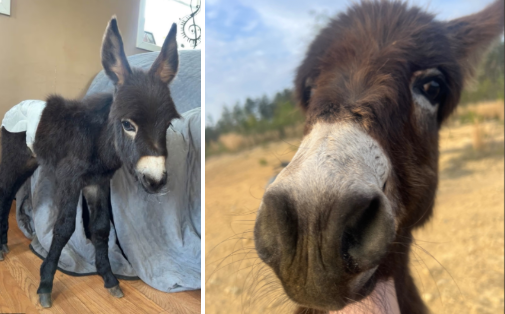
Photo Credit: Elsberry Riding and Farm / Official Website / photo of Heehaw in diapers and a close-up image. Heehaw was raised and bottle-fed by Hannah Israel on a farm.
HeeHaw, a miniature donkey owned by Hannah Israel, was fatally shot by Officer Trenton Garner on Aug. 30 during a search for a child reported missing in Georgia. Israel disputed the police account that HeeHaw behaved aggressively and posed a threat to officers. The release of body-worn camera footage brought additional scrutiny to the encounter. OpGov.News previously reported on the incident.
Livestock encounters can occur when these animals wander onto public roads or officers enter private property during searches and other operations. This story focuses solely on encounters with large animals rather than domestic pets.
Policies and training vary by agency
The Sacramento Police Department told OpGov.News it has a written policy governing the use of firearms against animals. However, a review of publicly available information did not immediately identify a documented case involving Sacramento Police Department encounters with livestock or other large animals. Officer Marcos Moreno, a department public information officer, told OpGov.News that an animal-control officer would often be involved in such situations.
General Order 580.02, the department’s use-of-force policy dated Dec. 16, 2021, permits officers to discharge a firearm to stop a potentially aggressive animal when it reasonably appears to pose an imminent threat of serious bodily injury or death to an officer or another person, and alternative methods are not feasible or would likely be ineffective.
The department’s policy also establishes reporting and review procedures for animal shootings. Such incidents are classified as Level 2 use-of-force incidents and require supervisor notification and a watch commander investigation. The policy identifies alternatives, including pepper spray, a conducted-energy device and assistance from an animal-control peace officer.
The policy requires annual use-of-force training for sworn personnel and identifies de-escalation, alternatives to deadly force and scenario-based decision-making among its training subjects. However, it does not specify whether officers receive specialized instruction in livestock behavior or how to assess encounters with horses, donkeys and cattle.
The California Highway Patrol also maintains a written policy governing the discharge of firearms at animals. Chapter 2 of the agency’s Highway Patrol Manual 70.6, revised in December 2020, permits officers to shoot an animal in self-defense or to protect another person from serious bodily harm, to destroy a critically injured animal when it can be done safely, or when necessary to destroy a suspected rabid animal or an animal attacking livestock.
The policy states that shooting an injured animal should be a last resort and outlines precautions, including obtaining supervisory approval and, when possible, the owner’s permission. It also requires officers to document animal shootings for review by a commander. Uniformed employees at the rank of sergeant and below must review the chapter quarterly.
The California Commission on Peace Officer Standards and Training (POST) told OpGov.News it does not require or recommend specialized training for peace officers on encounters with livestock or other large animals, nor does it provide guidance on the subject. Individual law enforcement agencies may develop their own training on animal encounters based on their policies and procedures, POST stated in an email response.
How local agencies handle livestock encounters
The Sacramento County Sheriff’s Office has responded to livestock roaming on public roads, including a January 2026 incident in Rio Linda involving three cows and a horse walking in a roadway, OpGov.News previously reported.
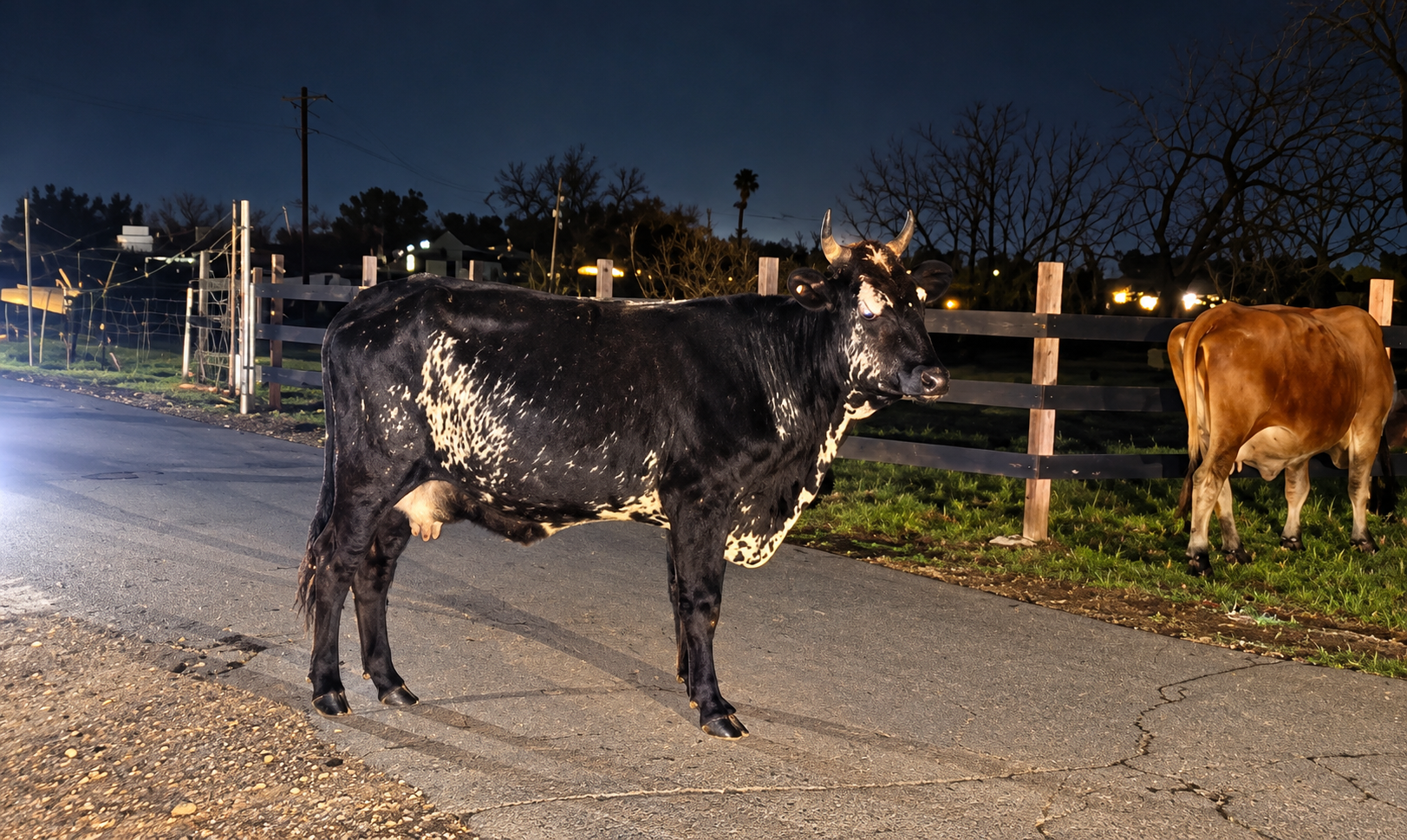
Photo Credit:Sacramento County Sheriff’s Office via Instagram / Sacramento County Sheriff’s Office North Patrol deputies responded to reports of three cows and a horse roaming down the middle of the road in Rio Linda. Deputies worked together to safely corral the animals and return them to their property, temporarily stopping traffic during the operation.
Deputies temporarily stopped traffic and worked together to corral the animals and return them to their property, according to the Sheriff’s Office. No injuries or other incidents were reported.
Other incidents involving large animals have also occurred in the region, including the escape of two zebras in Carmichael in August 2010.
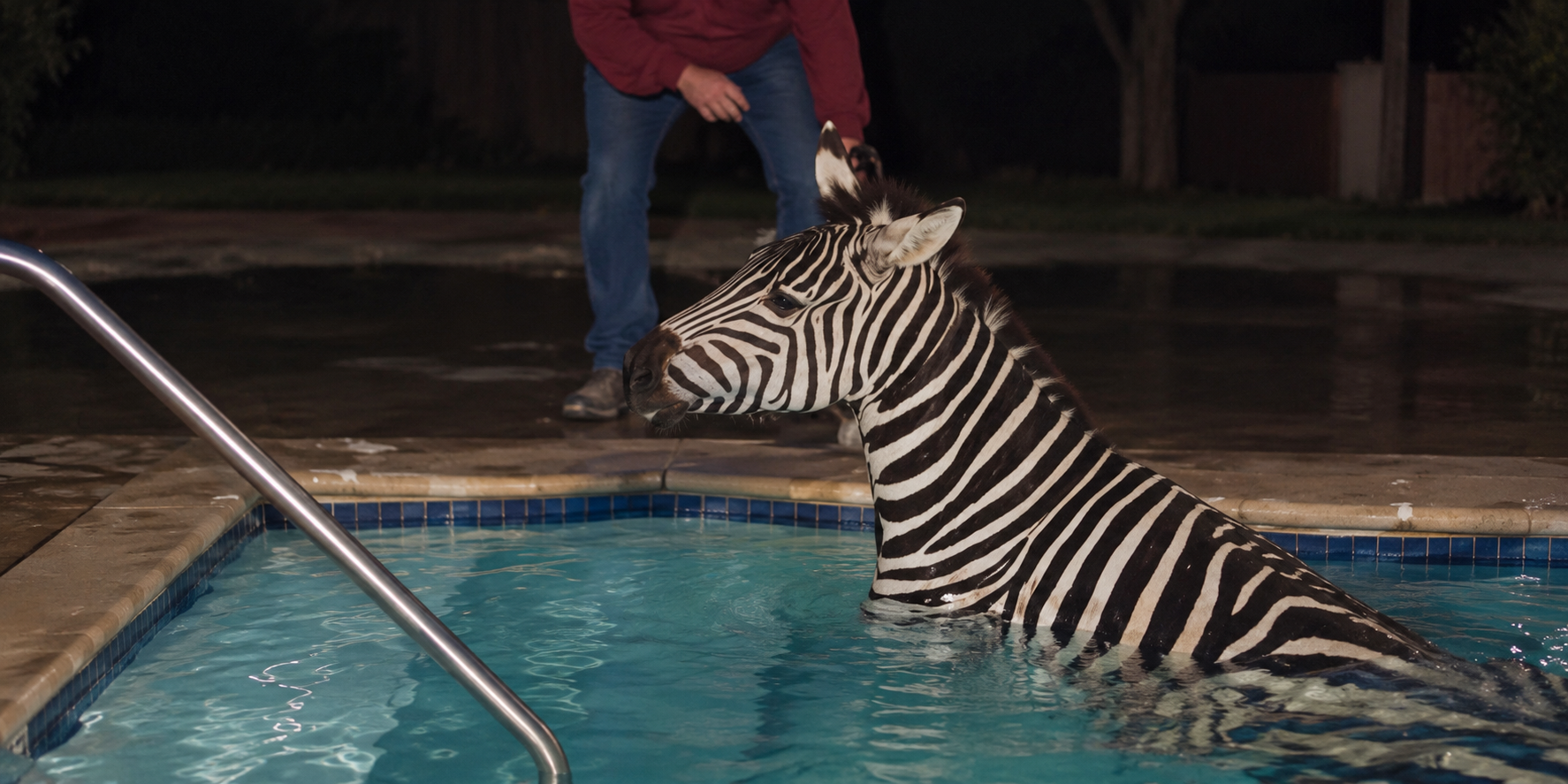
Photo credit: Cops Tv show Sacramento, California / zebra in a swimming pool, 2010.
According to KCRA 3, privately owned zebras escaped while being loaded onto a truck for transport to Oregon after reportedly being spooked by dogs. The animals ran in different directions, prompting Sacramento County sheriff’s deputies and residents to help corral them.
According to the reports, one zebra was struck by a vehicle and suffered a superficial injury. The other was eventually contained in the swimming pool area of an apartment complex, where responders worked to secure it.
More recently, a zebra named Zeus escaped from its enclosure in the Lincoln area twice in April 2026. According to CBS Sacramento, Placer County Animal Services and California Highway Patrol personnel helped locate and contain the animal. During one response, personnel used portable panels to guide Zeus into a trailer before returning him to his owner.
These incidents illustrate the coordination that may be required among law enforcement, animal-control personnel and animal handlers when large animals escape into public areas. They also demonstrate the practical challenges of protecting the public while attempting to safely contain an animal.
Sergeant Edward Igoe, a Sacramento County Sheriff’s Office spokesman and public information officer, said the department does not have training materials specifically dedicated to livestock encounters.
Deputies are still required to follow department policies governing the use of force; they must assess each situation individually, taking into account the circumstances and any potential threats to public or deputy safety, he said.
“When calls specifically involve animals or require specialized assistance, deputies request animal-control personnel when circumstances permit,” Igoe informed OpGov.News. He also confirmed that Sacramento County Sheriff’s Office documents and tracks firearm discharges involving deputies, including those involving animals.
In Galt, its agricultural surroundings make livestock encounters a relevant consideration, but the frequency of such calls varies across the region.
For dangerous-animal calls, Galt officers respond and wait for Sacramento County Animal Services, which handles other animal-related requests directly, the city said. The department also tracks incidents in which officers discharge firearms at animals and reported no firearm discharges involving animals in the past five years.
Galt Police Department does not provide formal training on animal behavior or encounters involving horses, donkeys, cattle and other livestock, according to a response from the city. Instead, the department relies on its policy manual, which authorizes officers to use firearms when an animal poses an imminent threat to human safety and alternatives are unavailable or likely ineffective.
Policy 311.7.1 calls for contingency plans, which may include animal control, pepper spray or other tools, when officers anticipate encountering a dangerous animal. The manual also permits pepper projectiles and less-lethal projectiles in certain animal encounters. Officers may euthanize a severely injured animal with supervisory approval when necessary to end its suffering and other options are impractical.
Most animal-related calls in Citrus Heights involve smaller animals, such as squirrels and dogs, while encounters with horses, goats and other large animals are relatively uncommon. The Citrus Heights Police Department says animal control is the department’s primary partner when animal-related calls arise.
“The first priority is to protect the public,” said David Jones, a sergeant and supervisor for problem-oriented policing with the Citrus Heights Police Department.“From there, what typically officers will do is request additional units or traffic control as needed.”
Jones said Citrus Heights follows Policy 308, which addresses dangerous animals. Officers do not receive formalized training specifically for livestock encounters and instead rely on their existing skills and judgment, he said.
“It’s really all on-the-job training,” Jones added.
That reliance on animal-control personnel is also reflected in the Placer County Sheriff’s Office response. Officers use their judgment and coordinate with animal-control personnel when responding to animal-related incidents, said Elise Soviar, a spokesperson for the agency.
Soviar said the department’s officers follow applicable POST requirements and often work with animal control to resolve incidents involving animals.
“Each incident is different, and the appropriate response depends on the circumstances,” Soviar said, adding the Sheriff’s Office had no significant livestock disturbances reported or disclosed over the previous two and a half years.
Understanding Equine Behavior and Warning Signs
Animal behavior specialists can help explain how horses and donkeys may react to unfamiliar people, sudden movements or perceived threats, and how to distinguish defensive behavior from signs of aggression. An animal’s approach or movement alone does not necessarily mean it poses an immediate danger, as behavior can vary by species and individual animal.
OpGov.News spoke with an animal care specialist who explained that horses and donkeys may react differently to unfamiliar people, sudden movements or perceived threats. They are generally more likely to flee than confront a perceived threat. However, when they cannot escape or experience extreme fear, they may become defensive or aggressive. Although the two species share some warning signs, their behavioral responses can differ.
According to the Merck Veterinary Manual’s guidance on horse behavior, signs of aggression in horses can include pinning their ears back, swishing their tails, baring their teeth, lunging, biting or threatening to kick. These behaviors usually occur in that order as they are pushed into fight mode, assuming they are unable to move away. They will also stick their noses out with the ears pinned back, not just pointed backwards but laid against their necks, and bare their teeth. Horses may also challenge a person by moving quickly towards the person with their head and neck held high, often with their faces vertical, and then stop to see if their perceived threat advances. If the person does not move, they may either run away or continue forward, sometimes snorting.
According to The Donkey Sanctuary, donkey behavior is significantly different to that of horses and ponies. They tend to be more stoic and less flighty. Fear can cause donkeys to either flee or become defensive when they cannot escape a perceived threat. Warning signs may include pinned or clamped ears, a tucked tail, increased muscle tension, head tossing, stamping, pawing, biting or kicking. The guidance notes that donkeys may show subtle signs of fear or distress and can respond defensively more readily than horses. Such behaviors may reflect fear or an attempt to escape danger rather than aggression. Nonetheless, donkeys can be more subtle with their body language than horses.
Overall, an animal’s body language should be considered in context, as no single behavior necessarily means it poses an imminent threat. An equine approaching a person may be curious or friendly, while rushing toward someone with its teeth exposed may indicate a defensive response. The specialist recommended that law enforcement agencies seek assistance from personnel with equine experience, local equine veterinary clinics, cooperative extension agents or qualified animal behavior professionals who can provide training.
When circumstances permit, animal-control personnel or qualified animal handlers may offer alternatives to the use of force. However, the availability of those resources depends on the urgency of the situation, the animal’s behavior and the personnel available to respond.
Questions of Training and Accountability Remain
The findings from Sacramento-area agencies raise broader questions about whether officers have sufficient training to recognize animal behavior and distinguish an actual threat from an animal responding out of fear. OpGov.News will continue examining how agencies prepare officers for these encounters, document firearm discharges involving animals and coordinate with animal-control professionals.
At the time of this publication, the Tallapoosa Judicial Circuit District Attorney's Office has determined that Officer Garner will not face criminal charges in connection with HeeHaw's death. In a report released Nov. 2, District Attorney Jaeson Smith concluded that Garner's actions did not warrant criminal prosecution, citing accounts from officers and witnesses who described HeeHaw as having a history of biting and charging people.
However, Israel has disputed the accounts describing HeeHaw as aggressive, and recently took to social media to challenge the credibility of a former boyfriend whose statements she says were included in the DA's report. Israel claims the two ended their relationship in September 2025, when HeeHaw was about four months old and still living at her home, and says the former boyfriend had no contact with the donkey after their breakup.
Attorneys representing HeeHaw's owner, Hannah Israel, have disputed the justification for the shooting and said they intend to continue pursuing accountability through a separate civil lawsuit.
Although the district attorney has declined to pursue criminal charges, questions remain about how officers are trained to recognize animal behavior and assess potential threats before resorting to deadly force.
The shooting has also prompted calls for broader changes to how law enforcement officers respond to encounters involving animals, including an advocacy effort known as “HeeHaw’s Law,” which seeks to address gaps in training, accountability and the use of force.
In the Sacramento region, law enforcement agencies have an opportunity to strengthen their response to livestock encounters through additional training in animal behavior, de-escalation and coordination with qualified animal handlers. Better preparation could help officers distinguish between an animal acting aggressively and one responding out of fear, potentially reducing the risk of unnecessary harm to both people and animals.
Submit tips and story ideas about Sacramento to Sarah Denos at sarahkdenos@gmail.com. For Roseville, Citrus Heights and Placer County, contact Piper Aweeka at piper.a@lead4earth.org.
0
0

Comments