(CHARLOTTE, N.C.) — At an additional April 21, 2026 Housing Trust Fund (HTF) Committee meeting, city leaders confronted a recurring but increasingly urgent policy challenge: how to allocate limited affordable housing dollars in a way that is both equitable in the short term and sustainable over the long term.
While staff presented Housing Trust Fund allocation recommendations as continued progress in expanding affordable housing supply, council members focused less on the volume of investment and more on whether those investments are reaching the right households, in the right locations, with the right level of affordability.
That public concern, however, was clearly present. As Rebecca Heifner of Housing and Neighborhood Services noted during the meeting, “So there are people paying attention, and they’re anxious about having access to better affordable housing.”
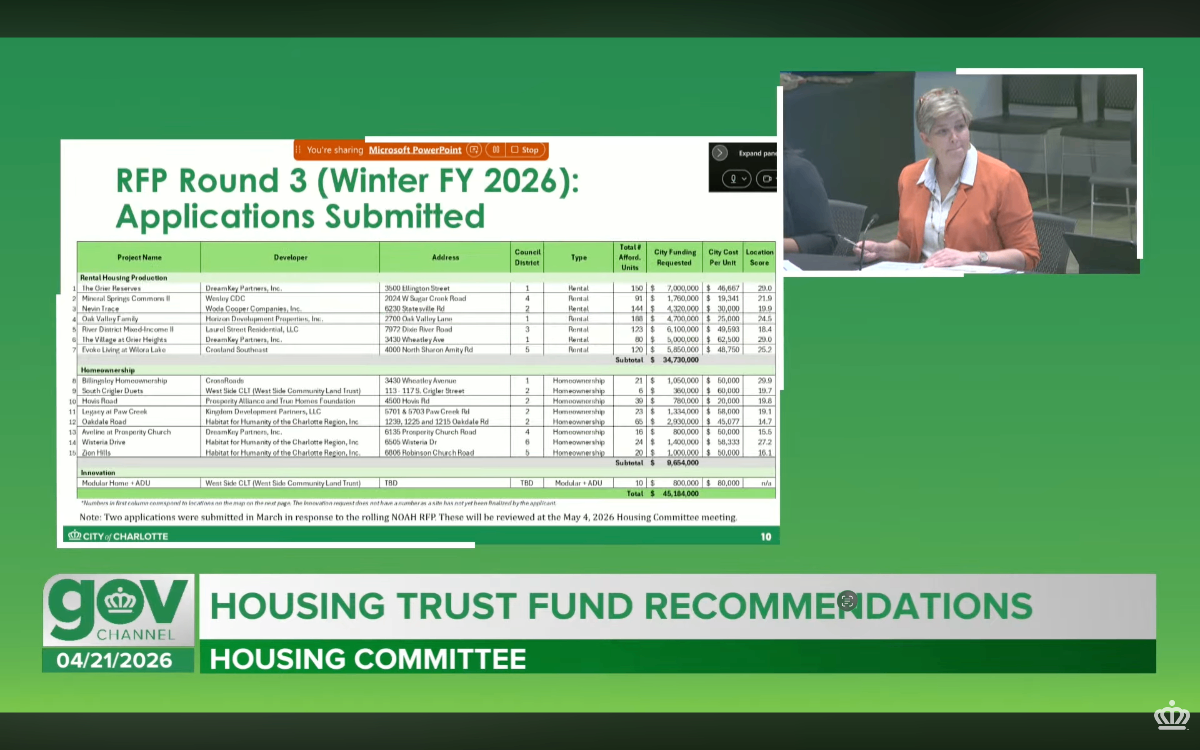
A staff presentation for RFP Round 3 outlines the specific project data and location scores that fueled intense committee debate over geographic equity and the concentration of housing investments.
(Photo Credit: City of Charlotte/YouTube)
Geographic equity and concentration of investment
A central concern raised by multiple council members was the geographic concentration of HTF-funded projects. While staff emphasized the strength and readiness of recommended developments, members questioned whether current funding patterns risk reinforcing existing development corridors rather than expanding opportunity into underserved areas.
That concern reflects broader research showing that affordable housing location is just as consequential as production volume. Studies from the Brookings Institution emphasize that housing built in high-opportunity neighborhoods can significantly improve long-term economic mobility outcomes, while concentrated development patterns risk reinforcing inequality rather than reducing it.
The discussion was further underscored by the approval of the 1001 Tyvola development, which fully exhausted the remaining $14 million allocation for rental housing preservation—closing out that funding category for the current cycle.
Defining “innovation” in housing development
The committee also reviewed four projects recommended for deferral, including River District 2, Nevin Trace, Greer Reserves, and a Westside Community Land Trust proposal described as an “innovation” model.
While each deferral had distinct technical reasons, the Westside proposal sparked a broader policy question: what actually qualifies as innovation in housing development—financing structure, delivery method, or measurable affordability outcomes?
Research suggests that innovation in housing must be tied to outcomes—not just structure. The Urban Institute finds that “increasing the overall supply does not guarantee the creation of affordable units,” nor does it ensure those units are accessible to low-income households.

The Housing Committee evaluates long-term strategy shifts and the potential for a massive future housing bond to address systemic gaps in affordability and innovation.
(Photo Credit: City of Charlotte/YouTube)
This type of policy ambiguity mirrors tensions seen in other cities. In Minneapolis, OpGov reporter Kristin Hassel highlighted similar governance friction in “Inability To Override The Mayor’s Veto Causes Tension At Apr. 23 Meeting,” where internal divisions among council members complicated decision-making and exposed broader disagreements over policy direction.
Persistent gaps in affordability depth and unit mix
Beyond individual projects, members returned repeatedly to a structural concern: the shortage of deeply affordable units, particularly for households below 80% of the area median income.
There was also strong emphasis on the need for more 3-bedroom and larger units, reflecting growing concern about whether current development patterns adequately serve families, multigenerational households, and vulnerable populations, including foster youth and LGBTQIA+ residents.
This aligns with national data from the National Low Income Housing Coalition, which continues to document a severe shortage of affordable housing for extremely low-income households.
Staff reiterated that all city-funded housing must remain “source of income agnostic,” ensuring voucher holders are not excluded. However, council members stressed that compliance alone does not resolve supply shortages or guarantee access to appropriately sized units.
Chairwoman LaWana Mayfield underscored the difficulty of aligning federal standards with local realities, stating, “One of our biggest challenges is the fact that the federal government identifies the MSA (Municipal Service Area), they say 30% AMI, you can earn up to 26,000 and some change.” Her remarks highlighted the disconnect between federally defined affordability thresholds and the actual cost of living facing residents.
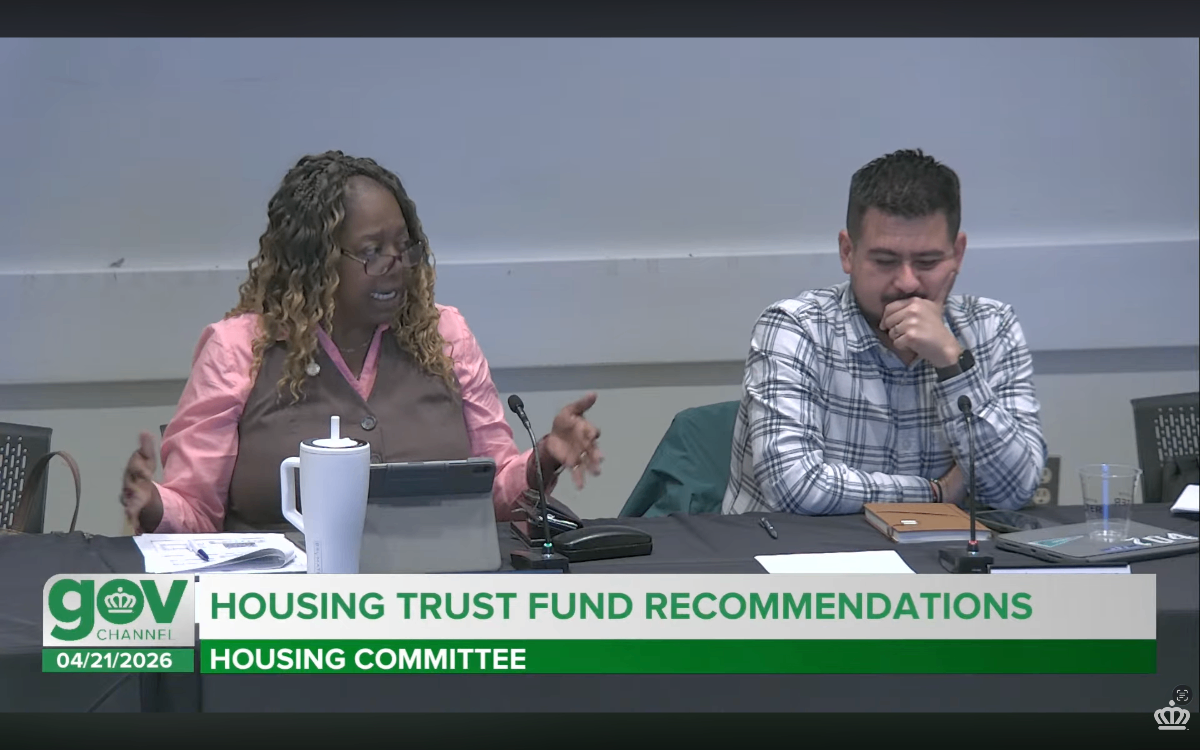
Chairwoman LaWana Mayfield highlights the growing disconnect between federal affordability thresholds and the actual cost of living facing Charlotte’s most vulnerable residents.
(Photo Credit: City of Charlotte/YouTube)
Homeownership policy and long-term affordability
The committee also revisited homeownership requirements, including a baseline 15-year affordability period and restrictions on rental conversion for subsidized ownership units.
While these safeguards are intended to preserve public investment, members questioned whether current structures may unintentionally limit scalability or reduce flexibility for expanding access to first-time homebuyers.
Federal guidance from the U.S. Department of Housing and Urban Development emphasizes that affordability policy must balance long-term protections with expanding access. HUD’s FY2026 plan highlights priorities, including “supporting access to quality, affordable housing” while also working to “expand housing supply” and remove barriers to development.
Early signals toward a major housing bond
Looking ahead, council members began preliminary discussions around a potential future housing bond ranging between $100 million and $300 million. While no decisions were made, the scale of discussion signaled growing recognition that incremental funding may no longer match the city’s housing needs.
A planned Housing Innovation Summit is also expected to explore new construction methods, financing tools, and delivery models aimed at increasing housing production capacity.
Debates over funding scale and allocation are not unique to housing policy. In San Diego, OpGov journalist Jenny Russell reported in “San Diego Proposes Fiscal Year 2027 Budget With Service Cuts To Close $118M Gap” that city officials faced similarly difficult trade-offs as rising costs outpaced available revenue, forcing leaders to reconsider priorities and long-term fiscal strategies.
Conclusion: a system under pressure to evolve
Across the meeting, a consistent theme emerged: while funding mechanisms continue to move projects forward, there is growing concern among elected officials that the current system may not be structured to deliver the depth of affordability, geographic equity, and housing diversity the city now requires.
As the Housing Trust Fund process moves toward future bond discussions and policy revisions later this year, the debate appears to be shifting from incremental allocation decisions toward a broader reassessment of how affordable housing success is defined—and who it is ultimately serving.
The full meeting agenda and material are available through OpGov.news at the City of Charlotte Meeting.
You can reach Victoria Osborne at victoriao@lead4earth.org.
(Thumbnail Photo Credit: City of Charlotte/YouTube)
0
0

Comments