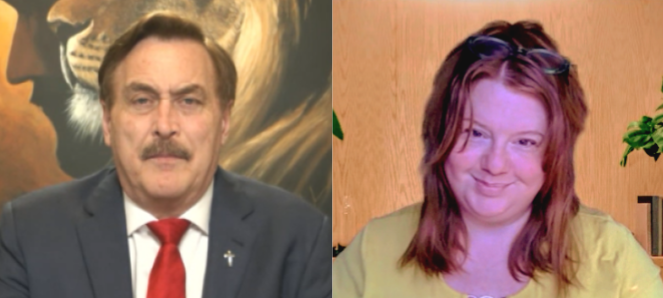
Photo Credit: Kristin Hassel /Mike Lindell sits down to talk with Open Governance News
(BLOOMINGTON, MN.) -- As I sat down to my interview with Gubernatorial Candidate and My Pillow CEO Mike Lindell, I wasn’t sure what to expect. One must admit, much has been said in the Press, and Candidate Lindell is not shy about speaking his mind. During the course of the conversation, there were moments of misunderstanding and some information to fact-check, but he never declined to answer questions about hot-button issues affecting Minnesota.
He was excited to talk to Open Governance Initiative about his Permanent Visa Plan (which you can read about exclusively on OpGov.news) and other major platform topics like drug addiction recovery and the State budget. On the human side, we discussed what he loves about Minnesota and why he’s passionate about affecting change in his home state. Take a look.
The following has been edited for clarity.
Interviewer: I actually had a chance to look at your book What Are the Odds? From Crack Addict to CEO, as part of my initial research for this interview, and it discussed your struggles with addiction and how you ultimately overcame that to become an educated businessman and give back and help others beat addiction. Most of our 500+ drug rehabilitation or treatment facilities are in large cities. How would you work to expand that towards rural areas?
Can. Lindell: This is my wheelhouse, everybody. This is where I put millions of dollars into Teen Challenges, Salvation Army, Union Gospels, and my own platform, Lindell Recovery Network.org. It's free, it's online. But there [are] a couple things, let's just talk with location. First, when you go into addiction treatment, you don't need to be in your same town. That's number one; in fact, it’s actually not even really a good thing… I want you all to know that faith-based treatment centers are 85% success rates and above, that's your Teen Challenges, Salvation Armys, Union Gospels… these are the ones that work.
Video Credit: Zoom / Kristin Hassel
It’s just a fact, I'm just saying, it's not subjective. We need to expand those. I mean, I've forgotten more about this than most people ever hear about [in] their lives. The secular treatment centers, 10% and below... I was with the President when he got the $6 billion opiate bill, and what works is God, God works, and you know, Jesus Christ. I went to many, many treatment centers back when I was a crack cocaine addict, alcoholic, and all the centers that I went to, the ones that were secular; this counselor [said], 'l went to school for 4 years'… but he's never been there, where I've been, and he’s teaching me? I wanna hear from a guy that's been there, the gal that's been there. I want to hear how they made it through."
Interviewer: "You did say, you know, it's not a good idea to stay in the same place, which I understand, I have some family members that have suffered with addiction, but the question I'd asked was about providing more opportunities for rural areas, and is that what you meant by expanding those programs instead of using secular options?"
Can. Lindell: "Yes. Those programs are the only ones [that work]. The reason you can expand them so fast [is] all you need is funding……..because they’re faith-based, but also because the instructors are people like me. When I got out of addiction, all I wanted to do was help other people out of those horrific addictions. So they're run by people [who] have been there. They don't have a four-year college degree, and all this. When Donald Trump did the opiate bill in his first term, $6 billion was going to go to the treatment centers across the country. Six billion. Now, he stood there in all the centers, arguing about who gets the money. You had your faith-based, and your secular treatment centers… Well, he gave all the money to Jesus, because this is what works. I will tell you one more thing in that industry that's relevant: 32 states have all these regulations that do treat someone in addiction or treat addicts. You have to have all these things from a one to four-year college degree, you gotta swim the English Channel, all this rubbish that you don't need… I know [that] I've been there; I want to hear from someone that's been there.
And they've got to have some training with it, of course, you do, but you got the guy who made it through, they know what they're talking about, right? If I'm going to go buy a pillow from somebody, I'm going to go, you know, get a guy that invented the pillow right. I mean, I want the guy that's been there. I want… what in my book I call hope matches, you know. It gives me hope that I'm getting counseled by a guy that made it, or a gal that made it, through these horrific things, these wounds inside, and everything that manifested into addiction."
Interviewer: "You talk about Christian faith-based addiction recovery centers, as you know, the U.S. is a land of religious freedom. Do you intend to expand/fund other faith-based recovery centers for other religions?"
Can. Lindell: "Absolutely not, it has to be Jesus. Other faith-based services just don’t work.*
Interviewer: "Minnesota currently has a projected surplus of about $3.7 billion**, but concerns have been raised regarding a potential spike in spending. Do you believe that the permanent visa would also help with that?"
Can. Lindell: "Yeah, I don't know where you got the surplus. I heard [that] with all the fraud money that's going to be back, it's really bad."
Interviewer: "All I know is the current projection is 3.7 billion surplus."
Can. Lindell: "We're not looking at surplus. We're looking for all this money that we will save so we can get our taxes lowered. We're the highest in the nation. We're getting taxed right out of our state. Yes, the stuff I'm doing with the immigration with that card that you're talking about… it’s going to [bring] billions, not millions, billions. Here's why: all of them are going to be contributing now and paying taxes. But remember, we talked about that employer? They now start paying employee taxes… all of that should then help in that capacity as well to help the state. Minnesota's gotta be affordable [to live in], or people are going to leave, businesses are going to leave."
They can't afford [one of] the highest corporate taxes in the nation, and then keep getting taxed for these welfare programs only to have the money stolen, shipped out of our state. You know, this whole system is broken. You ask me what I was going to do on day one. I'm doing all my due diligence now. So we can start solving this on day one… right away, immediately.
Our schools, that's an easy one. You bring in Mississippi's model, which I've already studied, nobody knows… [it's] amazing going from 50th in 2014 to 35th a couple years later, and now they're in the teens. They're doing stuff right now there, and for a lot less than we are in Minnesota. You have people [children] here who can't speak English in the classes, holding the other ones back. We've got to make some requirements like Mississippi. Did the children get to learn English?"
Video Credit: Zoom / Kristin Hassel
Interviewer: "So, with the new visa you’re proposing, would this include employers offering some sort of availability to learn English?"
Can. Lindell: "Oh, a hundred percent."
Interviewer: "I figured you were going that way, but I [always] want to clarify."
Can. Lindell: "That's a great program. You know, you teach them, you put the resources to them, they don't have the resources to come in….even if you did have the opportunity [to apply for citizenship], it's like $5,000 or so, and they gotta come up with that. So, you know, you get these things here, and we put our tax dollars into teaching them English. I thought about, do you make it part of the requirement? No, I think you offer that and you see; maybe they do, maybe they don't accept the offer."
Everyone says, 'well Mike, that's our tax dollars'. It was spent [on] a good thing because if they start being able to speak English and work, and contribute to society, and put these employers here in jail, or maybe they'll quit doing what they're doing Tuesday to the illegals. And to us as taxpayers, you could fund that whole program [with] the money they've been cheating us, this employer here, we're coming for you. Not only would [this] teach them English, and get them the jobs, and get that burden off their head, but [it would] also help them gain citizenship.
So I really like having that money that these employers have been stealing from us for a long time now. By the way, everybody, a long time. But if they're [immigrants] benefiting society, and we pay the money to teach them English, that's a good deal; and by the way, you've got to get rid of the $600 law, too, did I say that? "
Interviewer: "Yes."
Can. Lindell: "You've got to get rid of that, everybody nationwide; California didn't get rid of it, but they said, 'we're going to tax you on that $600 cash'. So they basically got rid of it, which was smart. So that'll be a little easy to eliminate, or you can just make a state law here in Minnesota where that's taxed too or something; we figure that out because I don't want these crooked employers to have any loopholes to keep doing what they're doing: cheating illegals and cheating us."
Interviewer: "All right, so I have one more question for you. You are more than Mike Lindell, My Pillow CEO, and Candidate for Governor of Minnesota. What is it that you love so much about this state that you wanted to run for Governor and effect change? "
Can. Lindell: "I would always go every summer to my uncle's farm down in southern Minnesota and walk beans and work on the farm and I think that's where my faith-seed was planted, but also my work ethic. I love the seasons here. I love everything about Minnesota, and remember. I have been an entrepreneur. I can tell you stories, I've lived in the streets of Minneapolis, all the way [to] I've lived the American dream. Going from a crack cocaine addict to building and having one of the biggest direct sale companies in history, selling 85 million My Pillows… I'll tell you, I love Minnesota so much. I mean, I could have moved my pillow a long time ago if not for the highest tax rate, but I love it here. I love everything about it.
And I hate to see, you know, things go. Downtown, where the Daltons used to be, we used to go shopping for Christmas and everybody was out, but, you know, now it’s this emptiness. I was like, 'everyone, what has happened?' I said, 'we need to bring back the people getting together.'"
Interviewer: "I’d like to take the time to thank you for doing this interview with Open Governance Initiative and answering all of my questions."
Can.Lindell: "I love your questions. I love your questions because you know what? Here's what happened me two months into this election: when I announced in December [I was running], only one reporter interviewed me, and all she did was attack me. One of my favorite things is doing interviews. I mean, I talk to everyone because I want to. There's only one truth, and so I don't even have to think about what I'm saying. I didn't have any notes for today; just scribbles.
You know, people have put me in a in a box with Donald Trump and Republicans, you know, put me in a bucket there, so when he says, you know, get 'em all out of here, the illegals. Well, obviously, there’s some of them here that are good. Just like I went through today."
Interviewer: "I’m glad we were able to give you more of a voice."
Can. Lindell: "Thank you for having me."
At this point, the interview ended, and Lindell appears passionate about resolving the current issues and tensions surrounding illegal immigrants in Minnesota in a way that benefits everyone, and continuing to support those who need help with addiction by increasing recovery program availability statewide.
Fact Checking and Sources:
*I checked statistics for the success rates of the following faith-based recovery programs as a sample group: Buddhist, Jewish, Islamic, and Atheist. Some intensive Buddhist-based recovery programs have shown a 70% success rate, while basic 12-step programs show an at least 50% success rates. Jewish-based recovery programs show that over 60% of participants stay sober for 5 years or more. Residential Islamic-based recovery programs have a 75% success rate, and finally atheist options can result in a 50% success rate depending on the methodology used. Regarding secular options having less of a success rate several programs have high success rates, including Women for Sobriety, Life Ring, and Smart Recovery are between 67-75%, despite Lindell’s assertion that secular treatment has a 10% success rate. As for the 85% success rate for Christian-based recovery centers while some programs like Freedom Farm Ministries have report an 87% success rate, as with other faith-based recovery programs it varies by the intensity of the program itself and the individual; most have around a 75% success rate. While this is amazing and there is a definite case for faith-based recovery, the assertion that non-Christian, faith-based models don’t work is inaccurate.
** Minnesota Management and Budget. Budget and Economic Forecast (Feb. 2026). PDF Link: https://mn.gov/mmb-stat/000/az/forecast/2026/budget-and-economic-forecast/february-presentation.pdf
To add to or correct any information in this report, please contact me at kristin.h@lead4earth.org and leave a comment below.
0
0

Comments