Photo Credit: Pixabay/ Tumisu
(OPGOV GLOBAL) - Ransomware has become the scourge of the past decade. While last year's popular targets were primarily businesses, this year the education and healthcare sectors are taking the hit. The beginning of 2026 has been marked by an increase in ransomware attacks on schools and universities. Most notable was the ransomware attack on Canvas, an education platform used by students nationwide in the U.S. to receive, submit, and keep track of assignments.
In 2025, Over 50% of all global cyberattacks were directed at U.S. business or government sectors, averaging about a 33% increase from year to year.
Our country isn’t the only one seeing a surge in cyberattacks; Germany saw an increase of 62% from 2024-2025, and South Korea saw an increase of over 500%. The only country where attacks declined was the UK, which has extremely strict data protection laws that force companies to do everything possible to safeguard client and employee data. The European Union’s General Data Protection Regulation (GDPR) enforces strict data protection rules on all organizations worldwide to help protect European citizens' data.
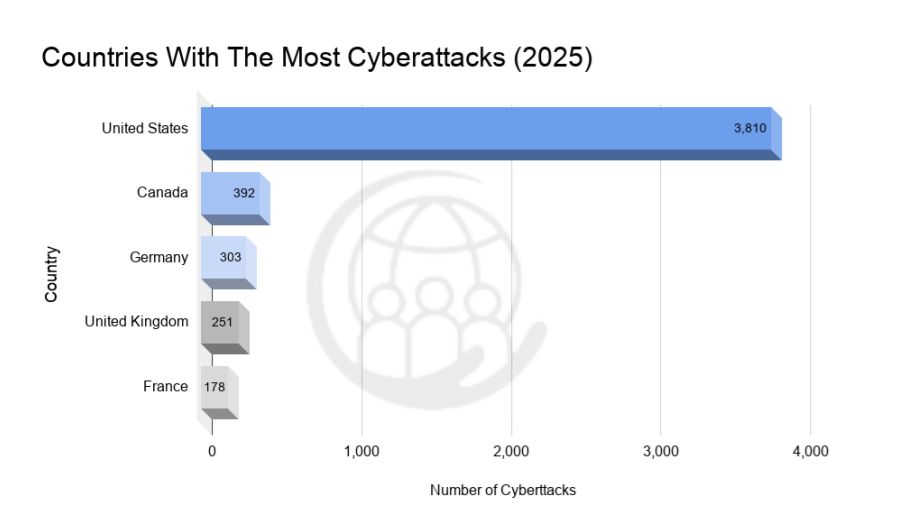
Data Source: International Cyber (2025)
While the GDPR is more about protecting citizens’ data, it creates strong boundaries regarding the collection of data, including a rule that an organization can only collect and store the minimum amount of data required for its purposes. This tends to make the companies less attractive to cyberattackers, as there isn’t as much information available.
Ransomware groups claimed to have stolen approximately 32.7 petabytes (PB) of data in 2025; one petabyte is equal to approximately 1 million gigabytes (GB). To put that figure into perspective, that’s around 6,386 iPhone 17es or 3,270 S26 Ultras filled to capacity with data (if you purchased the device with the maximum available storage space).
If there’s any silver lining to this issue, the attackers weren’t as greedy in 2025; the average ransomware demand fell from 1.4 million to a little over one million.
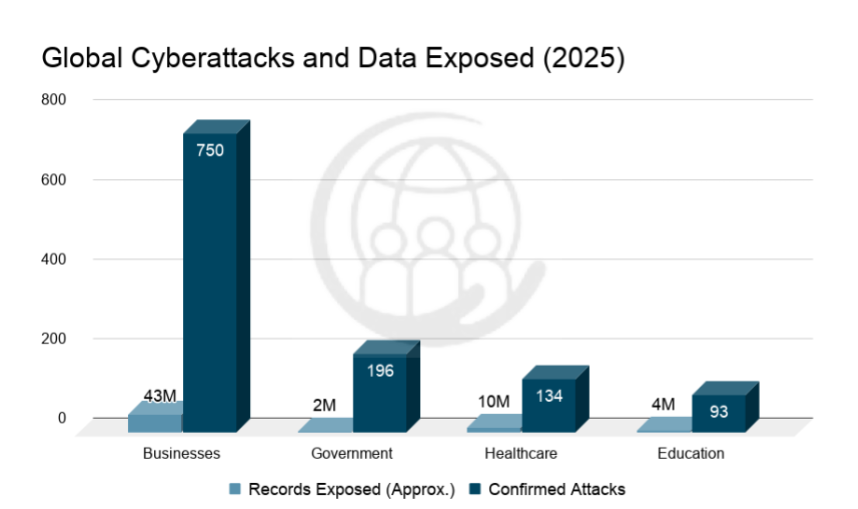
Data Source: International Cyber (2025)
In 2025, over 6K in cyberattacks were the result of ransomware groups on leak sites, and more than 59.2M records were compromised in those that were confirmed. Ransomware isn’t new, but it’s quickly becoming a nuisance as attackers evolve along with the latest technologies. To be fair, however, the real issue is now the mountains of personal data stored online and within under-protected network systems.
Cybersecurity Ventures, a globally-leading market and intelligence firm, projects ransomware to account for approximately $275 billion in damages annually by 2031. Ransom payments aren’t the only factor in that number; downtime, data theft recovery, legal fees, regulatory fines, and damage to a company's reputation help create the staggering cost of inadequate security and privacy protection.
Conflicting countries use cyberattacks as a means of disrupting opposing governments. Many cyberattacks over the past year have aligned with the geopolitical conflicts surrounding Ukraine, Taiwan, Iran, and NATO countries. State-sponsored espionage via cyberattacks like ransomware threats also increased, primarily involving China, Russia, Iran, and North Korea.
Many of these attacks target critical infrastructure, including energy, telecommunications, water, healthcare, travel, and government systems. The interconnectedness of these systems also allows cyberattackers to breach hundreds of locations or entities via a single attack. Attacks are less sloppy and more strategic, focusing on infrastructure instead of any open door.
The problem with ransomware has evolved far beyond IT security issues, heading toward a cyber-pandemic. Prevention is the best cure, but many global sectors don’t allocate an adequate budget for systems maintenance and cybersecurity.
When funds are applied, many fix what’s broken without doing a full audit of the system to ensure other issues don’t exist within the network, leaving potential weaknesses for attackers to exploit later.
Cybersecurity experts agree the problem is unlikely to go away anytime soon. Global ransomware costs are expected to increase by $218 billion in the next five years. Many expect an increase in ransomware attacks, projecting an estimated one attack every two seconds by 2031.
To add to or correct any information in this report, please contact me at kristin.h@lead4earth.org.
0
0

Comments