(GILBERT, Ariz.) – Gilbert’s town council meeting this week on October 20 featured a public hearing regarding the amendment of the town’s Land Development Code outlining future regulations for potential data centers before the town begins to receive proposals.
Residents who spoke at the hearing regarding data centers bore concerns of water availability for surrounding areas frequently less considered in water discussions and the strain on an already considerable water crisis, as well as the potential for residential and environmental disturbances affecting daily life for Gilbert residents.
Gilbert resident Nicki Reber highlighted her experience living close to the power plant, where she states she lives constantly with noise she attributes to fans cooling the plant’s energy storage.
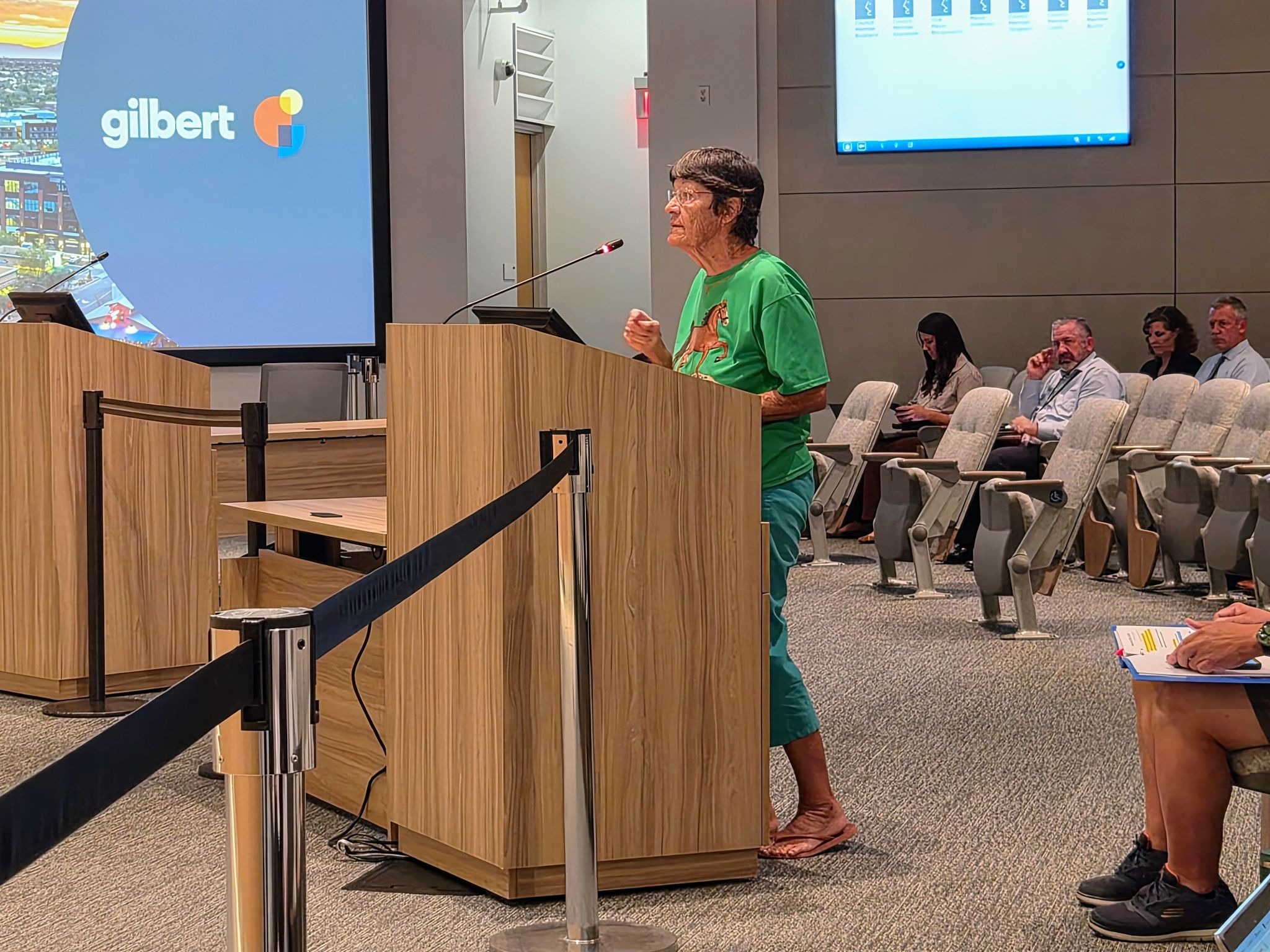
Photo Credit: Teri Tracy / OpGov.News
After acknowledging that she is aware that data centers are necessary for daily computer use, Reber said, “By the same token, I don’t want to see any more of them in Gilbert. We have one, that’s enough.”
However, Reber is open to smaller data center facilities, a sentiment which was later echoed by some council members.
“I don’t think there’s enough land left in Gilbert to build a big data center. It would have to be little, it would have to be medium, and it would have to be next to somebody's neighborhood.”
Reber compared the power plant near her residence to the noise a data center might produce.
“The council coming in is probably going to get hit with this, and I would want them to have the guts to stand up to a data center developer and say, ‘unless you provide your electricity, you ain’t building here, and unless you come with a better way of doing the water, we don't want you here’.”
“We already have enough problems with water in Gilbert, and we all know it,” Reber said.
Gilbert resident River Brown presented compiled research on the potential effects of data centers on the environment and in rural areas near the town.
“I do want to state that overall, we need data centers. I understand that our world is a digital world, and that’s how we operate,” she said, “but the fact is that A.I. data centers are harming our environment, essentially.”
“I don’t feel like people really talk about what essentially is going on in the Navajo Nation and the water, and basically about putting five data centers in the desert. Now think about how it would be to live without clean water and usable water, and having to haul in barrels in the desert when it gets [to be] 115 degrees. The Navajo Nation people don’t have to imagine; they live it.”
Brown emphasized the delicate water situation within the Navajo Nation, and how the water crisis is already affecting these areas.
“Around 30 percent of Navajo families have to haul water in barrels to have access to water," she emphasized. "30 percent of people in the Nation have no access to clean, [viable] water."
This figure adds up to include around 14,000 to 15,000 households, according to Navajowaterproject.org.
“We are just building all these data centers, and we are not thinking wisely,” she said. “We’re not thinking wisely about the communities that are affected by them.”
The research she provided to staff also included effects of the facilities themselves on surrounding ecosystems, and their well-documented disruptions to both wildlife and residential areas.
Town Planner Sal Disanto presented the proposed language from staff that the planning commission recommended for approval.
His presentation covered various facets of the proposed amendment, including ordinances regarding distance from residential areas, sound and light, and water and utility availability.
Many of the proposed restrictions only allow data centers within specific zones that tend to fall outside of residential zones, so concern for noise and light pollution with the recommended language was minimal.
The stopper for some council members was, however, water consumption. While language was proposed prohibiting principal data centers from accessing potable water, the same was not reflected in the proposal for accessory, or small, data centers.
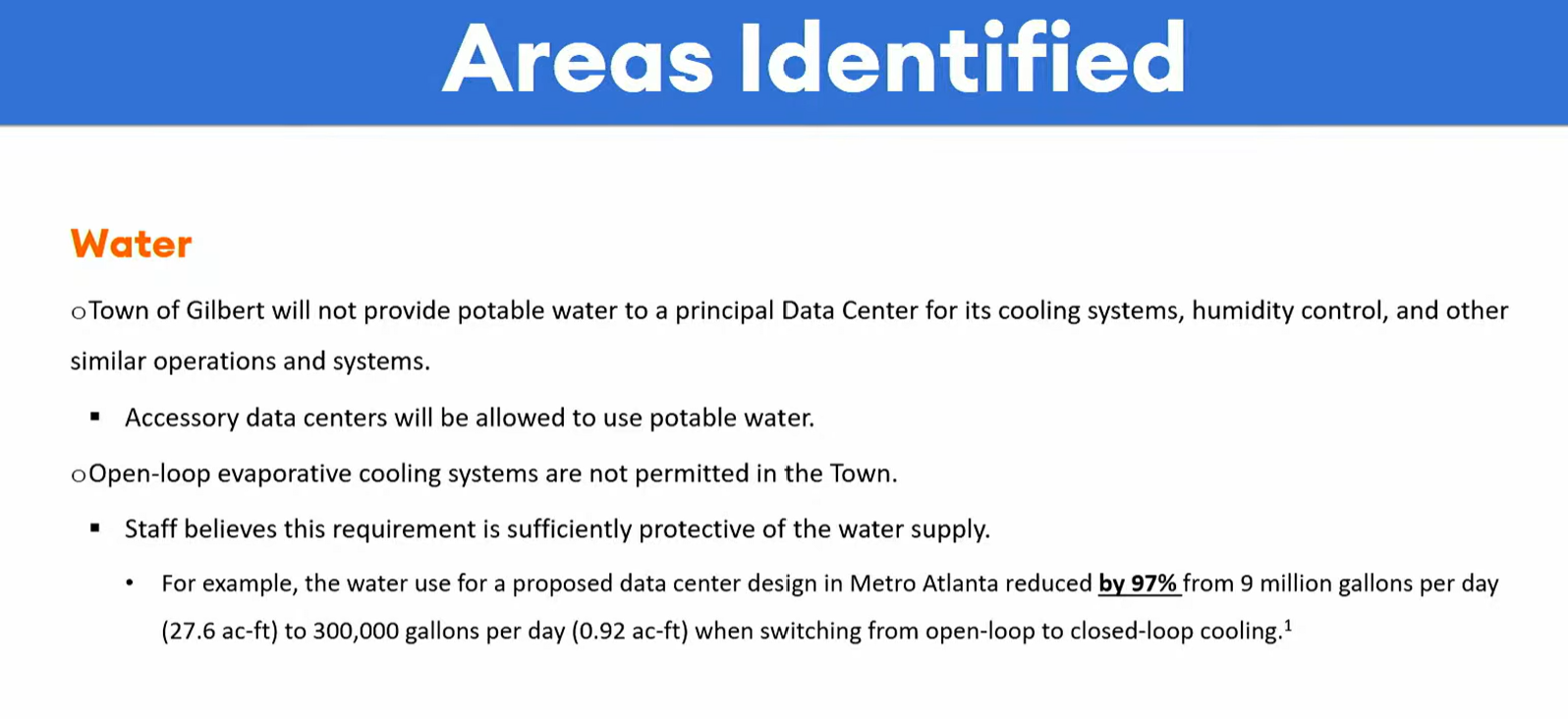
Photo Credit: YouTube / Town of Gilbert
The presentation offered by Water Resources Manager Lauren Hickson demonstrated the staff’s belief that allowing only accessory data centers to access potable water is “sufficiently protective of the water supply.”
Hickson supports this claim with an emphasis on closed-loop cooling systems, wherein open-loop cooling systems which use evaporative cooling would not be permitted. She supported her argument with a case study of one Atlanta data center which showed a 97% reduction in water consumption when switched from an evaporative cooling system to a closed-loop system.
Other proposed items include requiring principal data centers to develop their own water infrastructure, which will not be financed by the town. This is intended not only to protect crucial resources, but also to allow existing and future accessory data centers, including those used by hospitals, to operate unobstructed where accessory data centers may be considered necessary for such facilities to operate efficiently.
Councilmember Bobbi Buchli opposed any instance of Gilbert supplying water to any data centers.
“I had this issue in the study session as well (...) that we’re giving and supplying any water to data centers. I’m really not on board with that,” she said. “I think that we need to look at this a little bit tighter and a little bit closer, and that if (...) there are data centers here, they need to supply their own, period.”
Councilmember Yung Koprowski expressed a desire to vote yes on the amendment as is, aiming to return to it with revisions in favor of placing any restrictions before developers inquire. Her sentiment was shared by Councilmember Kenny Buckland.
Councilmembers Jim Torgeson and Monte Lyons, as well as Vice Mayor Chuck Bongiovanni, preferred to see a third-party assessment which was not provided alongside the presentation. They also agreed on a need to revise the proposed amendment before voting yes to it, as staff confirmed that no data center proposals have come across a staff desk in about five years.
Vice Mayor Bongiovanni questioned the hesitation of other councilmembers and staff to vote yes on the amendment without revisions.
“I could count four, maybe five properties in town that are big enough to do this in,” Bongiovanni said, emphasizing his doubt that data center developers will want to begin submitting proposals before any revisions can take place.
He also pushed for an expert to assess the practicality of focusing on ordinances for smaller micro-data centers.
Ultimately, the vote on the proposed amendment was pushed out to December 15, 2026, to give staff around five weeks to revise it, meet with a third-party assessor, and prepare another proposal. A motion was carried and approved to do so.
OpGov.News reached out to the Town of Gilbert for a clear statement on specific language the council is hoping to see from staff.
This is a developing story. OpGov.News will continue to follow the town’s data center policy as more information becomes available.
To add to or correct any information in this report, please contact me at teri@opgov.news, and comment below with your thoughts on allowing data centers in Gilbert.
0
0

Comments