(SACRAMENTO, CA.) — Nearly two years after California voters overwhelmingly approved Proposition 36, the debate in Sacramento has shifted from whether the measure should exist to whether the state is providing enough funding — and whether lawmakers are following the accountability-focused approach voters endorsed at the ballot box.
At the center of the funding debate is Senate Bill 926, known as the Funding of Proposition 36 Act, which would establish a dedicated funding source for implementation of the voter-approved initiative and require future governors to include Proposition 36 funding in their proposed state budgets, according to analyses prepared by the California Legislature.

(Close-up of clothing on hangers inside a fashion store window. Photo Credit: Mathias Reding, pexels.com.)
Proposition 36, approved by voters in November 2024 with nearly 70 percent support statewide, increased penalties for certain repeat theft and drug-related offenses while creating treatment-focused alternatives for eligible offenders, according to information published by the California Secretary of State.
While the initiative created new responsibilities for prosecutors, public defenders, probation departments, courts, and behavioral health providers, it did not include a dedicated funding mechanism for counties tasked with carrying out many of its provisions.
Supporters of SB 926 argue that omission has left local governments struggling to absorb growing implementation costs.
According to analyses prepared by the Senate Committee on Public Safety, the bill would create a dedicated state fund to support Proposition 36 implementation and establish an ongoing funding framework intended to help counties administer the measure.
Law enforcement organizations, district attorneys, and probation officials have become some of the legislation’s strongest supporters.
In a joint statement issued during state budget discussions, the California State Sheriffs' Association, California District Attorneys Association, and Chief Probation Officers of California argued that Proposition 36 created significant new responsibilities for local governments without providing a dedicated funding source to support implementation.
The organizations contend counties are already experiencing increased demands on prosecutors, probation officers, public defenders, courts, and treatment providers as they work to carry out the voter-approved initiative.
The funding concerns have also been echoed by researchers examining Proposition 36’s rollout.
A recent brief published by the UC Berkeley Law Criminal Law & Justice Center concluded that many counties lack the treatment capacity envisioned under Proposition 36 and cited legislative testimony indicating that 22 California counties have no residential treatment facilities and 10 counties lack adult drug courts. The report also noted that treatment availability remains limited in some larger jurisdictions, creating challenges for counties attempting to implement the initiative’s treatment-focused provisions.
The Berkeley report also highlighted polling conducted by the UC Berkeley Institute of Governmental Studies that found 53 percent of California voters disapprove of implementing Proposition 36 without dedicated funding for treatment programs, while 59 percent identified drug treatment and rehabilitation as the state’s highest funding priority for achieving the initiative’s goals.
The Newsom administration has taken a different position.
Administration officials have argued that Proposition 36 was drafted and approved without a dedicated funding source and that California already invests billions of dollars annually in behavioral health, public safety, homelessness, and treatment programs that support individuals involved in the criminal justice system. State budget documents point to existing funding streams available to counties and question whether an additional dedicated appropriation is necessary.
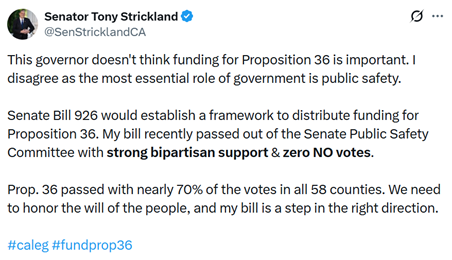
Senator Tony Strickland, author of SB 926, said in an April 22 social media post: “This governor doesn’t think funding for Proposition 36 is important. I disagree... Senate Bill 926 would establish a framework to distribute funding... passed out of the Senate Public Safety Committee with strong bipartisan support & zero NO votes. Prop. 36 passed with nearly 70%... We need to honor the will of the people.”
The funding debate is unfolding alongside another controversial public safety measure moving through the Legislature: Assembly Bill 2108. This bill would expand diversion opportunities for certain retail theft offenders, allowing eligible individuals to participate in diversion programs rather than proceed through the traditional criminal justice process.
Among the bill’s most vocal critics is Sacramento County Sheriff Jim Cooper, who argues the measure undermines the accountability provisions voters approved when they passed Proposition 36.
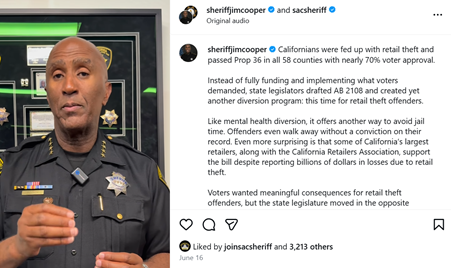
In a recent Instagram video, Cooper said Californians were frustrated with retail theft and approved Proposition 36 in all 58 counties because they wanted stronger consequences for repeat offenders. Cooper’s video drew strong engagement online, with thousands of views and comments supporting tougher enforcement of Proposition 36.
"You, the voters, passed Prop. 36 in 2024, and this bill comes along this year that creates a diversion path," Cooper said. "Like mental health diversion, it basically allows you not to go to jail or do your time."
Cooper also criticized lawmakers for advancing diversion legislation while counties continue implementing Proposition 36 without dedicated state funding.
"Law enforcement's doing a good job. The district attorneys are enforcing Prop. 36 with no funding from the state," Cooper said. "We've got to change things."
The sheriff additionally questioned why major retailers and the California Retailers Association support AB 2108 despite ongoing concerns over retail theft.
"The retailers, yes, the California Retailers Association, your big retailers, supported this bill," Cooper said. "Which is ironic. Their losses are in the billions. They're closing stores, yet they support this bill. It really makes no sense."
Cooper thanked Sacramento-area Assembly members who voted against the legislation and argued lawmakers should focus on fully implementing Proposition 36 rather than creating additional diversion programs.
"It's not okay," Cooper said. "Seventy percent of the voters in California passed Prop. 36, even in Los Angeles and San Francisco."
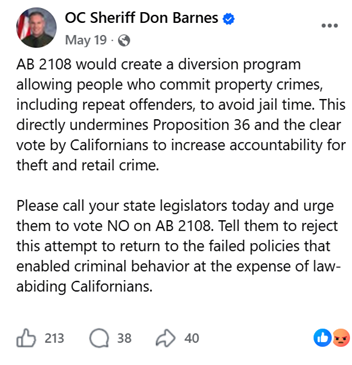
Orange County Sheriff Don Barnes echoed similar concerns in a May 2026 Facebook post: “AB 2108 would create a diversion program allowing people who commit property crimes, including repeat offenders, to avoid jail time. This directly undermines Proposition 36 and the clear vote by Californians to increase accountability for theft and retail crime... Please call your state legislators today and urge them to vote NO on AB 2108.”
Supporters of AB 2108 contend diversion programs can reduce recidivism, connect offenders with services, and provide alternatives to incarceration while still requiring participants to complete court-supervised program requirements. They argue the bill creates another tool for addressing retail theft while reserving more severe sanctions for offenders who fail diversion or continue committing crimes.
The debate has generated significant public reaction on social media. Many commenters responding to Cooper’s post — and similar messages from lawmakers — expressed frustration with retail theft, drug addiction, and the perceived lack of state support for Proposition 36.
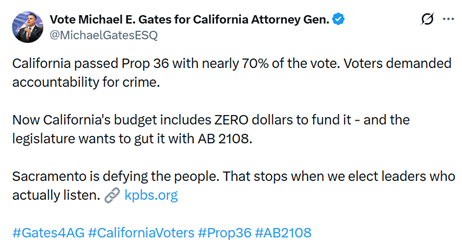
One widely shared post by California Attorney General candidate Michael E. Gates stated: “California passed Prop 36 with nearly 70%... Now California's budget includes ZERO dollars to fund it — and the legislature wants to gut it with AB 2108. Sacramento is defying the people.”
Law enforcement organizations and probation officials have amplified these concerns, with the Chief Probation Officers of California highlighting increased demands on local resources without dedicated funding.
"Law enforcement needs better. The state should give them what they need to do their jobs," one commenter wrote responding to Sheriff Cooper’s video.
Others voiced frustration with broader state policies.
"None of the stuff going on in California makes sense," another commenter wrote, while others thanked Cooper for speaking out and representing public safety concerns.
Not all commenters opposed diversion programs. Some argued diversion may be appropriate in nonviolent theft cases, while supporting incarceration when offenses involve violence against employees or loss prevention personnel.
The reaction underscores the broader policy debate that has emerged since voters approved Proposition 36.
While SB 926 focuses on whether counties should receive dedicated funding to implement the initiative, AB 2108 highlights ongoing disagreements over how California should balance diversion programs, rehabilitation, treatment, and criminal penalties.
The Legislature’s progress on SB 926 has intensified the funding debate, with the bill advancing through the Senate Public Safety Committee with strong bipartisan support. It now remains a key focus of ongoing budget negotiations between lawmakers and Governor Gavin Newsom. The governor will ultimately decide whether California will create a dedicated, long-term funding commitment for Proposition 36 or continue relying primarily on existing state and local resources.
The outcome could have significant implications for counties across California as they continue to administer treatment programs, court proceedings, probation supervision, prosecution efforts, and other responsibilities associated with Proposition 36.
Although voters settled the question of whether Proposition 36 should become law, the debate over how it should be funded — and how it should be implemented — has become one of the most consequential public safety discussions currently facing California policymakers.
Story image: The California State Capitol in Sacramento, where debates over Proposition 36 funding and SB 926 are taking place. Photo by Denihiza.
If you’d like to add or correct anything in this report, feel free to reach out to me or leave a comment below. Submit Sacramento County tips and story ideas to Sarah Denos at sarahkdenos@gmail.com.
0
0

Comments